No Riot Here
In June 1943, white sailors and soldiers beat Mexican American teenagers through the streets of Los Angeles. The national wire made the beaten the aggressors. One Black weekly named the machinery it said had set the violence going — and the paper that could have spoken for the boys who were hit was nowhere the free record reaches.
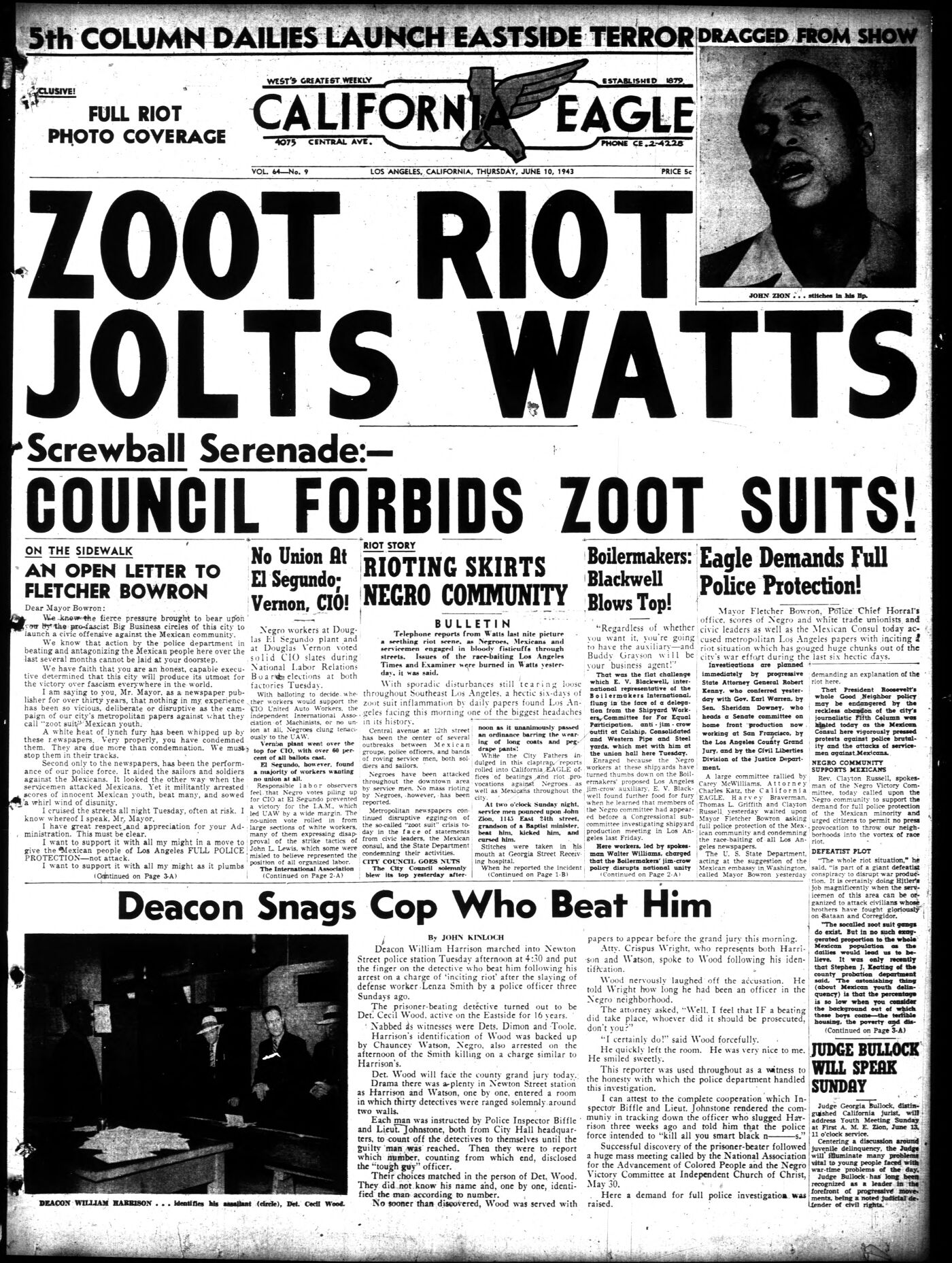
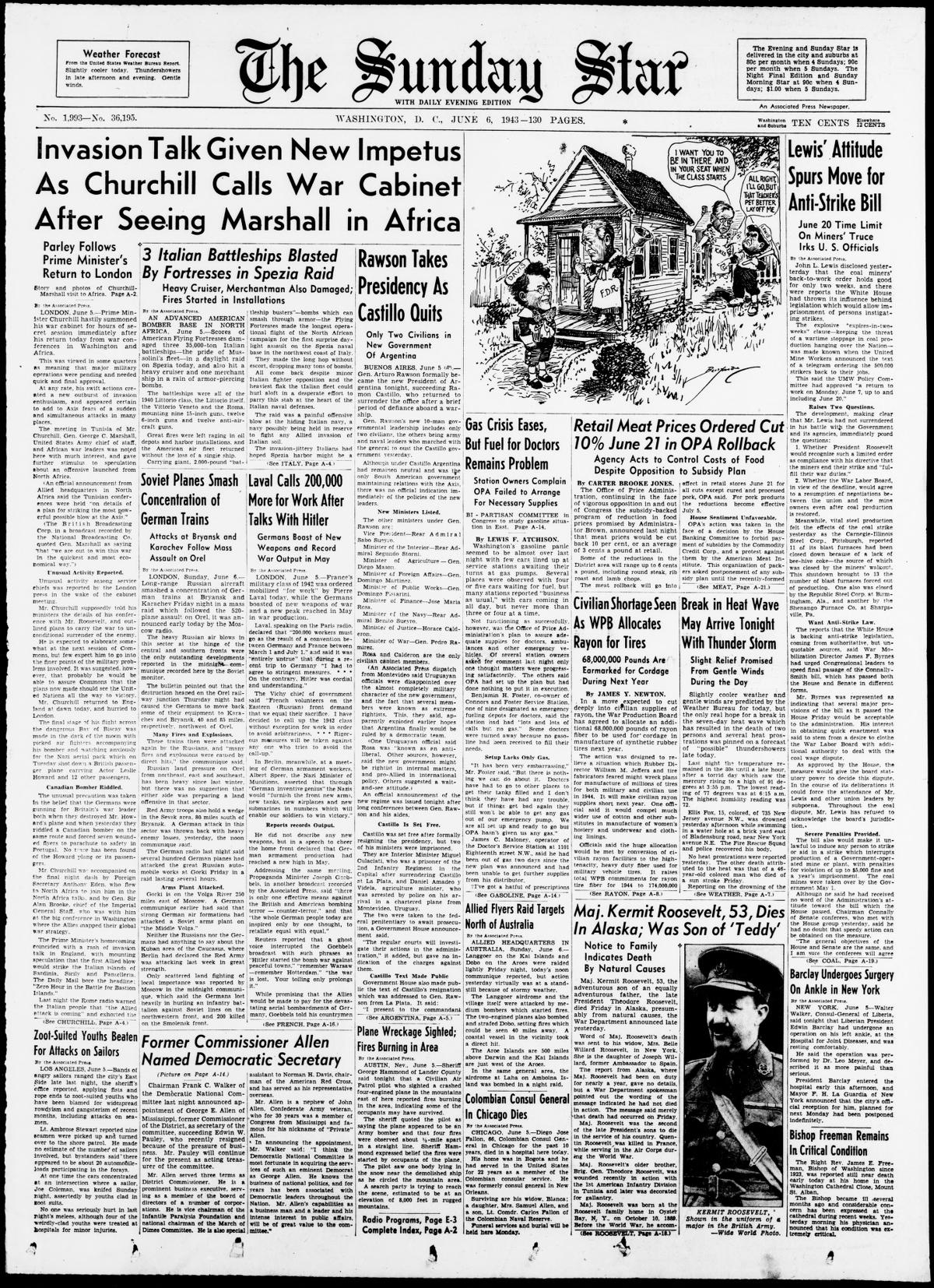
For about a week in June 1943, mobs of white servicemen — sailors, soldiers, and Marines — moved through Los Angeles beating Mexican American youths, and some Black ones, in the streets and dragging others out of theaters and streetcars. History would file it under the clothing the victims wore and call it the Zoot Suit Riots. Set two front pages of that week side by side and you can watch the naming happen: the same event, and no agreement about who had done what to whom.
What the wire told the country
On Sunday, June 6, the Evening Star in Washington ran the Associated Press account that appeared in papers far from California. The headline was “Zoot-Suited Youths Beaten For Attacks on Sailors.”
Read what the sentence does before you read the story. The beating is stated — beaten — but the headline hands you its reason in the same breath: For Attacks on Sailors. The lede keeps the arrangement. “Bands of angry sailors ranged the city’s East Side late last night, the sheriff’s office reported, applying fists and rope ends to zoot-suited youths who have been blamed for widespread rowdyism and gangsterism of recent months, including attacks on seamen.” The sailors are named as the actors; that much is not hidden. But the charge against the boys they beat arrives with no one attached to it — who have been blamed, blamed by whom the sentence never says — and it does the work of a verdict.
Then the injuries are set down to nearly nothing. “No one was seriously hurt in last night’s melees,” the Star reported, “although four of the weirdly-clad youths were treated at hospitals for minor injuries.” The weirdly-clad youths. The paper is not quoting anyone there; that is its own voice, sneering at the clothes on the boys in the hospital.
The frame was not one paper’s. It moved on the national wires, and the smaller dailies took it whole. The Imperial Valley Press of El Centro — printing that Sunday under its “Navy ‘Task Force’ Calls on Pachucos” banner — ran the United Press version, in which a convoy of servicemen hunting teenagers became a jaunty operation: “the navy’s punitive expedition, unofficial of course,” it called the caravan of taxicabs, directed against gangs of juvenile “roughnecks.” The Michigan Ypsilanti Daily Press told its readers a day later that the swinging fists of the servicemen had simply cleared the zoot-suiters from the streets. And in the same papers, the same week, the zoot suit was also a punchline. On the Waterbury Democrat’s sports page that Thursday, the boxing columnist Dan Parker wrote that the featherweight Phil Terranova’s “chief claim to fame” was “that he wears the zootingest zoot suit that ever came out of a bushelman’s nightmare,” and dubbed the fighter a zoot suiter — the same label that paper’s own front page would carry five days later, over the servicemen’s raids in Los Angeles. A pogrom in the news columns and a costume gag on the sports page, the same word doing opposite work, running side by side without a seam.
What the Eagle named
Los Angeles had a paper that told the story the other way around. The California Eagle, the Black weekly Charlotta Bass had run for three decades, did not yet have the servicemen’s rampage when it went to press on Thursday, June 3 — its account of the attacks would run the following week, after the wire’s. What its June 3 issue already had was what it said was driving the city toward bloodshed: a police killing and a newspaper campaign. Its lead editorial did not call for calm in the usual key. Its headline was an order: “Note To Disrupters: NO RIOT HERE!”
“The calculated effort of Los Angeles Big Business, spearheaded by the venal Hearst press and the Los Angeles Times, to goad the Negro and Mexican communities of our city into rioting and bloodshed backfired this week,” the editorial ran, “as the police slaying […] of a 36-year-old Negro defense worker wrought a miracle of unity among Negroes, Mexicans, trade unionists and patriotic white citizens […] to draw the stiletto of police brutality out of the back of Los Angeles’ all-out war production.” The dead man was Lenza Smith, shot by a policeman the Eagle named; the paper cast the whole crisis not as a race riot waiting to happen but as an attempt to provoke one — and the refusal it reported was the community’s, not its own byline. A mass meeting at the Independent Church of Christ, the editorial recounted, had resolved that “there will be no riot in this community to divide and disrupt the war effort which must carry weapons to the black and white soldiers who offer blood sacrifice on every continent of the world. We will not fall into the appeasers’ trap.”
The same issue gathered the coalition the mainstream frame could not see. The state president of the CIO, Philip Connelly, was quoted warning that “when they happen again and again, Hitler’s game is being played,” and that the answer was to “meet police brutality now, head on, and whip it.” A Mexican Defense Committee spokesman, Joe Marty, put the two communities on the same ground: “Mexican people are facing the same problem with which Negroes are confronted.” And John Kinloch, writing as an NAACP youth-council officer, drew the war home: “If we’re big enough to fight Hitler over there, we’re big enough to fight his pals at home.”
By the next Thursday, June 10, the servicemen had had their week, and the Eagle’s front page carried it in full. The banner across the top read “5th COLUMN DAILIES LAUNCH EASTSIDE TERROR.” Below it the paper printed photographs of the beaten under a caption that answered the wire directly: “These are what the downtown sheets call ‘baby gangsters’ and ‘murderous hoodlums.’ They are just kids, as you can see. […] Most of them, average American boys.” Another photo of an injured man carried the line that named the enemy the Eagle had in mind: “one of the casualties of the war which the Los Angeles Examiner-Times-Herald-News has declared against the Mexican people.” And where the wire had totted up “four of the weirdly-clad youths” with “minor injuries,” the Eagle gave one of them a name, an age, and a corner: Joseph Nelson, sixteen, a McKinley Junior High student, dragged off a streetcar at Fifth and Main, beaten, his pants cut.
The argument’s fullest form was Bass’s own front-page column, On the Sidewalk, written as an open letter to Mayor Fletcher Bowron and signed at its close. “As a newspaper publisher for over thirty years,” she wrote, “nothing in my experience has been so vicious, deliberate or disruptive as the campaign of our city’s metropolitan papers against what they call ‘zoot suit’ Mexican youth. A white heat of lynch fury has been whipped up by these newspapers.” She credited the mayor with having condemned the papers already — “Very properly, you have condemned them” — and then turned to the police: “It aided the sailors and soldiers against the Mexicans. It looked the other way when the servicemen attacked innocent Mexican youth, beat many, and sowed a whirlwind of disunity.” She had seen it herself: “I cruised the streets all night Tuesday, often at risk.” What she asked the city for was not a crackdown on the boys but their protection — “FULL POLICE PROTECTION — not attack.”
The paper’s editorial page refused the wire’s word in its own voice. Its lead editorial that week, “The Papers Are Responsible,” scare-quoted the label the country was using — not zoot-suiters but “so-called ‘Zoot-Suiters’” — and insisted the people beaten were “innocent citizens, working in the defense plants of the city,” who “have been victims of the terrorizing mob violence of sailors, soldiers and marines, who have been ably assisted by the police.”
The order of events is the whole point, and it runs opposite to the wire’s. In the Eagle’s account the metropolitan papers were not reacting to a wave of “zoot” crime; they had manufactured one. Bass named it directly — “the campaign of our city’s metropolitan papers against what they call ‘zoot suit’ Mexican youth” — and charged that the police had for months been “beating and antagonizing the Mexican people.” The servicemen who poured into the East Side were following where the headlines led. The Black weekly did not claim to have gotten there first. It claimed to have named the machinery — the press and the police — while the country’s front pages were still calling the beatings a response to the beaten.
The word, and the paper’s own headline
There is a complication in the Eagle’s June 10 front page that an honest account has to keep, because the paper did not resolve it either. Above Bass’s letter, above the photographs of “just kids,” the banner headline read “ZOOT RIOT JOLTS WATTS.” The paper that spent its editorial columns refusing the word riot ran the word in type three inches high on the same page.
The two are not quite a contradiction. A week earlier, that headline had meant something specific: that the effort to goad Los Angeles’s Black and Mexican communities into rioting against the servicemen had failed — that the people being hunted had refused to be provoked into the race war the “disrupters” wanted. By June 10, six days of servicemen’s violence had happened — checked at last when the Army and Navy declared Los Angeles off-limits to their men — and the front page reported it with the fastest word available. What the Eagle never conceded, in either issue, was the wire’s meaning of riot — a lawless uprising by the zoot-suiters. Its riot was something done to a community and answered by it. The title of this piece takes the paper’s June 3 editorial at its word, because the thing history named for the victims’ clothing was never a riot by the people it is named after.
The voices that are not here
This comparison is missing the paper that mattered most. La Opinión, the Spanish-language daily that was the Mexican American community’s own voice in Los Angeles, is not reachable in any free, open archive for June 1943; the digitized run of the collection that holds it stops in the middle of 1942. So the cross-press here is a Black ally paper set against the national wire — the Eagle’s solidarity is real, documented, and generous, but it is not the same thing as the young men who were beaten speaking for themselves. Two Spanish-language weeklies from Arizona, El Sol of Phoenix and El Tucsonense of Tucson, did cover the events that week, but from a careful distance — in the language of “pachuco” gangs and disturbances, with a worried eye on the reputation of Mexican soldiers in the war. They are Spanish-language papers; they are not the Los Angeles community answering the charge against it.
There is a second absence, and it sits inside the story the Eagle was telling. The papers Bass actually blamed — the Hearst chain’s Herald-Express, the Los Angeles Times, the Daily News, the metropolitan dailies the Eagle put under that June 10 banner — are not in the free record either; their pages sit behind paywalls. What can be shown of the mainstream is the Associated Press and United Press wire as it reached Washington, El Centro, and Ypsilanti — the frame at its most national, and its least local. The paper that made the frame and the paper that could have refused it are both, in different ways, out of reach. What is left is legible enough to read the shape of the thing: a beating with a reason supplied by the headline, and a Black weekly insisting the reason was the point.
Who gets to say what it was
The official record caught up fast. The citizens’ committee Governor Earl Warren had called for — chaired by Bishop Joseph McGucken, its report dated June 12, 1943 — found much of what the Eagle had been printing. It found that zoot suits did not denote crime, that tying “the phrase ‘zoot suit’ with the report of a crime” was “an aggravating practice” whose “repeated reports of this character tend to inflame public opinion on false premises and excite further outbreaks,” that “most of the persons mistreated” in the violence “were either persons of Mexican descent or Negroes,” and that “the existence of race prejudice cannot be ignored.” The Eagle printed the report’s full text on June 17 — nine days after its June 3 editorial, a week after the front page that named the servicemen. The same issue carried the paper’s own verdict on it, an editorial headlined “DAILY PRESS MADE ZOOT WAR!” What is worth holding onto is the timing. The Black weekly said it while it was happening, on the front page, over a signature, at some risk — while the country’s dailies were still printing that the youths had been beaten for attacks on sailors.
Lay the two front pages side by side one more time. A white mob moved through a city for a week, and one page made the mob the answer to a problem and the beaten the problem itself, and the other page made the mob the story and demanded the beaten be protected. The distance between them is not a dispute about what happened on the East Side. It is a dispute about who is allowed to say what a thing was — and, in June 1943, about which paper was willing to say it in time.
The California Eagle pages shown and quoted here are from the reel digitized by the Internet Archive, which states them to be not in copyright; the Evening Star front page is public domain via the Library of Congress, as are the pages of the Imperial Valley Press, the Ypsilanti Daily Press, El Sol, El Tucsonense, and the Waterbury Democrat linked above. Quotations from the Eagle are transcribed from microfilm and checked against the page images; where the film was unreadable the words are described rather than quoted. Casualty and arrest figures were reported very differently by different papers, and this account attributes each framing to the paper that printed it rather than settling on a count. The citizens’ committee report (dated June 12, 1943) is quoted from the California Eagle*‘s June 17 printing of its full text.* La Opinión, Los Angeles’s Mexican American Spanish-language daily, is not available in any free archive for June 1943; its absence is noted above and is part of what this comparison can and cannot show.
“No Riot Here,” California Eagle, June 10, 1943, p. 1. Internet Archive. https://archive.org/details/la_caleagle_reel25/page/n634