Beach Residents Now Sharing Cars
On July 15, 1942, three ships died in a battle off Cape Hatteras — two freighters and the U-boat that killed them. The front page of the nearest daily paper was about carpooling.
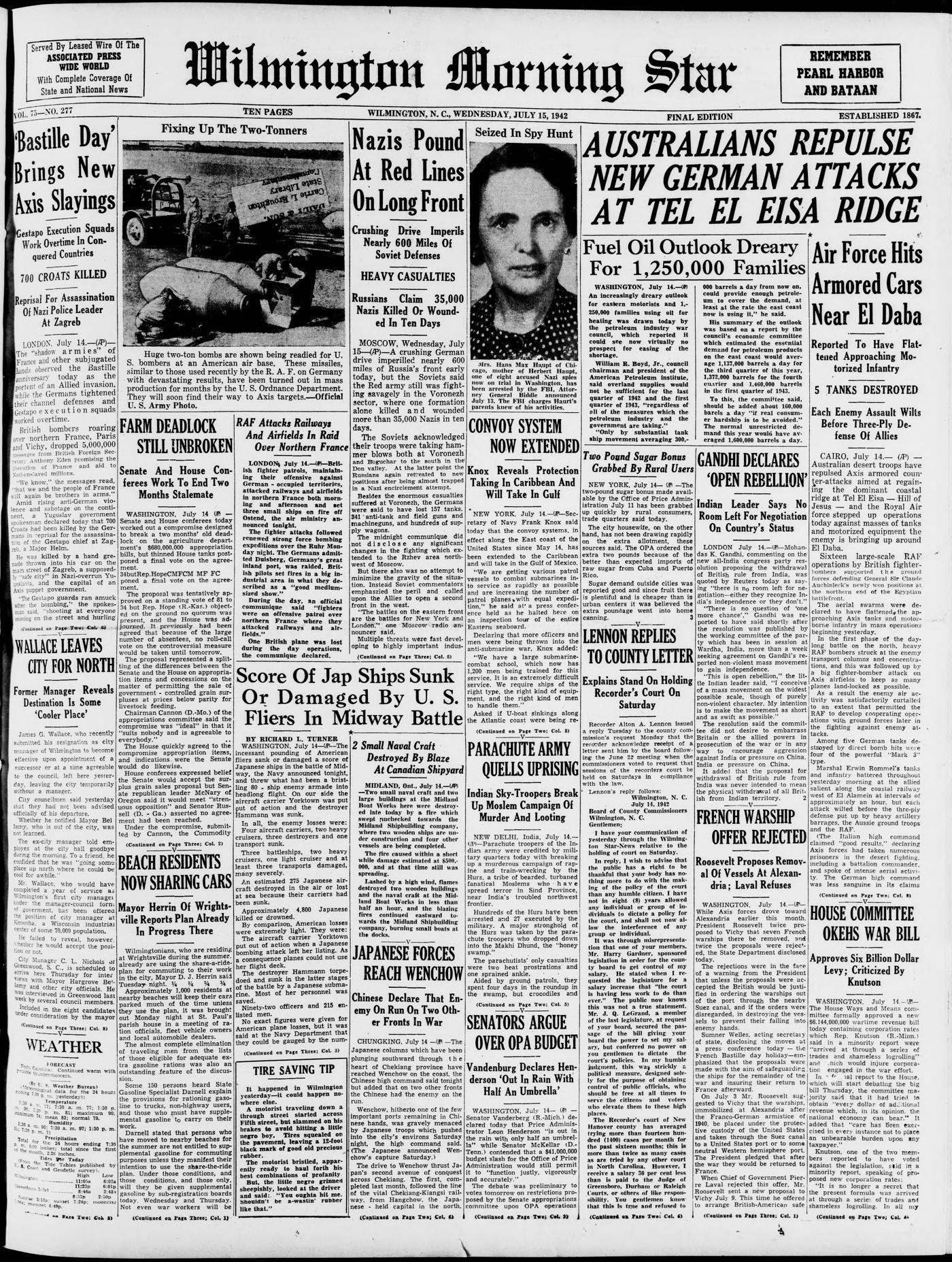
View the original at the Library of Congress →
On the morning of Wednesday, July 15, 1942, the front page of the Wilmington Morning Star led with a transportation story. “BEACH RESIDENTS NOW SHARING CARS.” Mayor D. J. Herrin of Wrightsville reported that the share-a-ride plan was already in progress. Wilmingtonians summering at the beach were commuting into the city together to save gasoline. “Approximately 1,000 residents at nearby beaches will keep their cars parked much of the time unless they use the plan.”
That same day, off Cape Hatteras — about a hundred and forty miles up the coast from those parked cars — three ships died.
The federal record, published by the Bureau of Ocean Energy Management and surveyed by NOAA, names them. The freighter Bluefields, torpedoed by the German submarine U-576. The Chilore, hit by the same boat. And then U-576 itself, destroyed within minutes by Navy aircraft and gunfire from the merchant ship Unicoi. A convoy battle, fought and finished inside a single afternoon, in the shipping lane that ran past North Carolina’s beaches.
None of the three appeared in the Morning Star. Not that day, not the next.
The submarine war did appear. It ran across the top of the same front page: “CONVOY SYSTEM NOW EXTENDED — Knox Reveals Protection Taking In Caribbean And Will Take In Gulf.” The Secretary of the Navy, Frank Knox, had told reporters that the convoy system, in effect along the East coast of the United States since May 14, had been extended to the Caribbean and would take in the Gulf of Mexico. More officers and men were being thrown into what the paper called “the anti-submarine war.” Knox gave the press conference in New York, where he had stopped on an inspection tour of the entire Eastern seaboard.
The entire Eastern seaboard. That afternoon, on the stretch of it Knox was touring, a German submarine would attack a convoy, sink two of its ships, and be destroyed. Readers in Wilmington learned that the Navy was fighting submarines. They did not learn that submarines were sinking ships in their own coastal water, that day, in the sea lane their beaches faced.
He named the war. He could not name the battle.
This is not a story about a newspaper that failed. It is a story about what a country decided its own citizens should not be told, and what that decision looked like on the front page of the paper nearest the fire.
The order came first
On January 15, 1942, the Office of Censorship issued the Code of Wartime Practices for the American Press, over the signature of its director, Byron Price. It is a government publication, and it is in the public domain.
The Code asked American newspapers not to publish — absent authorization from the appropriate government authority — information about the sinking or damaging of naval or merchant vessels in any waters, or about the identities, movements, positions, cargoes, and ports of such ships. What could be printed was what the Navy and the Maritime Commission chose to announce.
Three days later, on January 18, the tanker Allan Jackson was torpedoed off North Carolina by U-66. It was the first of fifty-one ships the federal catalog records as sunk off that coast between January and July of 1942.
The gag order preceded the killing by seventy-two hours.
And here is the thing worth holding onto: the Code was voluntary. Price’s office had no power to compel a single American newspaper to obey it. The press obeyed it anyway, almost without exception, for the duration. What follows is not censorship imposed on an unwilling paper. It is a paper agreeing.
What agreement looked like
Read the Morning Star’s front page on January 18 — the day the Allan Jackson burned. The submarine news is there, quoted from a Navy communique: “enemy submarine activities off the northeast coast of the United States continue.” The paper’s own gloss points the reader north, to two vessels torpedoed “in the distant approaches to New York harbor” and one sunk off Nova Scotia.
Not one word about the tanker that had died off North Carolina that day. The word “northeast” carried the reader’s eye four hundred miles away from the actual fire.
January 19: the federal record shows two ships sunk off the coast, the Ciltvaira and the City of Atlanta, both by U-123. The Morning Star’s front page that morning: a coming shortage of sugar, fats, and oils; the bombing of Singapore; the search for Carole Lombard’s plane.
Then, on January 20, the mechanism becomes visible in a single sentence. The Navy announced, the paper reported, “that another tanker, the S. S. Malay, had been attacked by a submarine off the Atlantic coast. The Malay survived the attack, but three other tankers have been sunk since last Wednesday.”
Read that twice. The ship that lived is named. The three that died are a number.
That is the Code working exactly as written — and the Morning Star’s readers, holding the paper over breakfast in a port town, could learn the name of a tanker that got away and nothing at all about the three that hadn’t.
The submarines they were allowed to name
The strange thing about these front pages is not that submarines are absent. Submarines are everywhere. Torpedoes, survivors, lifeboats, oil — the anxiety is on the page every week. What is missing is the local, the specific, the named.
And there was a place where the paper could be specific: the Pacific.
On July 7, 1942, a U.S. Army A-29 bomber attacked and sank U-701 about twenty miles off Cape Hatteras. Of the forty-six men aboard, thirty-nine died; seven were pulled from the Gulf Stream two days later. The federal record has it precisely, down to the squadron and the pilot’s name.
The Morning Star’s front page that morning carried a submarine headline in capitals: “THREE JAP DESTROYERS SUNK, ANOTHER HEAVILY DAMAGED BY U. S. SUBS OFF ALEUTIANS.”
Three thousand miles away, and named, and celebrated. Twenty miles offshore, and nothing.
The same pattern ran in May. On the ninth, the Coast Guard cutter Icarus depth-charged U-352 off Cape Lookout and forced it to the surface — the first U-boat sunk by the Coast Guard off the American coast. The Morning Star’s front page that day reported the Russian front, an RAF raid off the Dutch coast, and eight Canadians landed at Bermuda: “survivors of a torpedoed Allied ship… after drifting six days in a lifeboat.” Torpedo survivors, in the paper, from somewhere else.
And on the society page, from Wrightsville Beach, a war-fund campaign “concluded with a brilliant dance” at Lumina the night before.
A brilliant dance on the beach, the night a submarine died offshore.
Where the U-boats surfaced
There was one place the campaign off North Carolina reliably appeared in the Morning Star, and it is the most American detail in this entire story.
It appeared in the price of things.
On January 19, the government asked oil companies to shift petroleum to railroad tank cars — because, the deputy petroleum coordinator explained, “Tankers have been sunk on both coasts.” On July 7, the same official warned that prospects for enough fuel oil the coming winter were “not good,” conceding that things might improve if “the submarine problem might be overcome” — but he “would not bet on that, ‘certainly not without heavy odds.’”
The submarine problem. Fifty-one ships and several thousand merchant seamen, rendered as a supply-chain risk in a story about winter heating.
And on July 15 — the day Bluefields, Chilore, and U-576 went down together — the front-page consequence of the U-boat war, in Wilmington, North Carolina, was that a thousand people living at the beach would have to share their cars to save gasoline.
They were not being frivolous. They were being told the truth in the only form it was permitted to take. The gasoline was short because tankers were burning offshore. The paper printed the gasoline. It could not print the tankers.
The names they were allowed to print
On July 16, the morning after the battle off Hatteras, the Morning Star ran a long list.
The Associated Press had compiled, from official announcements, the loss of forty-eight United States naval craft since the sinking of the destroyer Reuben James in October 1941. The paper printed the tabulation in full, by name and by class. Battleships: Arizona. Aircraft carriers: Lexington. Cruisers: Houston. Destroyers: Reuben James, Downes, Cassin, Peary, Jacob Jones, Pope, Stewart, Edsall, Pillsbury, Sturtevant, Sims, Hamman. Submarines, gunboats, minesweepers, tugs — forty-eight ships, each one named.
Not one of them was a merchant tanker off North Carolina.
The Navy’s dead had names, because the Navy had announced them. The merchant marine’s dead — who died at a higher rate than the men of any American armed service — were the three other tankers sunk since last Wednesday.
Directly beside that list of forty-eight named warships, the paper carried a warning from a civil defense liaison officer in Raleigh: “The Army expects the east coast of the United States to be bombed” and was speeding up instruction of the civilian organization. He had just come from a bomb reconnaissance school run by the Army for civil defense officers of the Wilmington district.
So the readers of the Morning Star were told, in one issue, that forty-eight American warships had been lost by name; that the Army expected their coast to be bombed; and nothing whatever about the two freighters and the submarine that had died a hundred and forty miles up their own coast the previous afternoon.
What the paper was built to see
The Wilmington Morning Star did not lie to its readers. Every fact in it was true, and much of it was frightening. It printed the shortages, the fear of bombing, the survivors in lifeboats, the oil. Its readers knew perfectly well that ships were dying. The Code did not ask the paper to pretend the war was elsewhere. It asked the paper not to name the dead — and the paper, like every other paper in America, agreed.
What that produced was not silence. It was something stranger: a newspaper in a port town at the center of the deadliest stretch of water in the American war, in which submarines are a Pacific story, torpedo survivors land in Bermuda, the enemy is off the northeast coast, and the local consequence of a six-month slaughter is a note about carpooling from the beach.
The war was not censored out of the Morning Star. It was rearranged into everything except its own address.
Eighty-four years later, the federal government publishes what the federal government would not release. The catalog names the fifty-one ships and the U-boats that sank them. NOAA’s surveyors have been to the bottom. In 2014 they found Bluefields and U-576 lying about two hundred and forty yards apart on the seabed off Cape Hatteras — the freighter and the submarine that killed her, sunk within minutes of each other on the afternoon of July 15, 1942, and undisturbed for seventy-two years.
That morning, the Morning Star had reported that approximately a thousand beach residents would be sharing cars.
The front pages of the Wilmington Morning Star are in the public domain via the Library of Congress and are shown or linked above. Ship names, dates, positions, and the identities of the attacking submarines are taken from the federal public-domain record — the Bureau of Ocean Energy Management’s Battle of the Atlantic catalog and NOAA’s Monitor National Marine Sanctuary survey data — and never from the newspaper, which was forbidden to print them. The Office of Censorship’s Code of Wartime Practices for the American Press is a US government publication; its provisions are described here rather than quoted, because the reachable digitized text is not clean enough to quote verbatim. This account examines a single daily paper; the Code applied to all of them.
“Beach Residents Now Sharing Cars,” The Wilmington Morning Star, July 15, 1942, p. 1. Library of Congress, Chronicling America. loc.gov/resource/sn78002169/1942-07-15/ed-1/?sp=1