Bomber City
By 1944 the Associated Press put Willow Run's output at close to one heavy bomber every working hour. The workers came by the tens of thousands. And the town spent 1942 arguing about a city for them that the government swore it would not build — and then had to.
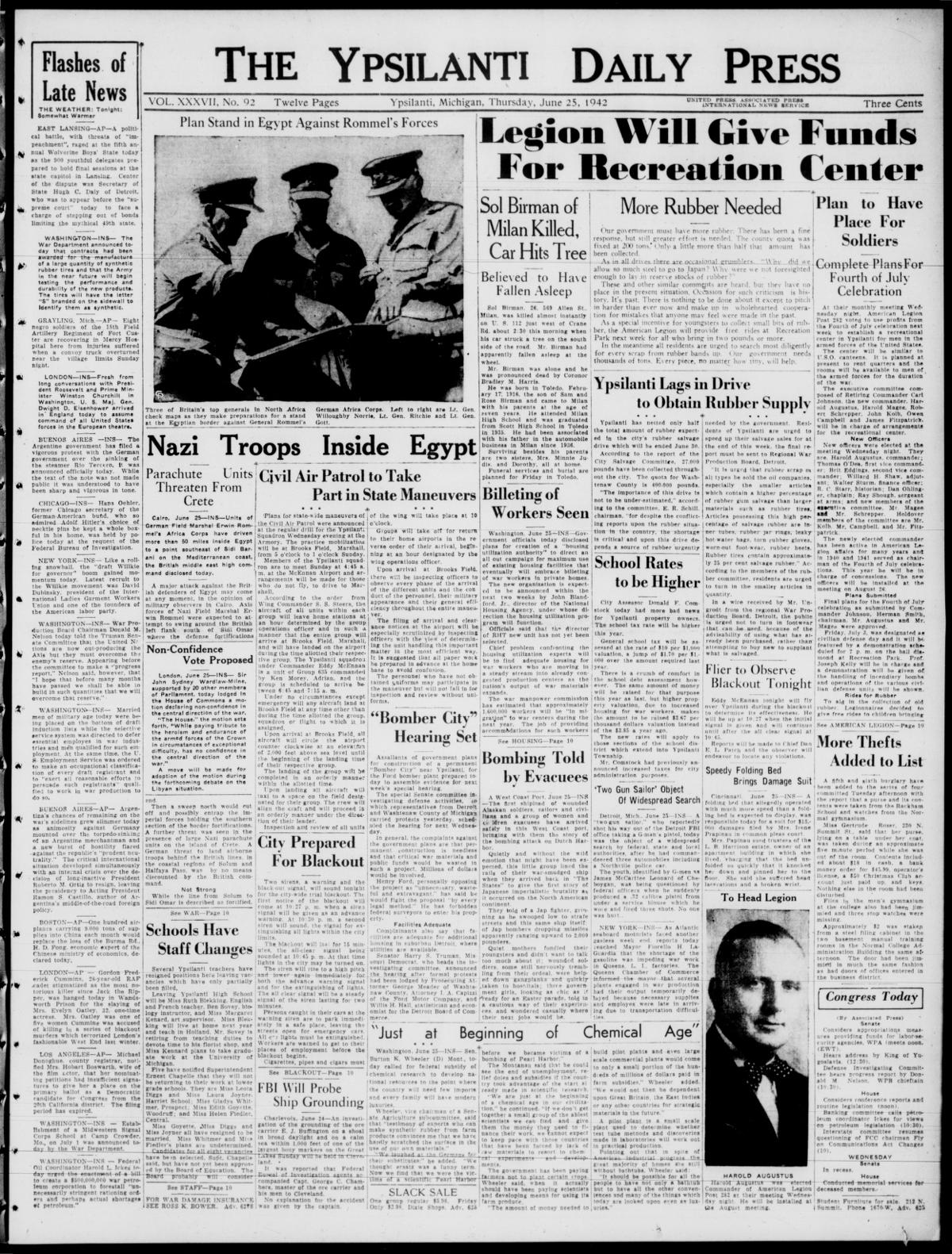
View the original at the Library of Congress →
Thirty miles east of the Willow Run bomber plant, in Detroit’s Wayne County, the population the census counted as nonwhite grew by nearly a hundred and seventy-four thousand between 1940 and 1950 — one of only eleven counties in the entire country to gain that many. Almost all of that was Black migration: the census’s separate count for Black residents rose by a hundred and seventy-two thousand of it. That is the Second Great Migration arriving at the arsenal, and it is the pressure that, in February 1942, produced the Sojourner Truth housing riot this publication has already told.
This is the story of what happened at the edge of that pressure, in the county next door.
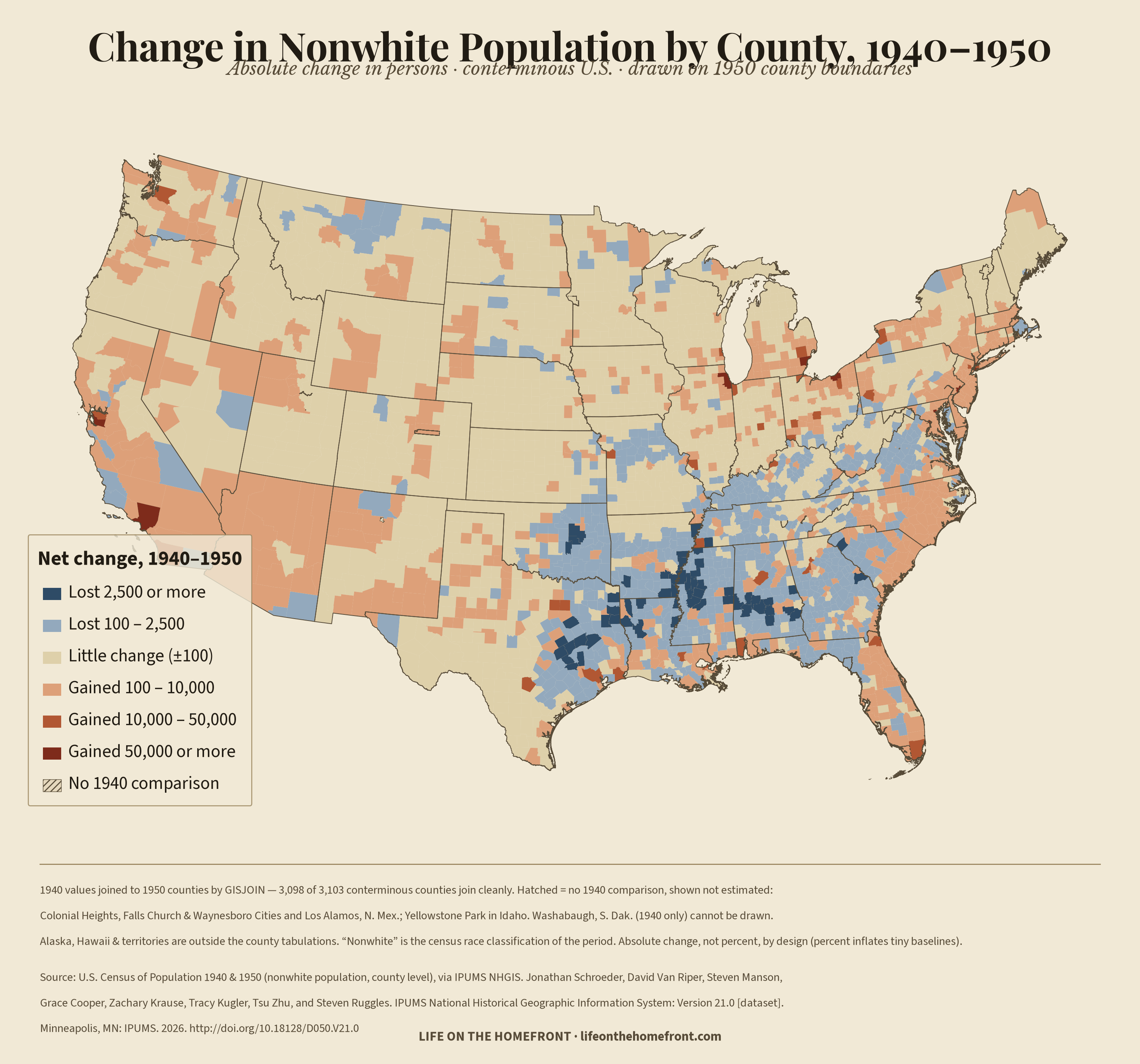
The bomber plant sat in Washtenaw County, just across the Wayne line. Washtenaw was a smaller place — eighty thousand people in 1940 — and it did not gain a hundred and seventy-four thousand of anyone. But between 1940 and 1950 it grew by two-thirds, to nearly a hundred and thirty-five thousand, and its own nonwhite population went from under four thousand to over ten thousand — the Black count alone from about 3,600 to about 9,400. A rural county grew by two-thirds in a decade because a factory landed on it. The figures are the census. What that felt like week to week is in the pages of the county’s newspaper — a small daily in Ypsilanti that spent 1942 watching the largest bomber plant in the world come down on its farmland, and watching the people arrive that there was no place to put.
The plant
The Ypsilanti Daily Press loved the plant without reservation, and said so on its own banner: on the plant’s first anniversary, in April 1942, it published a twenty-eight-page special edition headed “Anniversary Finds Bomber Plant Tribute to American Enterprise.” Inside, the paper told the origin story the way it wanted it remembered: “Henry Ford said ‘yes’ and America knew its answer to the dictators.” And, in the epigram it clearly loved best: “From soy beans to bombers in a year! That tells the story.”
The special edition printed the plant’s vital statistics in a box: an estimated cost of fifty-seven million dollars, and more than three and a half million square feet of floor under one roof. It was, in the paper’s telling, a wonder — a soybean field turned in twelve months into what it called “the world’s biggest bomber factory.”
As for what it made and how fast: in September 1944 the Associated Press reported contracts to keep Willow Run running through all of 1945, according to Henry Ford II. The same story reported that the output of the huge four-engined Liberators at Willow Run was still close to one every working hour. That is the wire service, in late 1944, describing a rate rather than a record — but it is the figure the record actually supports, and it describes a building that three years earlier had grown soybeans.
That is the thing the workers came for.
The city that would rival San Francisco
They came faster than anyone could house them, and for most of 1942 the Daily Press carried, week after week, the story of the arguments about where to put them — a story that runs from a fantasy to a fistfight to a row of buildings designed to come apart.
It began as a dream city. In February 1942 the Associated Press reported that defense planners were assembling data for “a defense city north and west of Detroit which some predicted would, by 1943, rival San Francisco, the nation’s 12th largest city, in size.” Six hundred thousand defense workers and their families, in a triangle of two thousand square miles with its apex just west of Ann Arbor. The recommendation went to Frederic Delano — chairman of the National Resources Planning Board, and, as the paper noted, the President’s uncle — with one careful caveat: no permanent housing beyond postwar need, so that readjustment “will leave no ‘ghost town’.”
By March the dream had a blueprint. “University Has Bomber Plant Housing Plans,” the paper reported: University of Michigan architects had drawn “a plan for the creation of 10,000 two-bathroom homes in a model community three miles from the Willow Run bomber plant.” The model city, the story noted, sat “on a table in the corner of one of the University’s architectural laboratories.” Delano had examined the drawings and was “greatly pleased with the possibilities.” The plans were specific to the point of poignancy: an estimated fifty million dollars, a hundred apartments, twenty-five hundred single-family houses and thousands of row houses, each home of seven rooms with two bathrooms and four bedrooms, five sections with a school and playground and church and corner grocery apiece, a central heating plant — a community its planners had already named “Bomber City,” straddling the Washtenaw and Wayne county line.
Ten thousand two-bathroom homes, on a table, in a lab. That was the high-water mark of the vision, and it is worth holding next to what actually got built, because the distance between them is the whole story of wartime housing.
Within days the counter-vision arrived, from the National Housing Agency, and it was made of a different material. Not a model city but “demountable homes, dormitory units for single persons and trailers for families” — for the Detroit and Ypsilanti area, a hundred and fifty trailers and five hundred dormitory units, explicitly “temporary” and involving no long-range planning. Demountable — the same word that turned up in the federal childcare grants of that year. The government’s actual answer to housing a wartime workforce was, repeatedly, a building specified in advance to be taken apart.
And by late March the dream was formally dead. When Michigan offered the government tax-reverted land, the Daily Press reported the new Federal Public Housing Authority — “a new agency being established in Detroit” — had settled the question: it “does not plan to erect a ‘bomber city’ near Ypsilanti but to build federally-constructed homes on federally acquired land as near as possible to the bomber plant.” No San Francisco. Homes on acquired land, as near as possible, as temporary as possible.
”After all, this is war”
Then the acquiring of the land turned into a fight, and the fight went to the United States Senate.
In June 1942 the county board of supervisors sent a protest to Washington objecting to the model bomber city. The complaint, as the Daily Press reported it, was that “government men have gone on their land without permission, trampled crops and peeked in windows.” Farmers had ejected federal surveyors from the Ford Trade School farm, on the advice of Ford’s own counsel. (The supervisors were careful to note they did not object to the dormitory project east of town — only to the city.)
Two days later it had a bigger stage: “‘Bomber City’ May be Probed.” The Truman Committee — Senator Harry Truman’s committee on the war program — was taking it up. Ford’s man Harry Bennett announced the company would use “every legal means” to prevent construction. And the National Housing Agency’s Colonel F. Charles Starr laid out the government’s position with a bluntness the paper printed in full. On Ford: “I imagine he will not be allowed to stand in the way of a war activity.” On the disputed ground — only three hundred and eighty-four acres, but “in the exact center of the proposed town site” — Starr said operations had been at a standstill since the thirteenth of May. And then the sentence that is the entire argument of the home front compressed to four words: “After all, this is war.”
The next day’s front page — the one reproduced above — set the hearing and the influx side by side, which is why it anchors this piece. “‘Bomber City’ Hearing Set,” with Henry Ford “personally opposing the project as ‘unnecessary, wasteful and extravagant’” and forbidding federal surveyors to enter his property. Directly beside it, “Billeting of Workers Seen” — the housing authority preparing to billet war workers in private homes — and the War Manpower Commission’s estimate that approximately 1,600,000 workers would be “in migration” to war centers over the following year.
That is one front page: the richest manufacturer in America calling federal worker housing extravagant, and, in the next column, the government preparing to move strangers into people’s spare rooms because there was nowhere else to put a million and a half of them. The paper did not editorialize on the juxtaposition. It simply set the two stories in adjacent columns and let a reader in Ypsilanti hold both.
What arriving actually looked like
Underneath the Senate fight, the Daily Press was keeping a quieter ledger — of what the arrival was doing to the town, in the plainest municipal terms.
It was in the tax rate, which the paper reported jumping from $15.85 to $22.40 per thousand — “the outgrowth of the war… due to location of the Bomber plant here,” requiring additional police. It was in the hospital, “originally built to house 18 beds” and, by August 1942, “double that number” — thirty-five adults and twelve babies under treatment on the tenth, wards designed for four beds holding nine, and “corridors are being used for bed space.” It was in the population line the paper dropped into that hospital story: Ypsilanti, estimated at 16,000, had gained at least 3,000 people, with a possible 10,000 more living outside the city limits.
And it was in the classified pages, which are the housing market with the rhetoric stripped off. Furnished rooms, one mile from Bomber Plant, trailer space. Room and board near Bomber Plant, two working men, lunches packed. Farmland advertised, in the same columns, as a perfect setting for a trailer camp. A private estate, “one of the loveliest properties near Ypsilanti,” being converted to a forty-nine-trailer camp. By February the county already had nine licensed trailer camps holding around five hundred people — two of them already closed by the health department.
By June 1943 the paper put the consequence on its own front page, in its own voice rather than a wire service’s: “Forced housing on a huge scale to accommodate Bomber workers has brought extreme health threats. There is not enough local money available to meet the present need.” The state had to send nurses. The town that a year earlier had been promised a rival to San Francisco could not, by itself, keep its water clean.
What got built
What rose instead of Bomber City was Willow Lodge and Willow Village — dormitories and demountable homes — and the Daily Press recorded their life mostly through the least sentimental instrument a newspaper has: the court and police columns.
The population of Willow Lodge was such that in July 1943 a branch of the sheriff’s office opened inside the project, staffed around the clock by six deputies; the sheriff wanted the Lodge classified as a metropolitan area. When the federal housing manager, Guy Larcom, argued for a beer license that May, his case was the loneliness of the place: 2,100 men away from home and friends should have a program of general social life as pleasant as possible, beer being a part of the whole program of labor supply, housing, recreation and social adjustment at Willow Lodge. The municipal-court columns filled with Willow Lodge addresses. One defendant, that spring, was listed as a “resident of New York Central bunk cars” — a man living in railroad cars, entered in the record as his address.
The Village had a first Christmas, in December 1943, and the paper covered it with real tenderness: carols, a Community Building dedication, and “Christmas Dinner Invitations Sought” — households asked to take in “single men and women without their families, who have no home in which to spend the holiday.” It is a kind detail, and it is also a census: a brand-new town, full of people far from wherever home was, needing to be invited somewhere for Christmas.
The whole migration is in one obituary. On the first of November, 1943, the Daily Press recorded the death of Clayton T. Pelfrey of Willow Village. He had been born in Jacobs, Kentucky. He died at his home on Sunday. The funeral was in Olive Hill, Kentucky. A man came north to the plant, and went home in a coffin — the arrival and the departure in three lines of small type.
What the paper did not see
There is one thing the Daily Press almost never showed, and its absence is the sharpest fact in this record.
Washtenaw County’s nonwhite population nearly tripled in the decade. Thousands of Black Americans came to this county for the same reason everyone else did — the plant. And in the pages of the county’s own newspaper across these years, they appear almost exclusively in the police blotter. Not in the anniversary edition, not in the housing-machinery coverage, not among the named arrivals — in the court columns, and once in a story that is worth quoting because the framing is the point.
In September 1942, under the headline “New Resident Has Difficulty,” the paper reported a white plant worker who had been beaten after going into what the paper called “the colored section” of town, looking for a room. The account is entirely police-sourced. No Black resident is quoted. And the police chief’s comment — that “the motive may be commendable” — files the assault under the housing shortage while stepping carefully around what a “colored section” was and why a white worker crossing into it looking for a bed became news.
That item is real evidence of two things at once: the housing desperation was so total that a white worker would go door to door in a Black neighborhood for a room, and the color line was firm enough that his doing so was an incident. But it is nearly the only place the tripling of the county’s Black population surfaces in this paper. This account will not fill that silence with what it suspects — that the new federal housing sorted its residents by race, as most wartime housing did. These pages do not say so, and a finding requires a source. What can be said is only what the record shows: a county whose nonwhite population nearly tripled, and a newspaper that recorded those arrivals almost entirely as crime.
That, too, is what a paper is built to see.
The soybean field
The Daily Press was a booster, and it never hid it. It cheered the plant, financed bombers with a thermometer outside the post office, and printed “From soy beans to bombers in a year!” as though the housing were a detail that would sort itself out.
It didn’t sort itself out. The city that would rival San Francisco became a hundred and fifty trailers and five hundred dormitory units, explicitly built to be taken apart. The farmers threw the surveyors off the land. Ford called the housing extravagant while the plant he was proud of pulled in workers who slept in railroad cars. The hospital doubled up in its corridors, the water needed state nurses, and a man from Jacobs, Kentucky was buried back in Olive Hill.
The census counts the arrival cleanly: Washtenaw up two-thirds, its nonwhite population up nearly threefold, Wayne next door up a hundred and seventy-four thousand — the map at the top of this page, the Second Great Migration landing on the arsenal. The newspaper counts it messily, week by week, in tax rates and trailer licenses and court dockets and one obituary. Between the two, you get the thing whole: the soybean field really did become bombers in a year. It was the people the bombers required that the year was not ready for.
The pages of the Ypsilanti Daily Press are shown or linked above from the Library of Congress, which states it is not aware of any U.S. copyright restrictions on them — an institutional assertion rather than a statutory public-domain guarantee; this is a single-newspaper account, and that paper was an openly celebratory local booster — the skeptical material here (the Bomber City fight, the health warnings, the tax jolts) appears in its own pages, much of it carried from Associated Press and other wire services, and is reported as its record. County population figures for 1940 and 1950 are drawn from the U.S. Census via IPUMS NHGIS (Version 21.0; full citation below); the plant sits in Washtenaw County, and the +173,924 figure on the map is neighboring Wayne County (Detroit), used here for metropolitan context. The 1940–1950 census interval brackets both the wartime influx and the plant’s postwar wind-down, so the 1950 count is not a wartime peak; wartime figures are the newspaper’s own contemporaneous estimates, quoted as estimates. Production, cost, hospital and population figures printed by the paper have been read from the page images, because the machine transcription of them is unreliable — it renders the hospital’s eighteen beds as “IIS,” for one. Where a quotation here differs from that transcription, the page image governs. The near-absence of the county’s Black wartime migration from this newspaper’s coverage is stated as a feature of the record; this account makes no claim about the racial policy of Willow Village housing, which these pages do not address. Census data: Jonathan Schroeder, David Van Riper, Steven Manson, Grace Cooper, Zachary Krause, Tracy Kugler, Tsu Zhu, and Steven Ruggles. IPUMS National Historical Geographic Information System: Version 21.0 [dataset]. Minneapolis, MN: IPUMS. 2026. http://doi.org/10.18128/D050.V21.0
“Bomber City,” The Ypsilanti Daily Press, June 25, 1942, p. 1. Library of Congress, Chronicling America. loc.gov/resource/sn97063183/1942-06-25/ed-1/?sp=1