Rocks Hurt 2 in a Melee
Sixteen months before Detroit burned in the summer of 1943, a white mob stopped Black families from moving into a federal housing project. Three Detroit papers watched the same morning and could not agree on who had rioted.
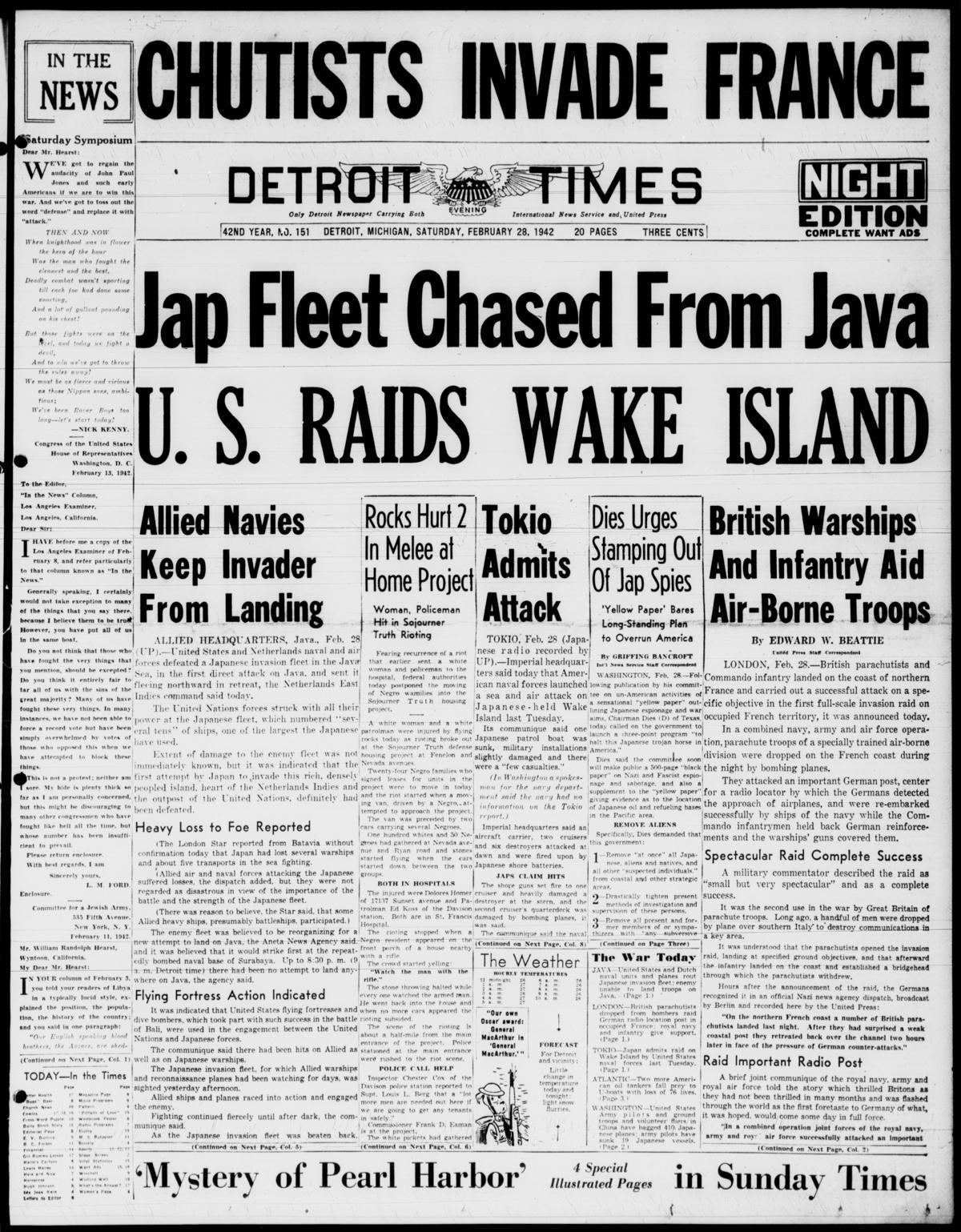
View the original at the Library of Congress →
On Saturday, February 28, 1942, twenty-four Black families held signed leases for apartments in a brand-new federal housing project on Detroit’s east side. It was called the Sojourner Truth Homes. When they arrived that morning with their moving vans, a white crowd was waiting at the corner of Nevada and Ryan to turn them back. By the end of the day the project stood empty, the streets were full of tear gas, and Detroit police had made more than a hundred arrests.
The Detroit Evening Times — the city’s mainstream daily — put the day on its front page under this headline: “Rocks Hurt 2 In Melee at Home Project.” The subhead named the injured: “Woman, Policeman Hit in Sojourner Truth Rioting.”
Read the headline again, because every word of it is a choice. It was a melee — a word for a confused scuffle with no aggressor. The two people it names as hurt, “a white woman and a white patrolman,” were white. And the cause, as the paper explained, was that “the riot started when a moving van, driven by a Negro, attempted to approach the project.” The van attempted to approach. The families trying to move into their own leased apartments are the sentence’s subject; the mob that gathered to stop them is the weather.
This was sixteen months before the Detroit race riot of June 1943 — the one that left more than thirty dead and that this publication has written about before. Same city. Same police department. The same collision between a wartime housing shortage and the color line. The warning was on the front pages in the winter of 1942, and it is worth reading what those front pages did with it — because three Detroit papers watched the same morning, and they could not agree on who had rioted.
The housing the war built, and the fight over who could live in it
The Sojourner Truth Homes existed because of the war. Detroit’s factories had converted to war production and workers were pouring into the city faster than it could house them — part of the vast wartime migration that carried more than a million and a half Black Americans out of the rural South toward the industrial North. The federal government built defense housing to absorb the influx. Sojourner Truth was one such project, named for the abolitionist, and designated for Black occupancy.
That designation was the fight. For weeks before the families arrived, a congressman from a neighboring district, Rudolph Tenerowicz, had led a political campaign in Washington to have the project reassigned to white tenants, declaring it located in a “100 per cent white neighborhood.” The Evening Times carried his charge that Mayor Edward Jeffries had been “blundering” in handling the affair. So when the vans arrived on February 28, the question of who would live in the government’s new houses had already been made combustible by months of organized opposition — and a crowd was ready.
Three front pages, one morning
By the next day the Evening Times had upgraded “melee” to something larger, but kept the grammar intact. Its March 1 front page: “Rioting Delays Occupancy in Truth Homes.” The subhead counted more than a dozen hurt — “as Negroes Attempt to Move In.” Again the Black families “attempt to move in” and the rioting simply happens, subjectless, around them. The paper’s own account described “an attempt by white residents of the neighborhood to prevent Negroes from entering the new government-built homes” — but that sentence sat below a headline in which the Negroes are the ones doing the acting.
The two Black weeklies published in Detroit told it the other way. Both are Saturday papers, and the riot fell on a Saturday, so their accounts land a week later, on March 7. (The Michigan Chronicle’s February 28 front page had gone to press before the violence, hopefully headlined “RIOT FEAR FADES.”) When the Chronicle did report it, the headline put the cause where its reporters found it: “POLICE BRUTALITIES AT RIOTS BAR NEGROES FROM PROJECT,” over the line “Rioting Breaks Loose At Housing Project When Police Fail To Protect Tenants.” The Detroit Tribune’s front page named names the mainstream paper did not: it blamed the police, and it blamed the Klan.
The difference is not which facts each paper had. It is which fact each paper put in the headline. To the mainstream daily, the event was a melee that delayed some Negroes from moving in. To the Black press, the event was a mob — protected by police — that barred Black families from homes they had leased. Same morning. Opposite subjects.
The one fact all three papers reported — and it settles the question
Here is where the cross-press method does something a single source cannot. On the framing, the papers diverge. On one specific fact, they converge — and it is the fact that tells you which framing the evidence supports.
Who did Detroit arrest?
The Evening Times — the mainstream paper, no friend of the Black families in its headlines — reported from the courtroom on March 2. The first case was against a white man, Bernard Augustyniak, accused of felonious assault for attacking another man in the neighborhood. And then, in the paper’s own words: “Four other warrants were drawn up as the court began sessions.” Each of those four, the paper reported, charged a Black defendant with disturbing the peace. The white man’s assault; and then four Black defendants charged with disorderly conduct.
The Detroit Tribune reported the same courtroom from the other side of the room — and gave the number that turns the arrest asymmetry into an indictment. Of the twenty-two people charged with disturbing the peace, the paper reported, twenty were freed by Judge Murphy. The police had charged twenty-two Black defendants; the court threw out twenty of them. The arrests did not survive contact with a judge.
And the Tribune did something the mainstream paper never did: it let one of the accused speak. Mrs. Ann Coklow, a mother of four children, told the court she had been knocked down by a patrolman named Jack Caldwell, of the Connors station — and that Caldwell had called her a “dam nigger” and threatened to kick her. The slur is printed here as the Tribune printed it, because sanitizing it would conceal exactly what the paper put on its front page: a Black woman, under oath, naming what a Detroit police officer said to her while he was knocking her down. Caldwell’s answer, in the next line of the same report, was that the women had attacked a group of 50 whites.
That is the whole case, in one paragraph of a Black weekly. The mainstream daily reported an arrest count. The Tribune reported who was arrested, what the officer called her, and what the judge then did with the charge.
Set the two accounts together. A white mob assembled to stop Black families from occupying a federal housing project. In the arrests that followed, the people charged with “disturbing the peace” were overwhelmingly the Black residents the mob had come to stop. Both the mainstream daily and the Black weekly report this — the mainstream paper against the grain of its own headlines. When the paper that called it a “melee” and the paper that called it “police brutality” agree on who got arrested, the arrest record is no longer a matter of framing. It is the thing the framing was built to obscure.
The cross in the field
There is one more fact the mainstream paper printed and then let fall. Buried in its March 1 riot coverage, in a single sentence: “a fiery cross blazed in a field near the homes. The men who had set the fire fled before police arrived.” A Klan cross, burned the night before Black families were to move in, reported by the city’s mainstream daily and then not mentioned again in its headlines.
It was the Black press, and organized labor, that refused to let it fall. On March 4 the Evening Times did print — inside, on page five, under the headline “Housing Riots Blamed on Klan” — a resolution from Ford Local 600 of the UAW-CIO, one of the most powerful union locals in the country. The riot, the local resolved, could be laid at the door of members of the “un-American Ku Klux Klan who Friday night burned a cross” near the project, and it “requested the FBI to make a thorough investigation.” A cross had been burned, a union had named the Klan, and an FBI investigation had been demanded — in Detroit, in the winter of 1942.
Nothing came of it. The families did not move in that day, or for weeks. And sixteen months later, in the summer of 1943, the same city with the same police force and the same housing pressure produced a riot that killed more than thirty people. The warning had been printed. It had simply been printed, on the mainstream front page, as a melee.
What the three papers were built to see
There was one Saturday morning at the Sojourner Truth Homes. In the Evening Times it was a melee that hurt two white people and delayed some Negroes from moving in. In the Michigan Chronicle and the Detroit Tribune it was a police-protected mob that barred Black families from homes they had leased and a burned cross that went uninvestigated. The papers had the same facts. They did not have the same headline.
And underneath the divergence sat the fact none of them could spin away, because all of them reported it: at a riot started by a white crowd, the people Detroit arrested for disturbing the peace were the Black families the crowd had come to stop. Reading the three papers against one another does not only tell you what happened at Nevada and Ryan. It tells you what each paper needed the morning to mean — and it lets the arrest record, printed in all three, say what the headlines would not.
The front page of the Detroit Evening Times and the front pages of the Michigan Chronicle and the Detroit Tribune are in the public domain via the Library of Congress and are shown or linked above; all three papers were published in Detroit and covered the same event. Because the two Black weeklies went to press on Saturday — the day of the riot — their accounts appear in the following week’s editions of March 7, 1942. The Ford Local 600 resolution is quoted as it was printed in the Detroit Evening Times of March 4, 1942.
On the sources themselves: every quotation above was checked against the raw OCR of the scanned page. The 1942 scans are imperfect. In the Tribune’s court report, the slur Mrs. Coklow attributed to Patrolman Caldwell is legible and is printed as she gave it. In the Evening Times of March 2, the sentence recording that each of the four remaining warrants charged a Black defendant with disturbing the peace is legible in substance but garbled in the scan, and is therefore reported here rather than quoted. Where this account quotes, the words are the paper’s; where the scan fails, we say so instead of guessing.
“Rocks Hurt 2 in a Melee,” Detroit Evening Times, February 28, 1942, p. 1. Library of Congress, Chronicling America. loc.gov/resource/sn88063294/1942-02-28/ed-1/?sp=1