Seventeen Allowed to Purchase Tires
Washington's rationing rules decided who was essential enough to buy a tire — a physician, a food truck, and, after February 1942, a minister. The rules did not make tires. In two counties, unpaid neighbors sat where the widening list of the essential met the shrinking supply, and decided who got them.
View the original at the Library of Congress →
Three nights a week through the winter of 1942, in the office of the county clerk in Ann Arbor, Michigan, three people decided who in Washtenaw County would be allowed to buy a tire. They were not paid for it. The board met three evenings a week, the Ypsilanti Daily Press reported, and served without compensation. Its chairman was the county clerk herself, Mrs. Luella M. Smith; the other two members were Albert Parker and Herbert Upton, of Ann Arbor.
The paper printed their decisions by name. On the fifth of February, under the headline “Seventeen Allowed to Purchase Tires,” it reported that certificates to purchase seventeen tires and thirteen tubes had been granted to ten applicants by the county rationing board the night before. One application was rejected. Then it listed the people: Dr. Neil Gates, Jr., an Ann Arbor physician, one tire and tube; the Chelsea Milling Company, a food truck; Swift and Company, a food truck; R. M. Stein, of Whitmore Lake, two tires for a farm vehicle; Dr. L. L. McCleary, another Ann Arbor physician.
The list of the essential
None of those people had decided they were essential. Washington had. On the thirtieth of December, 1941, the Office of Price Administration issued the Tire Rationing Regulations, and the Wilmington Morning Star told its readers that this drastic curtailment on the sale of tires — “made in anticipation of the loss of a sizable portion of America’s foreign supply of rubber through Japanese action” — was “the first rationing measure to be put in force since the country entered the war.” The regulations set who could still buy a new tire at all. The list was short and specific. A tire could be mounted, the regulations said, “on a vehicle which is operated by a physician, surgeon, visiting nurse, or a veterinary, and which is used principally for professional services.” On an ambulance. On vehicles used exclusively “to maintain fire fighting services,” “necessary public police services,” “public health and safety,” garbage and sanitation, mail. On essential trucks — hauling ice and fuel, and food.
That is why the Ypsilanti Daily Press could print a physician’s name beside a milling company’s food truck and a farmer’s tractor: they were the federal categories made flesh. When the paper tagged Dr. Gates as a physician and Chelsea Milling as a food truck, it was reading Washington’s list back to its own neighbors, one certificate at a time.
The list was not fixed. It was, that winter, visibly in motion — and a county courthouse caught it moving. In the same February 5 column that named Dr. Gates and the food trucks, the board’s chairman relayed a coming change. Rationing regulations, the paper reported, still excluded clergymen from the lists of persons eligible to purchase tires, but further instructions concerning them were expected soon. Two weeks later they arrived: the Revised Tire Rationing Regulations of February 19, 1942, added a new eligible class — “a vehicle which is operated by a regularly practicing minister of any religious faith and which is used principally in, and is necessary to, the performance of his religious duties.” Washington had widened who counted as essential. A county board had read the widening to the public before it happened.
The board was only watching the list change, not changing it. But its chairman was also, separately, trying to push it. Mrs. Smith, the paper reported, was continuing to attempt to obtain a rationing ruling that would let defense workers buy new tires for the cars they drove to work — a category the regulations then excluded. Whether Washington ever granted it, the reachable record does not say. What the record shows is a county clerk in Ann Arbor lobbying the federal government to widen the definition of who was essential, even as the tires to give the essential were running out.
The supply
Some six hundred miles to the south, in Wilmington, North Carolina, the tires ran out on schedule. New Hanover County had its own three-man board — O. H. Shoemaker, a retired businessman, as chairman, with C. Van Leuven and Fred A. Matthes, appointed by the governor and sworn in at the superior courthouse that January. The paper carried the governor’s charge to them, relayed by the assistant state civil-defense director — that in performing their duties as members of the board they would be “serving your country just as fully and effectively” — and there, as the paper set it, the sentence breaks off and is lost.
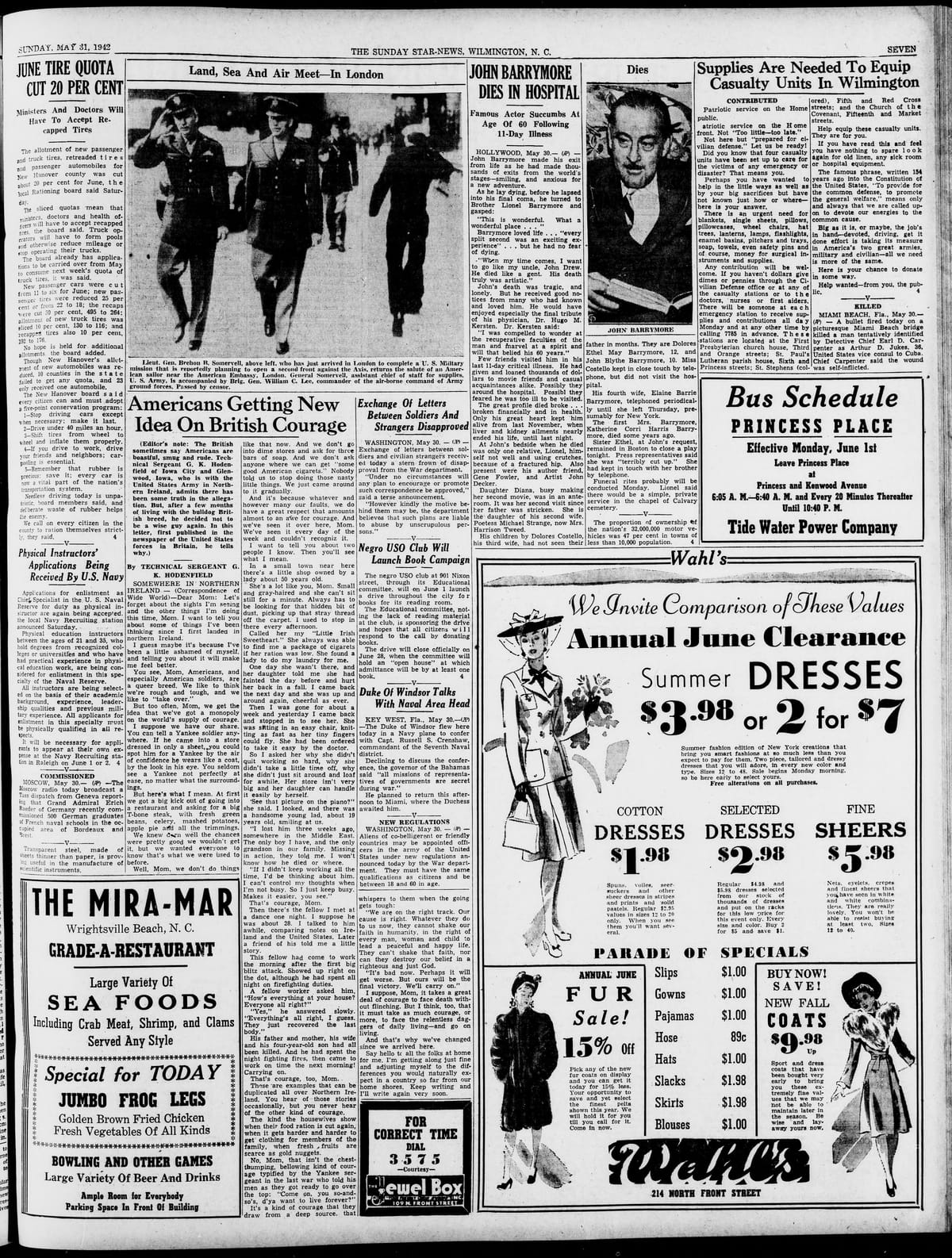
By late spring the arithmetic had caught up with the list. On the thirty-first of May, the Wilmington Morning Star ran the numbers under a headline that read “JUNE TIRE QUOTA CUT 20 PER CENT,” and beneath it, “Ministers And Doctors Will Have To Accept Recapped Tires.” The county’s June allotment had been cut about twenty per cent, the board announced. New passenger tires dropped from twenty-two to eighteen; recaps from four hundred ninety-five to two hundred sixty-four; new truck tires from a hundred thirty to a hundred sixteen. No hope was held for additional allotments, the board added.
The board did not set those numbers, and the paper does not say who did. It says only that the allotment “was cut,” and that New Hanover was not alone: ten counties in the state failed to get any quota at all, and twenty-three received only a single automobile. A shortage apportioned that unevenly across a state was not the work of three men in a Wilmington courthouse — but the paper leaves the hand above them unnamed, and so must this.
What the board did was decide what the shortage meant for the people on the list. The sliced quotas, it said, meant that ministers, doctors, and health officers would have to accept recapped tires instead of new ones; truck operators would have to form pools, cut their mileage, or stop operating their trucks altogether. This is the collision. Washington had added ministers to the list of the essential in February; by late spring, New Hanover’s board was telling its ministers they would get a retread. The promise of who counted was widening. The supply was shrinking. The board sat exactly where the two met.
Who decided, and who is missing
The two boards leave very different records, and the difference is not a difference between the two counties. It is a difference between the two papers.
In Washtenaw, the applicant has a name. We can read that Dr. Gates got one tire and Chelsea Milling got one for a food truck; that on another night eleven applicants were granted certification to buy nineteen new tires and twelve tubes; that the board, applying Washington’s eligibility test, turned people away — “five applications for permits were rejected for failure to establish eligibility,” it reported one week, and “one application was rejected” the next. The Ypsilanti Daily Press printed the roster of the eligible and counted the refused, week after week, so that the working of the federal list is visible down to the individual physician and the individual bakery.
In New Hanover, there is no roster. The Wilmington Morning Star reports what “the board said” — that the quota was cut, that doctors would take recaps, that citizens should ration themselves strictly — but it never names a single applicant granted a tire, and it never names one refused. Shoemaker, Van Leuven, and Matthes are named as the deciders and then fall silent; the paper does not quote them, and the neighbors they decided for do not appear at all. We can show three men given the power and no one they used it on.
Because Washtenaw’s paper named its applicants, we know exactly what a county paper could have printed about who got the last tires and who was turned away — and we know that Wilmington’s paper chose not to. The man refused a tire in New Hanover County is not missing from history. He is missing from the paper.
The board proceedings are drawn from The Wilmington Morning Star (New Hanover County, N.C.; the May 31, 1942 edition carries the Sunday masthead “The Sunday Star-News”) and The Ypsilanti Daily Press (Washtenaw County, Mich.), both public-domain and digitized in the Library of Congress’s Chronicling America collection; the scan shown is self-hosted and the link points to the original. All statements attributed to either board are the papers’ reported summaries; neither paper places any board member’s words in quotation marks, and none is quoted directly here. The Ypsilanti Daily Press names its board chairman as “Mrs. Luella M. Smith, county clerk” in its January reports and as “Mrs. Luella R. Smith, board chairman” on February 5; the middle initial differs in the paper’s own print, and the earlier “M.” is used here. The federal eligibility rules are quoted from the U.S. Office of Price Administration’s Tire Rationing Regulations (dated December 30, 1941) and the Revised Tire Rationing Regulations and Tire Rationing Guide (February 19, 1942, incorporating Amendments 1–16), both public-domain government publications on GPO’s govinfo; the county quota figures are not in those federal texts — they were apportioned to the counties through the OPA and appear here only as the Wilmington paper printed them. The governor’s charge to the New Hanover board is quoted only as far as the January 4, 1942 page legibly prints it; the sentence is broken in the original and its final clause was never set.
“Seventeen Allowed to Purchase Tires,” The Wilmington Morning Star, May 31, 1942, p. 7. Library of Congress, Chronicling America. loc.gov/resource/sn78002169/1942-05-31/ed-1/?sp=7