Cast Off
In September 1942 the United States launched a Liberty ship named for Booker T. Washington and gave it a Black captain. The Black press ran his own account of the twenty-four years it took. The white press ran a couple of sentences and put his race in the headline.
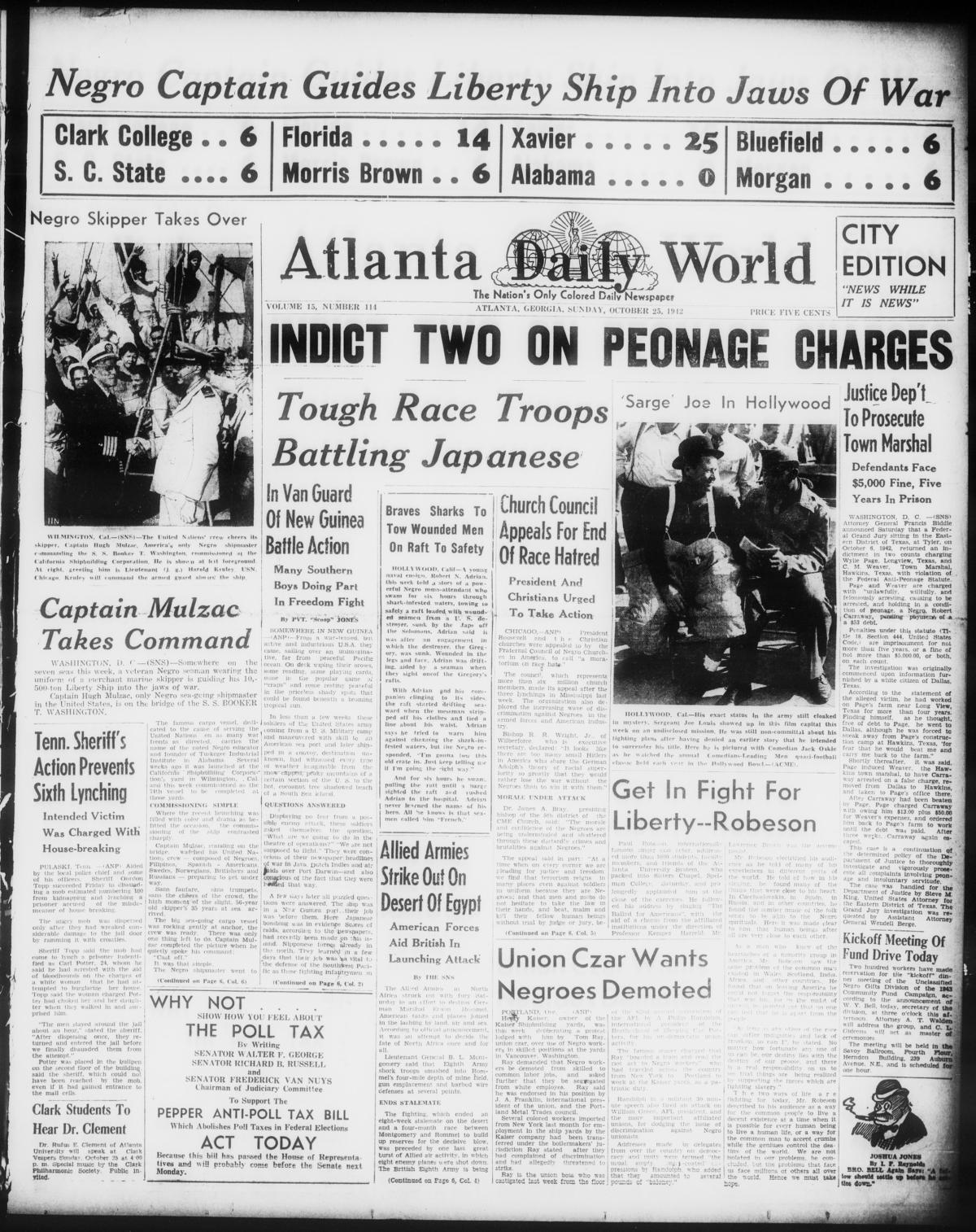
View the original at the Library of Congress →
Sometime in the autumn of 1942, on the bridge of a newly commissioned Liberty ship in a California harbor, a fifty-six-year-old man gave the order to leave the dock. The Atlanta Daily World printed the moment the way it happened, which was without ceremony:
“There was only one thing left to do. Captain Mulzac completed the picture when he quietly spoke his command: ‘Cast off.’ It was that simple.”
It was not simple. Captain Hugh Mulzac had held an American shipmaster’s license since 1918. He had commanded a ship once, briefly, in the early 1920s. And then for roughly twenty-four years — a licensed master, qualified to command a steam or motor vessel of any tonnage on any ocean — the only work he could get on an American ship was as a steward, waiting on the officers he was licensed to be. The command he took in 1942 was not a beginning. It was the end of a quarter-century in which the United States had a qualified Black captain and would not let him captain anything.
That is the story of the SS Booker T. Washington: the first Liberty ship named for a Black American, the first with a Black master commanding an integrated crew. And it is two stories at once — a triumph and an indictment — because they are the same fact. This account can tell it in stereo, because the Black press and the white press both covered it, and the distance between how they covered it is itself the thing worth seeing.
The register and the wire brief
Start with the gap, because it is stark.
The Atlanta Daily World — which called itself, in its masthead, “The Nation’s Only Colored Daily Newspaper,” and which had a stake in this and never hid it — ran the Booker T. Washington as sustained front-page news through September and October 1942. The naming, the launch, the christening, the commissioning, Mulzac’s own biography, a letter from the maritime union, the crew. Its October 25 front page, reproduced above, gave him the full width of the top of the page: “Negro Captain Guides Liberty Ship Into Jaws Of War,” over a photograph of Mulzac in uniform on his bridge with his cheering crew.
Now the same event in the white dailies of this project’s corpus.
The Washington Daily News, September 23, page six — two sentences, headed “Negro Commands Ship.” A War Shipping Administration announcement, and the headline names his race rather than his name. The Evening Star, the same day, page twenty-five: “Colored Skipper Named For New Liberty Ship.” A fuller Maritime Commission brief, still buried inside. The Ypsilanti Daily Press, October 27, page three: a wirephoto under “FIRST NEGRO TAKES SHIP COMMAND.” The Imperial Valley Press of El Centro gave it the one mainstream front page — “Ship Turned Over To Negro Master” — and it was vivid, describing how Mulzac “stood proudly on the bridge as the 10,500-ton cargo ship slipped away.”
Every one of those headlines names his race. Not one of them names the twenty-four years.
That is the finding, and it is not “the white press ignored it” — this is not a silence. The wire services carried it; the mainstream papers ran it. It is that the same event became two different kinds of news. In the Daily World it was a man’s vindication, told with his own voice and his own history. In the mainstream dailies it was a novelty item — a “Negro Master,” a “Colored Skipper,” a curiosity worth two sentences next to a bank-loan advertisement — with the injustice that made it news filed off. The white papers reported that a Black man had been given a ship. Only the Black paper reported what it had taken, and how long, and why.
What it had taken
Here is the history the mainstream briefs left out, as Mulzac gave it to the Atlanta Daily World on October 4, 1942, under the headline “Washington’s Commander Got His Post The Hard Way.”
He had his master’s certificate. He was, the Daily World reported, “the first of his race to hold an American master’s… certificate” entitling him to command a ship of any tonnage on any ocean. He had held it since 1918. And it had bought him almost nothing. “None of the ship companies would employ a Negro ship’s officers,” he told the paper (the plural is the paper’s). He recounted that even after the war began, when — as he put it — “the Maritime Commission was advertising for ship’s officers,” he still “couldn’t land a berth.” (The sentence is compressed as the Daily World set it, but its sense is plain: the wartime shortage of officers still did not open the door to a Black master.) What finally forced it, he said, was pressure: the National Maritime Union and, in his words, several Negro societies protested to the War Shipping Administration, and only then did the appointment come through.
The Daily World laid his record beside the claim. He had been master of the Yarmouth — a ship of the Black Star Line, the Black-owned steamship company of the early 1920s — from 1920 to 1922. He “lost his command when the company went out of business, and since then has not been able to land a berth at anything on American passenger liners except a rank of steward.” Licensed to command; permitted to serve.
The maritime union told the same span even more flatly. In a year-end report the Daily World ran on December 20 — and this is the union crediting its own campaign, which is worth saying plainly — the National Maritime Union stated that Mulzac “was forced to sail in the steward’s department of vessels from 1920, when he obtained his master’s license, until 1942 when he finally was given a command,” and attributed those years to what it called the official government policy of discrimination, fostered and encouraged by shipowners. The union had a stake in the telling. But the union’s protest is also, by Mulzac’s own account, the reason the command came at all — so its claim to the victory is not merely boast; it is causation.
Twenty-four years, 1918 to 1942. That is the number the white dailies did not print.
The ship they named, and who came to name it
The ship itself was an argument, and the ceremony around it was staged to make the argument out loud.
The idea had come from the yard floor. A sixty-two-year-old Black shipyard worker at California Shipbuilding named Peter B. Ross had written to his congressman proposing that a Liberty ship be named for Booker T. Washington; the Maritime Commission’s chairman, Admiral Emory S. Land, telegraphed approval about a month later. Ross’s wife served as matron of honor at the launch. The ship was built at Wilmington, California, by a workforce the Daily World described as integrated — “Workers of many racial extractions — Chinese, Filipinos, Mexicans, Negroes and whites — helped construct” her — in a yard the company called, in the paper’s quotation, a splendid example of democracy in action.
It was christened by Marian Anderson — the contralto who three years earlier had been barred from Constitution Hall and had sung instead from the steps of the Lincoln Memorial. “It is with a great feeling of pride,” she said, “that I accept the sponsorship of this Liberty ship named after that great American, Booker T. Washington.” The principal speaker was Mary McLeod Bethune, who called the ship “an advanced step in building the morale of a people who want only a chance to fight,” and said: “It is fit that this ship should bear the name of a great American, who happened to be a Negro.” The ceremony went out coast to coast on network radio.
You could not assemble that cast by accident. A ship named for Booker T. Washington by the idea of a Black shipyard welder, built by an integrated yard, christened by the woman turned away from Constitution Hall, commanded by a Black captain kept ashore for a generation — every element of it was chosen to say a single thing. The maritime union’s president, Joseph Curran, said the thing directly, in a letter the Daily World put on its front page: a ship so named, so sponsored, and so commanded was, he wrote, “America’s answer to Nazi distortions about our attitude toward the… Negro people,” and proof that “all the talk about the Four Freedoms was not just empty talk.”
That is the logic the whole home-front Black press was pressing in 1942 — victory over fascism abroad and victory over racism at home, each earning the other. The ship was nearly its literal embodiment. (The slogan the campaign is remembered by does not appear on these particular pages; the argument does, in Bethune’s words and Curran’s.)
The crew, and the gun crew
The crew was the point made physical. The Daily World described Mulzac’s “United Nations crew composed of Negroes, Filipinos, Spanish Americans, Swedes, Norwegians, Britishers and Russians.” Even the mainstream wire items registered it — the Imperial Valley Press noted the “United Nations crew,” and months later the Waterbury Democrat, running the fullest mainstream piece of the lot after the ship’s first voyage, described the ship’s crew as a checkerboard of races and reported that the War Shipping Administration “could find nothing but friendly cooperation aboard,” and that of the whole ship’s company only four men had wanted to leave.
But the Imperial Valley Press, in the same front-page story that celebrated the integrated merchant crew, recorded one more fact without comment — and it is the detail that keeps this from being a clean triumph. The ship’s Navy armed guard — the gunners the Navy put aboard merchant vessels to man the deck guns against submarines — was, the paper noted, “an all-white armed guard under command of Lt. (jg) Harold Kruley.”
So on the deck of the Booker T. Washington two American arrangements sailed at once. The merchant crew that ran the ship was integrated, seven nationalities under a Black master — the future, deliberately built. And the Navy gun crew that defended it was segregated white, because in 1942 the United States Navy did not yet put Black and white sailors at the same guns. The breakthrough and the thing it was breaking against were on the same hull, in the same photograph, and the wire services printed both facts side by side and remarked on neither.
Cast off
Set the two presses beside each other and the whole shape is there. The United States, in 1942, did something genuinely and deliberately new: it named a warship for Booker T. Washington, built it in an integrated yard, christened it with Marian Anderson, and put on its bridge a Black captain it had kept ashore for twenty-four years. The Black press told all of it — the triumph and the twenty-four years and the segregated gun crew and the man’s own voice. The white press told a piece of it — a “Negro Master,” three sentences, inside the paper — and headlined the one fact about Hugh Mulzac that had kept him off a bridge since 1918: his race.
That is what a paper is built to see. To the Atlanta Daily World, Mulzac was a man who had finally been allowed to do the job he was licensed for, and the story was the injustice of the wait. To the mainstream dailies, he was a novelty — a colored skipper, a first — and the story was the novelty, with the injustice removed, which is to say with the reason for the story removed.
Mulzac had one word for it, and he spoke it quietly from the bridge with his United Nations crew around him and an all-white gun crew at the rails. Cast off. He had been waiting to give an order like that since 1918.
The pages of the Atlanta Daily World, the Washington Daily News, the Evening Star, the Imperial Valley Press, the Ypsilanti Daily Press, and the Waterbury Democrat are shown or linked above from the Library of Congress, which states it is not aware of any U.S. copyright restrictions on them — an institutional assertion rather than a statutory public-domain guarantee. The Atlanta Daily World was an advocacy Black daily and styled itself “The Nation’s Only Colored Daily Newspaper”; much of its Mulzac coverage moved on the Black-press wire services, and the National Maritime Union material it printed is that union’s own account of a campaign it had waged — celebratory and interested, and load-bearing precisely because the union’s protest was, by Mulzac’s own telling, why the command came. Captain Hugh Mulzac’s biography — the 1918 master’s license, the Yarmouth command of 1920–22 under the Black Star Line, the years as a steward — is given here as he told it to the Atlanta Daily World; the paper names the “Black Star Line” but not Marcus Garvey. Where the newspapers’ figures disagree (the ship’s tonnage appears variously as 10,000, 10,500, and, in one garbled transcription, 12,000; Mulzac’s age is given as 56 in 1942 and 57 a year later), they are reported as each page printed them. The institutional facts of the ship — its builder, tonnage, commissioning, and voyages — properly rest on the federal record of the War Shipping Administration (National Archives RG 248) and the U.S. Maritime Commission (RG 178), which announced and administered the command; those records are U.S. government works in the public domain, cited here as the ledger against which the newspapers are the voice. Period racial terms appear as both presses printed them, including in the mainstream headlines, which are quoted as evidence. Two of this article’s quotations are given as each paper set them, including its typesetter’s slips: Captain Mulzac’s “None of the ship companies would employ a Negro ship’s officers” carries the plural the Atlanta Daily World printed, and the Waterbury Democrat’s description of the crew — rendered here in the author’s words rather than quoted — appeared on the page as a “checkerborad” crew, a transposition of “checkerboard.” Captain Mulzac’s 1963 memoir, A Star to Steer By, is under copyright and is not quoted here.
“Cast Off,” Atlanta Daily World, October 25, 1942, p. 1. Library of Congress, Chronicling America. loc.gov/resource/sn82015425/1942-10-25/ed-1/?sp=1