The Christmas Edition
On December 6, 1942, military police shot twelve people at Manzanar. The camp's newspaper did not publish again for twenty days, and when it did, its front page named forty-three men who had come back from a work furlough.
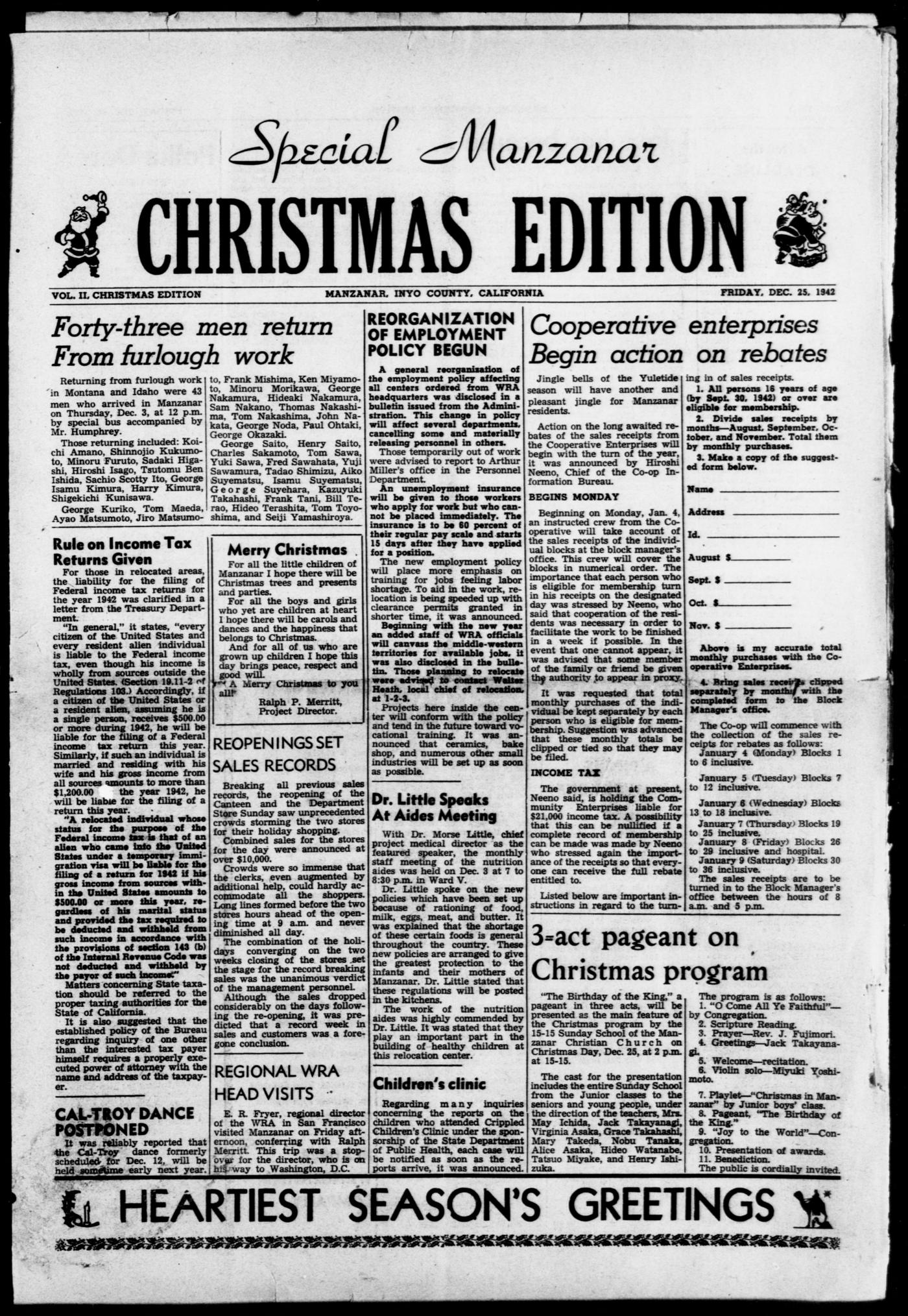
View the original at the Library of Congress →
The last thing the Manzanar Free Press told its readers before the shooting was where to be on Sunday night.
It ran in the calendar on page three of the Saturday, December 5, 1942 issue, under “CALENDAR OF THE WEEK.” Sunday, December 6: a PTA movie, four showings, one o’clock through eight. The picture was In the Navy — an Abbott and Costello service comedy, Bud and Lou in sailor suits, playing for an audience of American civilians held behind barbed wire in the Owens Valley by their own government.
That night, military police fired shotguns and a Thompson submachine gun into a crowd of the people the calendar was written for. One was killed where he stood. Eleven others were hit. A second died in the camp hospital five days later.
The Manzanar Free Press did not publish again for twenty days.
When it came back, on Christmas Day, its front page carried a headline that read “Forty-three men return From furlough work” — and then it named them. Koichi Amano. Sadaki Higashi. Hiroshi Isago. Tsutomu Ben Ishida. Sachio Scotty Ito. George Isamu Kimura. Harry Kimura. Shigekichi Kunisawa. George Kuriko. Tom Maeda. Ayao Matsumoto. The list ran on down the column, forty-three men who had gone out to the sugar beet fields of Montana and Idaho and come back by special bus.
Beside it: a Treasury Department clarification on filing federal income tax returns.
The paper had room to print the names of forty-three men who came home from a work furlough. It never printed the names of the two who were shot.
What the paper was
Turn to page two of any issue and the Free Press tells you exactly what it is, in its own masthead: “Official Publication of the Manzanar Relocation Center Administration.”
That is not a slur invented by a historian eighty years later. It is the paper’s own description of itself, printed above its own staff box — the editor Chiye Mori, the city editor Mary Kitano — in every issue. The camp newspaper was published by the agency that ran the camp.
And the government knew what that meant. After the shooting, the War Relocation Authority investigated its own disaster and produced a list of twenty-five underlying causes of the unrest at Manzanar. The grievances ranged from the mundane to the structural: delays in wage payments, the wage differential between chefs and cooks, rumors of misappropriated sugar, “uncertainty about the future in this country.” Number thirteen on the government’s own list was this:
“The pro-government policy of the Manzanar Free Press.”
The camp’s newspaper was not an incidental bystander to the violence of December 6. Its supervising agency listed the paper’s editorial line among the causes of the riot that killed two of its readers. And when the crowd formed that night, the people it went looking for included, in the federal record’s own words, “staff members of the Manzanar Free Press.” Two of the paper’s editors had been interviewed by the FBI. Some of the paper’s people ended up among the sixty-five evacuees taken into protective custody and trucked out of Manzanar under armed guard to an abandoned Civilian Conservation Corps camp in Death Valley.
So the silence that follows is not a simple story of a censor’s hand. It is stranger and worse than that. The paper did not report the killing of two of its readers by the government, because the paper was the government — and because its own staff were on the list of people the dead men’s neighbors had come to kill.
What the record says the paper wouldn’t
The federal government now publishes what its own newspaper would not print.
The National Park Service’s historical study of Manzanar — a Department of the Interior publication, in the public domain — sets out the casualties of December 6 by name, with their ages, their birthplaces, their jobs, and their wounds. There are twelve of them.
James Ito. Seventeen years old, born in Los Angeles. Unmarried. He had a brother serving in the United States Army and another brother working the sugar beet fields. He was, in the study’s phrase, reportedly “a quiet boy who seldom went out at night.” He was shot through the heart and abdomen from a distance of no more than twenty-five feet, and pronounced dead on arrival at the hospital.
Jim Kanagawa. Twenty-one, born in Tacoma, Washington, educated in Japan, unmarried. Bullet wounds in the stomach and lung, perforating the pancreas. He died on December 11.
Then the ten who lived. Tom Hatanaka, 26, a produce broker before the evacuation, assistant manager of one of the camp’s cooperative stores; fourteen inches of his small bowel were cut out. Charles Sakihara, 18, who worked in the Manzanar motor pool. George Kano, 25, a night watchman in the public works office. Kenjiro Nagamini, 50, who came to the United States in 1919. Harry Nukada, 28. Jingo Nakamura, 40, a carpenter, father of two sons. Frank Takahashi, 22, a kitchen worker, married, one child. Henry Mukado, 20, the timekeeper in a mess hall. Henry Inouye, 24. Yoshio Yoshihiro, 31, a junior cook, married, one child, who suffered from the tear gas.
And one sentence in that federal study does more work than any adjective could:
“All wounds were ‘from the side or behind,’ except for those of James Ito who was shot from the front.”
Eleven of the twelve were hit in the side or the back. They were running.
What the other camps printed
Here is the part that turns a silence into a finding. Manzanar’s paper said nothing — but the other camps’ papers did not.
Six other WRA newspapers named Manzanar in the weeks after December 6, while the paper closest to the bodies was dark. And what they printed is its own kind of document.
The Heart Mountain Sentinel, in Wyoming, said it plainly on December 12: the trouble had resulted, “according to press reports, in the military police firing on a mob of evacuees, causing one death and a number of serious injuries.” It went on to note that the WRA project directors had blamed “Axis groups,” and that “hundreds of loyal pro-American evacuees” had stood by the administration and, in its telling, done everything they could to keep order.
The Daily Tulean Dispatch, at Tule Lake, ran the story on December 11 under a headline about Boy Scouts guarding the flag — recounting, from a San Francisco Chronicle story, how fourteen Japanese American Scouts armed only with stones had protected the American flag during the rioting. In the next column, the Tulean announced that the long hoped-for moving picture had become a reality: Deanna Durbin in It’s a Date, showing nightly at the mess halls, admission five cents.
The next day, the Tulean’s editorial page went further. It described the demonstration at Manzanar as a banzai celebration of the Pearl Harbor anniversary staged by pro-Japanese nationals, praised the nisei Scouts who had faced down what it called a surging, fanatical mob, and delivered a verdict on the protesters: forcing one group’s wishes upon another, it wrote, is unadulterated fascism.
Read that again, and remember who wrote it. That is an American newspaper, published inside an American concentration camp, by American citizens imprisoned there without charge, describing other imprisoned American citizens as a fanatical pro-Japanese mob — and calling them the fascists.
The camp press did not fail to report the killings. It reported them in its jailers’ vocabulary. The frame arrived from outside, and the incarcerated papers wore it.
Outside, that frame was louder. The Imperial Valley Press of El Centro led its December 7 front page with “Guns Quell Japs In Pro-Axis Riot At Calif. Center.” Washington’s Evening Star ran it as “Troops Fire Into Pro-Axis Mob; Nipponese Loyal To U. S. Badly Beaten.” In the mainstream telling, no one was shot in the back; guns simply quelled a riot, on the eve of the anniversary of Pearl Harbor, and the story’s victims were the loyal.
Christmas Day
On December 21, they buried the two young men. The evacuees asked to hold a memorial in the camp’s outdoor theater, and asked that the ban on mass meetings be lifted so a thousand people could come. The Ninth Service Command refused, and proposed instead a service in Bishop with only family present. In the end, a hundred and fifty mourners were allowed to gather in the woods outside the sentry line, with a Buddhist priest officiating, and only those authorized to travel in cars driven by Caucasian staff were permitted through.
At one o’clock that afternoon, the entire population of the camp — some ten thousand people — stood still for two minutes of silence.
Four days later, on Christmas morning, the project director, Ralph P. Merritt, sat down and wrote a letter to his aunt. It is quoted in the federal study:
“Last Monday we buried our dead. At the Buddhist funeral held in the woods, beyond the Lacey Ranch, we mourned with their families the death of the two boys, innocent of wrong doing, the victims of the riot. The only soldier present stood at the head of one of the coffins — the brother of the dead boy. This soldier of Japanese ancestry was on active duty at a distant point, but the Army granted my request to bring him home to his family. The Buddhist Priest prayed that the lives of these young men would be a sacrifice for the sins of all the camp.”
James Ito’s brother was a soldier in the United States Army. The Army brought him home on leave to stand at his brother’s coffin, in the woods outside the fence of the camp where the Army had shot him.
The man who wrote that sentence was the same man whose administration published the Manzanar Free Press. He called the dead boys innocent of wrongdoing. He wrote it on Christmas Day, 1942.
And on that same Christmas Day, his newspaper — printed, the federal record notes, at his own suggestion as part of a plan to relieve tensions in the camp, and not published at all since the violence — went out to ten thousand people with a front page about forty-three furlough workers and the federal income tax, and a gossip column whose only use of the word trouble was this:
“Looks as if ole St Nick will find a trifle bit of trouble in making it down the Manzanar chimney.”
What the paper was built to see
The Manzanar Free Press was written and edited by incarcerated people. Their names are in the staff box. They were not villains; they were prisoners running a newspaper for their jailers, some of them with their own names on a death list, and there is no evidence any of them chose the silence.
But the silence is on the page, and it is total. Twenty days of nothing, and then Christmas. In the whole of that Christmas issue there is no reference to the shooting, none to the funeral, none to the two minutes at one o’clock when everyone the paper was written for stopped and stood still — an event the entire camp participated in and the camp’s own newspaper did not report.
The federal government eventually published the names, the ages, the jobs, the entry wounds, and its own count of what caused the disaster, including its newspaper’s editorial line. Nothing was ultimately suppressed. It was only delayed by half a century, and printed by a different agency, for a different audience, long after everyone concerned was beyond being consoled by it.
Sunday, December 6, 1942. One, three, six, and eight o’clock. In the Navy.
The pages of the Manzanar Free Press, the Heart Mountain Sentinel, the Daily Tulean Dispatch, the Imperial Valley Press, and the Evening Star are shown or linked above from the Library of Congress, which states it is not aware of any U.S. copyright restrictions on the WRA camp press — an institutional assertion rather than a statutory public-domain guarantee. The names, ages, and wounds of the twelve casualties, the War Relocation Authority’s list of causes, the funeral restrictions, and Project Director Merritt’s letter are taken from Harlan D. Unrau’s The Evacuation and Relocation of Persons of Japanese Ancestry During World War II: A Historical Study of the Manzanar War Relocation Center (National Park Service, U.S. Department of the Interior, 1996) — a federal publication in the public domain — and never from the newspapers, which did not print them. Heart Mountain published a separate Japanese-language edition; the Library of Congress returns no machine-readable text for its December 1942 pages, so this account makes no claim about what that edition did or did not report. The Manzanar Free Press had no Japanese-language edition in 1942.
“The Christmas Edition,” Manzanar Free Press, December 25, 1942, p. 1. Library of Congress, Chronicling America. loc.gov/resource/sn84025948/1942-12-25/ed-1/?sp=1