Community Life
The one time America ran something close to public childcare, it was never authorized as childcare. It rode in under a housing act, on a phrase broad enough to carry it and vague enough to drop it.
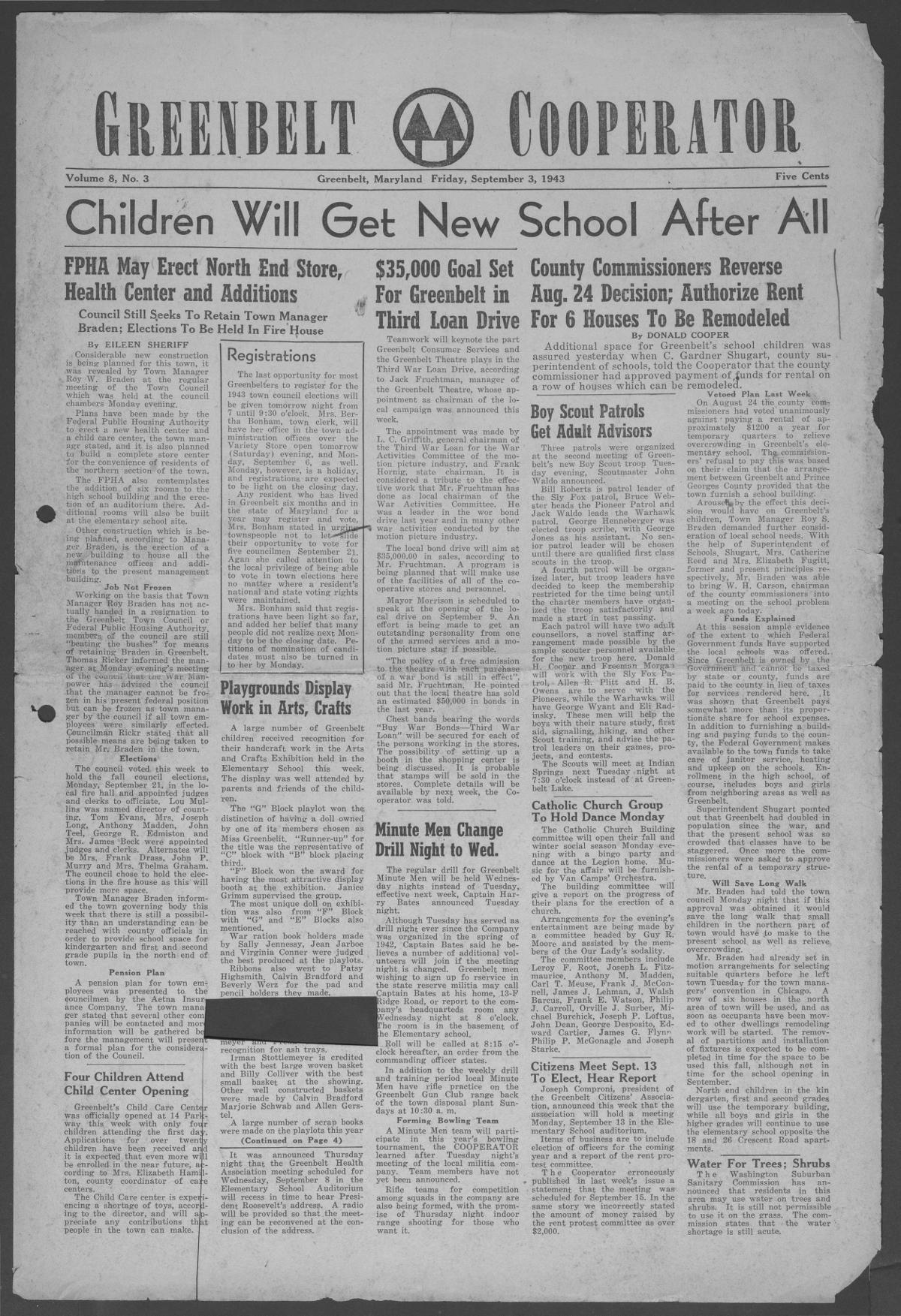
View the original at the Library of Congress →
On Friday, September 3, 1943, the Greenbelt Cooperator — a volunteer-run weekly in a town the federal government had built from scratch — reported that the child care center had finally opened.
Four children came.
The item ran at the bottom of the front page: the center had opened at 14 Parkway “with only four children attending the first day.” Inside, on the editorial page, the paper allowed itself a sentence: “It is very discouraging…”
By the following March that center had a hundred and twenty-seven children on its list.
This is the story of the one time the United States ran something close to public childcare — and of the fact that the statute it rode on never called it childcare at all.
What the law actually says
The money came from Lanham Act grants, administered by the Federal Works Agency. Everyone in this story knows that; the papers say it plainly.
So read the law.
The Lanham Act of October 14, 1940 is a housing act. Its own title says so: to expedite the provision of housing in connection with national defense. Its 1941 amendment extended it to community facilities — schools, waterworks, sewers, hospitals, recreational facilities, streets and access roads. What the amendment authorizes, in the operative phrase, is “any facility necessary for carrying on community life substantially expanded by the national-defense program.”
Search both texts and you will not find the words child care. Or nursery. Or day care. They are not there.
America’s largest experiment in public childcare was funded under community life.
That phrase is doing an extraordinary amount of work. It is broad enough to carry a national daycare program inside a housing statute — and vague enough that when the war ended, there was nothing in the statute to point at and say this. You cannot defend a program the law never named.
One thing the 1941 amendment does say, and says explicitly, is that public works under it “shall be provided on the basis of need and in determining need no discrimination shall be made on account of race, creed, or color.” In 1941. In a housing bill.
One town, from beginning to radishes
Greenbelt, Maryland was a New Deal town — planned, built, and owned by the federal government, its houses administered by the Federal Public Housing Authority. Its newspaper was a co-op, run by residents, five cents. Which means the Cooperator was in the strange position of covering a federal experiment being performed on itself, and lobbying its own landlord in its own pages.
It did exactly that. On April 2, 1943, under the headline “Where Is the Child Care Center?”, the paper demanded one:
“Without a child care center available to all, what will mothers of pre-school children do when they have to take up jobs in war industries? […] funds from the Lanham Act appropriation are available […] Where, then, is the delay?”
The delay, per the editorial, was not money. The Lanham funds existed. The bottleneck was permission from the FPHA to convert a building — one federal agency waiting on another. The double bureaucracy is not a detail of this story; it is the mechanism of it.
Five months later: four children.
Then the thing found its feet. October 15, 1943 — “22 Now Attending” — seventeen pre-school and five kindergarten, the center open eleven hours a day, from seven in the morning to six at night, which is what it takes when a mother’s shift is a shift and not an errand. The paper printed every child’s name. (Its own roster sentence begins “The twenty-one who play while mother works are…” and lists twenty-one; the headline says twenty-two. Both numbers are the paper’s, printed a column apart, and I leave them as it left them.)
February 25, 1944 — “Care Center To Double In Size,” to fifty children, with an official from the FWA administrator’s office conferring with the town about a separate building.
March 17, 1944 — “Child Care Center Has 127 On List.” A survey found thirty-one pre-school children and ninety-six school-age.
And on May 12, 1944, with enrollment at forty-two, the Cooperator reported that “the older tots are gardening with enthusiasm. Their radishes and beans are up.”
Four children in September. A hundred and twenty-seven on a list by March. Radishes by May. That is the whole national pattern in one town’s own words: a slow start against skepticism, and then demand so far past supply that the paper is publishing survey numbers.
Who actually pushed
The centers did not appear because a policy was enlightened. Someone made them.
The CIO News — the union’s own paper, and therefore crediting itself, which is worth saying out loud — reported from Cumberland, Maryland in October 1943: “Continued pressure from organized labor is generally credited with having caused the establishment on a continuing basis of the Child Care Center in the West Side School.”
The agitation, the paper said, had begun in February 1942, by the newly established Women’s Auxiliary of the CIO. It had taken a year and a half. The center had started under WPA nurseries and continued when “the Lanham Act funds became available.”
And then the union kept fighting about the terms, which is the part that makes it real. The fees were too high — a flat three dollars a week, the same for everyone, and the auxiliary wanted a sliding scale. The hours weren’t enough: they wanted round-the-clock care, because a war plant runs three shifts and a mother on graveyard has nowhere to put a child at eleven at night.
Federal money, a school building, and a union arguing about the price. That is what it looked like from underneath.
”I have had it inspected”
On March 10, 1944, the Evening Star covered a fight on the House floor under a headline that is its own artifact: “Child Care Center Here Called ‘Dirty’ In House Debate.”
Representative John Taber of New York moved to cut the funds, and made his case about a specific center in Washington — 314 D Street S.E. It was, he said, “a place that children ought not be living in.” His evidence: “I have had it inspected. The people who came back from it told me it was dirty.”
He went after the administrator, too — Mrs. Florence Kerr of the FWA — by way of her lineage in the WPA and Harry Hopkins. The program’s paternity was the argument against it.
The women of the House took it apart. Representative Mary Norton of New Jersey pointed out what the government was doing with one hand while Taber legislated with the other: it was “begging” women to take war jobs. And then she said the thing that shows exactly how narrow the ground was, even for the defense:
“A mother’s first duty is to her children, even above that of working for the Government in war cervice.”
The misprint is the Star’s own — its compositor set “cervice” for “service.” The quote is as printed.
That is the defense. To keep federal childcare alive in 1944, its champion conceded the premise — that a mother’s place is with her children — and argued the centers were the way to honor it. Representative Frances Bolton of Ohio asked the other question: “what of tomorrow?”
Taber’s motion failed, 64 to 59. Five votes. And the Star noted, in its own text, that the vote “was tentative since the House was sitting as a committee.”
The program America is now nostalgic about survived a Thursday afternoon by five tentative votes, on the argument that it protected motherhood.
The center Taber called dirty
Six months before Taber described 314 D Street S.E. as a place children ought not to be, the Washington Daily News had gone out to see the center opening in that block.
Its September 1943 story describes “nine two-story brick houses on D-st and North Carolina-av se […] between Third and Fourth streets,” a facility “designed for 80 children of pre-school age and 30 of school age but only 15 have been registered so far.”
The Daily News does not print the number 314; the Star does. What can be said is that the address Taber attacked sits in the block the Daily News described — and that the center he called filthy, when a reporter visited it, was a row of brick houses fitted for a hundred and ten children with fifteen enrolled. Same shape as Greenbelt: built, then nearly empty, then not enough.
And the Daily News is the paper that shows how the sausage was actually made. In November 1944 it reported a District center that never opened at all: “NCHA then suggested that the District apply for a Lanham Act grant from FWA to operate the building. The District asked $13,000 for salaries and equipment for a year but was rejected by FWA on grounds that jurisdiction over the building was not clearly defined.” Rejected — not on need, not on merit — because nobody could establish who owned the building.
Beside it, in the same paper, FWA approved thirteen thousand dollars for a child care center in Silver Spring, to be housed in “one-story, prefabricated demountable building.”
Demountable. The word is in the grant. It was designed to come apart.
The children’s own invitation
In September 1944 the Omaha Guide, a Black weekly, ran an invitation on its front page. The Howard Kennedy Child Care Center, at 30th and Binney — Lucille Gray Clay, Supervisor — was asking the public to come and see it — an invitation extended, the paper said, by the children and staff, and set in verse:
“If you will be our guest, We will truly do our best, To show you how we learn and play / While our parents are at work each day.”
The page does not name a funding source, so this piece will not claim one; wartime centers in school buildings were commonly Lanham-funded, but the Guide does not say so and neither will I.
What can be said is what else was on that front page, three columns over: “NO WAVES FOR STATIONS HOUSING NEGRO SAILORS” — a Navy directive, uncovered by the NAACP, barring the women’s naval service from stations where Black sailors were housed.
That is a layout fact, not the Guide’s argument; the paper drew no line between the two stories. But its readers held one page. On it, an invitation in their children’s collective voice described what they did while their parents were at work, and the Navy explained where their daughters could not be sent.
What the phrase was built to carry
Here is the shape of the thing.
A housing statute, amended to cover community facilities, containing no reference to children. A phrase — any facility necessary for carrying on community life — elastic enough to fund a national daycare system. Two federal agencies, one holding the money and one holding the keys, waiting on each other while a town’s newspaper asked where, then, is the delay? A union auxiliary agitating for eighteen months over a three-dollar fee. A congressman attacking a specific address on the word of people who came back and told him it was dirty. A defense that conceded a mother’s first duty was at home. Five tentative votes. A building specified as demountable.
And underneath all of it, working: four children, then twenty-two, then a hundred and twenty-seven on a list, then radishes.
When the war ended the funding went, because the thing the funding paid for had never been named in the statute it rode on. You cannot repeal community life; you simply stop finding that a facility is necessary for carrying it on. The centers closed. The mothers, who had been begged, were thanked.
The Cooperator asked the question in April 1943, and it is still being asked: what will mothers of pre-school children do when they have to take up jobs?
The pages of the Greenbelt Cooperator, the Evening Star, the Washington Daily News, the CIO News, and the Omaha Guide are shown or linked above from the Library of Congress, which states it is not aware of any U.S. copyright restrictions on them — an institutional assertion rather than a statutory public-domain guarantee. The statutory finding is verified against two texts only — the Lanham Act of October 14, 1940 (54 Stat. 1125, ch. 862) and its community-facilities amendment of June 28, 1941 (55 Stat. 361, ch. 260), both U.S. government works in the public domain via govinfo. Later amendments and the wartime appropriations acts were not examined, and childcare was subsequently funded under explicit appropriation language; the claim here is about those two foundation texts, not about everything Congress ever wrote. Lanham grants were administered by the Federal Works Agency; Greenbelt itself was owned by the Federal Public Housing Authority — two distinct agencies, and the Cooperator and the Star style the FWA administrator’s rank differently (“Colonel Flemings’” and “Maj. Gen. Philip B. Fleming” respectively). Representative Norton’s quotation ends in “cervice” because that is what the Star printed; the misprint is the paper’s, reproduced rather than corrected. Bracketed ellipses in quotations mark elisions; every quoted fragment is verbatim to its page. The statutory quotations were verified against the govinfo page images, not the PDF text layer, which interleaves marginal notes. The identification of 314 D Street S.E. as the center the Washington Daily News visited is a block match: the Star prints the address, the Daily News locates the center’s nine brick houses in that block, and neither paper connects them. The Omaha Guide page names no funding source. Where the Cooperator*‘s own headline and roster disagree on a count, both are reported as printed. This account cannot speak to the Kaiser shipyard centers in Portland, which are not among the titles digitized in Chronicling America.*
“Community Life,” Greenbelt Cooperator, September 3, 1943, p. 1. Library of Congress, Chronicling America. loc.gov/resource/sn89061521/1943-09-03/ed-1/?sp=1