She Knew Rules
In July 1942 the tenor Roland Hayes — who had sung for the King of England — was beaten and jailed by police in Rome, Georgia, after his wife declined to move to the back of a shoe store. The American press did not ignore it. It could not agree on what it was.
On a Saturday in July 1942, Helen Hayes walked into the Higgins Shoe Store in Rome, Georgia, to buy shoes for her daughter, Africa. She took a seat near the front. A clerk told her to move to the rear.
Her husband was Roland Hayes. He had been born at Curryville, in the same northwest corner of Georgia, the son of a woman who had been enslaved, and he had become the first African-American man to win international fame as a concert tenor — a man who had sung spirituals for King George V and Queen Mary at Buckingham Palace, and who kept a six-hundred-acre estate not far from the store. That afternoon, when he came back into the shop to settle the matter, the Rome police beat him and put him in a cell.
That is what happened. The rest of this is about how it got told.
The three headlines
The beating was not a secret, and it was not ignored. Within days it was in newspapers from Georgia to California — and they did not tell it the same way.
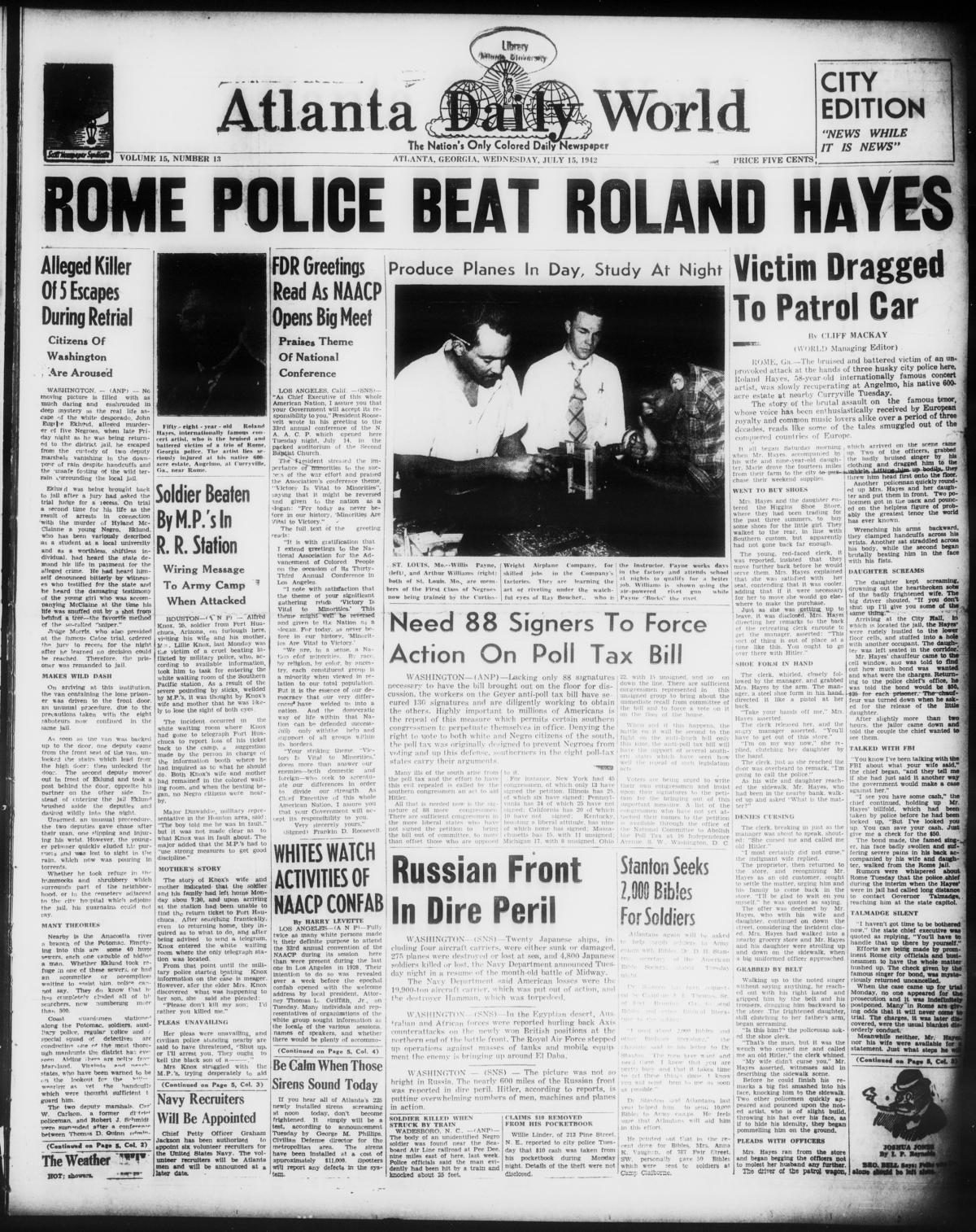
The Atlanta Daily World ran it across the top of page one: “ROME POLICE BEAT ROLAND HAYES.”
The Evening Star, in Washington, ran the Associated Press account on page eight: “Roland Hayes Charges He Was Beaten, Jailed By Georgia Police.”
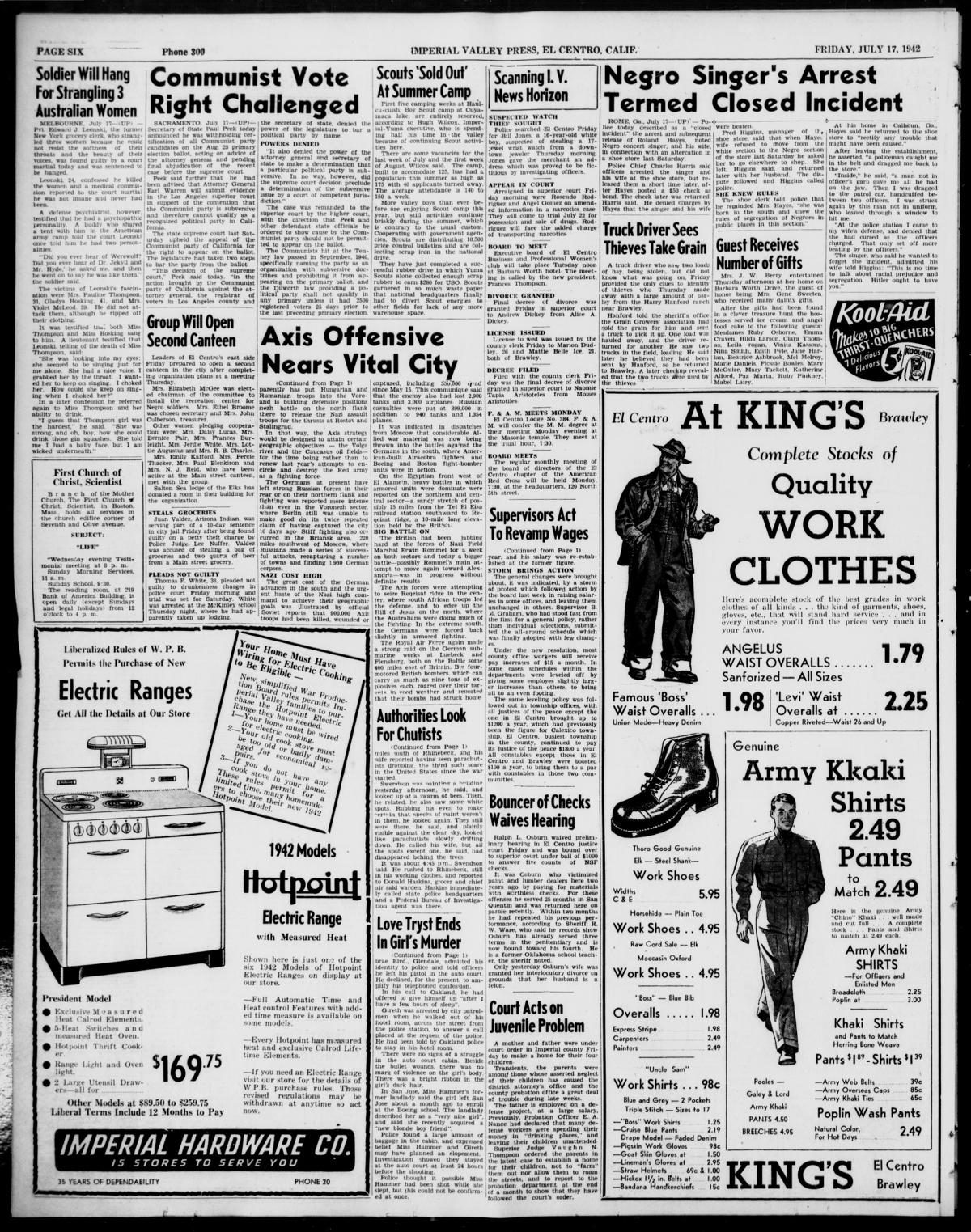
The Imperial Valley Press, in El Centro, California, ran the United Press account on page six: “Negro Singer’s Arrest Termed Closed Incident.”
Same event. Same week.
The same day, two wires
The Evening Star’s story and the Imperial Valley’s ran on the same day, July 17 — one from the Associated Press, one from the United Press. Under their different headlines, both carried the same two accounts.
Both printed Hayes’s version. He had gone back to the store, he said, and “a policeman caught me in the belt and dragged me back to the store”; inside, “a man not in officer’s garb gave me all he had on the jaw.” And both printed the police chief’s denial: Charles Harris insisted the Hayeses had not been beaten, and the police called the arrest a “closed incident.”
Over the California story the copy desk set a second line, in capitals: SHE KNEW RULES. It belonged to the store. The clerk, the paper reported, had reminded Mrs. Hayes that “she was born in the south and knew the rules of segregation of Negroes in public places in this section.” What Mrs. Hayes had said, by the same account, was different. Told to move as the country fought a war against Hitler, she had answered: “This is no time to talk about racial prejudice and segregation. Hitler ought to have you.”
In none of the white papers is the beating stated as a fact. It is always something Hayes charges, or “he asserted,” or, as the Massachusetts paper put it, “the singer beaten up, he says.” The store’s account of his wife ran as a headline.
The strangest of them ran it on page one
That Massachusetts paper is worth stopping on, because it did what the big dailies would not: it put the beating on its front page. The Springfield Weekly Republican carried it on page one — in its editorial column. It called episodes like this one “minor incidents,” and it objected to this one for a particular reason: “the mere revelation of such actions replenishes the ammunition of the axis.”
The Springfield paper ran it on page one when larger papers ran it inside, and there is no reason to doubt its discomfort was genuine. But the problem it named was not the beating. It was the enemy hearing of the beating.
A calendar
Set the coverage against the dates.
The beating happened on Saturday, July 11 — “last Saturday,” in the papers of that week. On July 15 the Atlanta Daily World — “The Nation’s Only Colored Daily Newspaper,” published in Atlanta — carried it across the top of page one under the byline of its managing editor, Cliff Mackay. Mackay described the tenor as “the bruised and battered victim of an unprovoked attack at the hands of three husky city police.” His account also reported that when the case came up for trial the following Monday, “no one appeared for the prosecution and it was indefinitely postponed.”
On July 19 the World gave the case a second page-one banner: “URGE FBI TO PROBE HAYES’ CASE.” The National Association for the Advancement of Colored People, meeting in Los Angeles, had wired the Attorney General.
On July 24 the governor answered. The Associated Press carried his statement into the Evening Star, onto the same page eight that had run the beating a week before, under the headline “Talmadge Cites Roland Hayes Row.” Talmadge, the story reported, had advised Negroes who did not like the state’s segregation laws “to stay out of Georgia,” and had added that “outside influences know nothing about the traditions and conditions here and should not interfere with the friendship between the two races of long years’ standing.”
The Black press had put the beating on page one; the governor had answered; and the white press had reported the answer. The order of those events is on the calendar. What connects them is left to the reader.
The chief and the bureau
There is one more thing in Mackay’s July 15 account. He reported that while the Hayeses were still jailed, the chief spoke to Roland Hayes about the Federal Bureau of Investigation.
“You know I’ve been talking with the FBI about what your wife said,” the chief said, in the World’s telling, “and they tell me if she had just said it in another way the government would make a case against her.”
Four days later, the NAACP asked the same bureau to make a case against the police.
The column that misremembered
Five months later a columnist looked back on all of it and got one thing wrong.
In late November and early December 1942 a syndicated column ran in several Black weeklies, among them the Dayton Forum. It argued that the Negro press had become a necessity because the white press ignored Black life, and it offered the Hayes beating as its proof: “the white newspapers did not give prominence to this news, and most of them completely ignored it.”
The second half of that is not true, and this account has just shown why. The beating ran on the front page of a Massachusetts weekly and filled a column of Washington’s paper of record. It was not ignored.
But the column was not being careless; it was looking back across five months. And what lasts across five months is not a page-eight story that ran on a Friday in July and was gone by Monday — it is the silence around it: the trial no one came to, the governor telling people to leave the state. By December a reader could look back and remember that no one had seemed to care, because the papers that had carried the story had not carried it as though they did.
Afterward
What became of the case is not in the record we can reach. The NAACP’s telegram to the Attorney General is there, on the front page of the Atlanta Daily World for July 19. What came after it — an investigation, a charge, a hearing — is not. No Rome policeman is recorded as having answered for the beating of Roland Hayes, and the trial that was postponed in July does not appear to have been held.
What the record does show is that Roland Hayes went on. His name keeps appearing in the newspapers of 1942 and 1943 as it had before, and by every account of his life he sang for decades more, until his death in 1977. In the summer of 1942 he had also been dragged from a shoe store in the state where he was born and beaten in a cell, and the newspapers of his own country had told it, and had not agreed on what it was.
The front pages of the Atlanta Daily World (July 15, 1942) and the Imperial Valley Press (July 17, 1942) are shown above; both, along with the Evening Star*, the* Springfield Weekly Republican*, and the* Dayton Forum*, are in the public domain and digitized in the Library of Congress’s Chronicling America collection. The scans shown here are self-hosted; the links point to the originals. The account of Roland Hayes’s life — the first African-American man to win international fame as a concert artist, the son of a formerly enslaved woman, his 1921 command performance for King George V, his death in 1977 — is drawn from the New Georgia Encyclopedia and standard reference works; the six-hundred-acre estate and the local details of the incident are from the* Atlanta Daily World account. He was fifty-five at the time of the beating, though the Atlanta Daily World gave his age as “58-year-old.” The date, July 11, is the “last Saturday” named in the wire stories of that week. The beating itself is Hayes’s account: every paper attributed it to him (“charges,” “he says,” “he asserted”), and the Rome police denied it. The Atlanta Daily World reported three city police; in the wire accounts Hayes described a policeman who dragged him and a man not in uniform who struck him. The opening follows the Atlanta Daily World*. Governor Talmadge’s statements quoted here are from the Evening Star of July 24. The syndicated December column was unsigned in the copies examined and is quoted here as a Black-press column of the period. That no investigation, charge, or trial followed is the silence of the reachable record — a search of Chronicling America for the months after the beating turns up his name often but no such outcome — not a proof that none occurred. Period racial language is quoted from the sources and never adopted.*
“She Knew Rules,” Atlanta Daily World, July 15, 1942, p. 1. Library of Congress, Chronicling America. loc.gov/resource/sn82015425/1942-07-15/ed-1/?sp=1