Not a Race Riot
In August 1943, a white patrolman shot a Black soldier in Harlem. Everyone agreed on what to call what followed — and no two of them meant the same thing by it.
View the original at the Library of Congress →
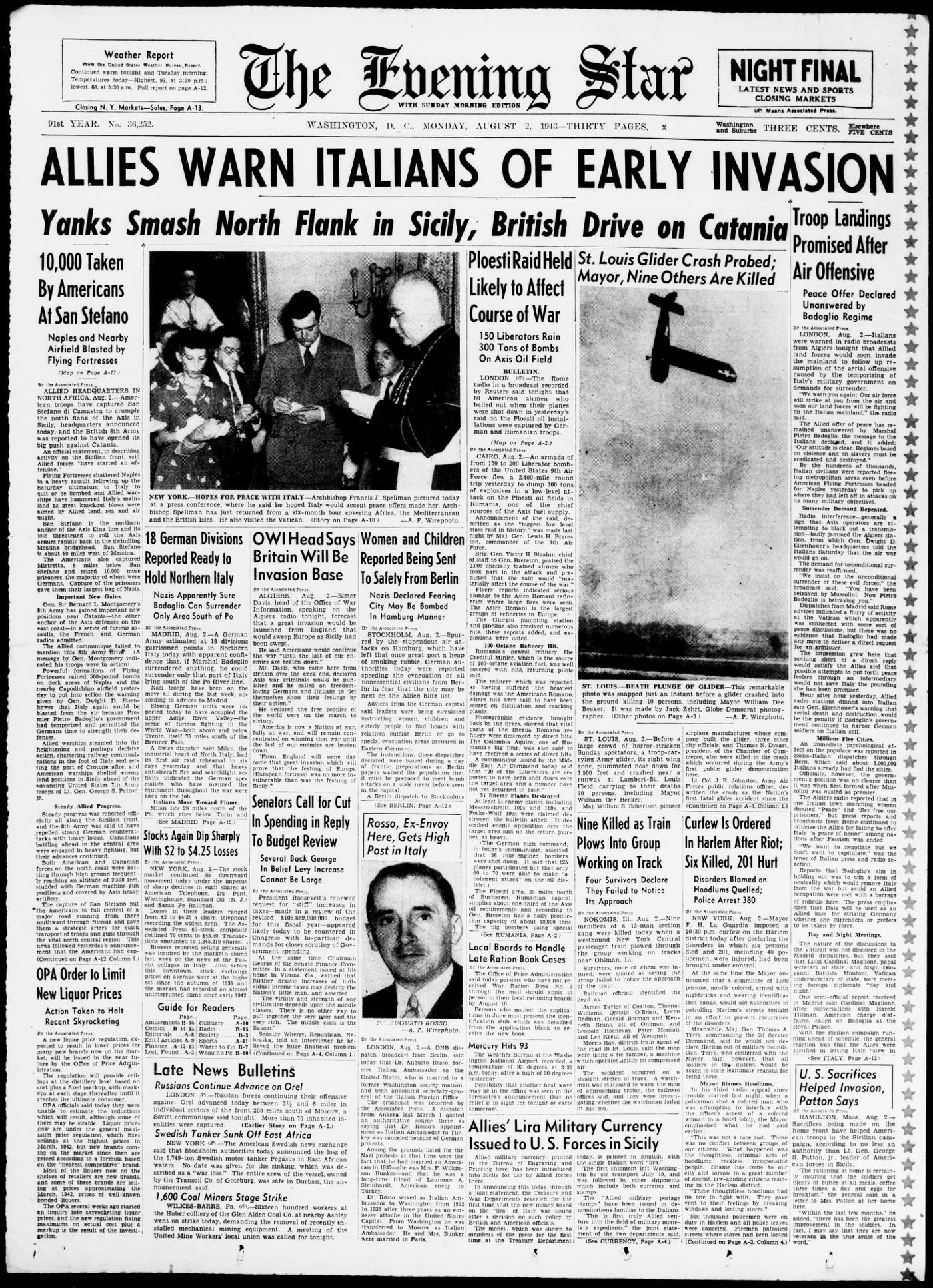
On Monday, August 2, 1943, the front page of the Evening Star in Washington told its readers that Harlem had been brought back under control. The headline named the trouble and named the cause: “Curfew Is Ordered In Harlem After Riot; Six Killed, 201 Hurt — Disorders Blamed on Hoodlums Quelled; Police Arrest 380.”
Mayor Fiorello La Guardia, the paper reported, “imposed a 10:30 p.m. curfew on the Harlem district today after declaring the disorders in which six persons died and 201, including 40 policemen, were injured, had been brought under control.” The story was one of quelled disorder: a curfew, a body count, 380 arrests, and hoodlums.
One thing was missing from the front page. The riot had a spark, and the spark was a man with a badge shooting a man in a uniform.
The gun the front page left out
Harlem’s Black newspapers — and, further down its own inside pages, the mainstream press too — began the story where it actually began. On the night of Sunday, August 1, a white patrolman named James Collins tried to arrest a Black woman in the Braddock Hotel. A Black soldier, Private Robert Bandy, intervened. Collins shot him in the shoulder.
The Detroit Michigan Chronicle put it on its front page under a banner that was the whole argument in four words — “WE Are Americans Too” — over the headline “FIGHT BEGINS WHEN N.Y. COP SHOOTS MP.” The Chronicle traced it to the source: “Harlem’s worst dist[urbance] in history began when a white policeman shot a soldier, Robert Bandy, in the shoulder in Braddock hotel.”
The mainstream press had the same fact, and it is instructive to watch which papers said it plainly and which did not. The Evening Star — the paper whose front page led with the curfew and the hoodlums — carried the spark inside, on page 2, and softened it as it went: “Precipitating the disorder, police said, was an altercation between Patrolman James Collins and Pvt. Robert Bandy.” An altercation, police said. The shot is gone; the gun is gone; a white officer firing on a Black soldier has become a two-sided scuffle attributed to the police account. Other mainstream papers were blunter. The Detroit Evening Times and the Washington Daily News both printed that Collins “drew his revolver and shot Bandy in the shoulder.” The fact was the same everywhere. The willingness to name it was not.
Bandy was wounded, not killed. But the rumor that ran through Harlem that night said a white policeman had killed a Black soldier — and it was that rumor, in a district that had spent the war reading its own sons’ names in casualty lists while reading “no vacancy” on the door of the war plant, that emptied into the streets. What burned in Harlem was not a battle between white and Black residents. It was Harlem, against the fact of a white officer’s gun.
Which is what made the phrase everyone reached for so strange.
Everyone agreed it was “not a race riot”
Here is the peculiar thing about the coverage. The mayor said it was not a race riot. The mainstream dailies said it was not a race riot. And the Black press said it was not a race riot. On the surface, a rare consensus. Underneath, two flatly opposed meanings — and the gap between them is the entire story.
La Guardia said it first, in a radio appeal the papers quoted at length. “This was not a race riot,” he told the city. “There was no conflict between groups of our citizens. What happened was the thoughtless, criminal acts of hoodlums, reckless, irresponsible people. Shame has come to our city and sorrow to a great number of decent, law-abiding citizens residing in the Harlem district.”
Read what that sentence does. “No conflict between groups of our citizens” is true — Harlem was not white-versus-Black. But the mayor uses that truth to arrive at hoodlums: if it was not a race riot, then it was not about race at all, and if it was not about race, then it was simply crime, simply looting, simply the “thoughtless” acts of the reckless. The absence of a white mob becomes the absence of a reason.
The Chronicle used the identical phrase to mean the opposite. “Both Negro and white leaders were of the opinion that the outbreak was not of a racial nature,” it reported — and then kept the gun on the page. In the Black press, “not a race riot” did not mean “not about race.” It meant: this was not two mobs of citizens fighting each other; this was a community responding to what a white officer’s gun represented. Not a riot between races, but a rebellion with a cause — the cause being everything the banner “WE Are Americans Too” was protesting.
Same six words. One paper used them to close the question. The other used them to open it.
The editorial that argued for silence
If the news columns implied a position, one paper’s editorial page stated it outright. On Tuesday, August 3, the Evening Star’s leader — the institutional voice of the paper, over no byline — took up the phrase and turned it into an argument about what should and should not be discussed.
“Mayor La Guardia was correct in maintaining that the Harlem outbreak ‘was not a race riot,’” the editorial began. “A number of Negro leaders in New York who helped restore order by public appeals to their people have taken the same view. The fact is worth emphasizing, for the simple reason that too much stress has been placed lately on racial tension, and the possibility of racial outbreaks, adding by the power of suggestion to dangers which are always present in hot, crowded cities, where any minor disturbance can be spread by gangs of looting hoodlums.”
That is not a report. It is a thesis: that naming racial tension helps cause it — “by the power of suggestion.” The paper is not merely observing that people called it a riot; it is arguing that they should stop talking about race, because the talk itself is combustible. Discuss the tension and you feed it. Better, the leader implies, to file the whole thing under weather and crime — “hot, crowded cities,” “looting hoodlums” — and let the subject cool.
It is a familiar argument. The claim that discussing racism is what produces it, that the naming is the danger, did not stay in 1943.
The riot kept secret for three days
And then, buried on page 13 of the Evening Star on August 5, five column-inches disclosed the last layer — the one that turns Harlem from a story about a riot into a story about the management of a riot.
“Reports of Sunday’s riot in New York’s Harlem were published for the first time today under large headlines in London newspapers,” the item read. “The news was released for the first time by the United States censor yesterday. Two newspapers featured the line, ‘Riot kept secret three days.’”
The United States censor had withheld the Harlem riot from Britain’s press for three days. An ally’s newspapers were not permitted to print what had happened in an American city until the American censor released it — and when they did, they led with the fact of the suppression itself. A country in the middle of a propaganda war against fascism had decided that a race riot in Harlem was something the world should not be shown, at least not yet.
This is the same logic as the editorial, escalated from persuasion to policy. The leader argued that Americans should not talk about racial tension because the talk was dangerous. The censor decided that the world should not see it. In both cases the reasoning is identical: the problem is not the thing itself but the visibility of the thing. Manage the visibility and you manage the problem.
The body count that would not hold still
There is one more tell, and it runs underneath all the framing. The papers could not agree on how many people had died.
On August 2, the Evening Star’s front page said six dead, 201 hurt. Three days later, on August 5, the same paper’s page 10 reported the rioting had “caused death of 5 and injuries to 261 persons.” The Detroit Evening Times had led with four. The figure moves — four, five, six — while the frame never does: it is “disorders” and “hoodlums” on August 2 and it is “disorders” and “hoodlums” on August 5, no matter how many are counted dead.
The instability is not sloppiness to be corrected. It is what early accounts of a suppressed event look like — a story being assembled in real time, under a censor, by papers working the official channels. The number was the thing nobody was sure of. The meaning was the thing everybody was sure of, before the counting was even done.
Four papers, one word
Lay them side by side and the pattern is clean. A white officer shot a Black soldier, and Harlem answered. Every account agreed to call it “not a race riot” — and used that agreement to travel in opposite directions. For the mayor and the mainstream, the phrase led to hoodlums: no race, no reason, only crime, and the accompanying instruction to stop discussing racial tension lest the discussion inflame it. For the Black press, the same phrase led to WE Are Americans Too: not a clash between citizens, but a rebellion with a cause the country was refusing to name. And around all of it, the machinery of wartime visibility — an editorial arguing for silence, a censor enforcing it — worked to decide not what Harlem was, but what Harlem would be allowed to mean.
There was one Sunday night in Harlem in August 1943. In the newspapers there were several, and the distance between them is not a disagreement about facts. It is a disagreement about whether the facts were permitted to have a cause.
The pages of the Evening Star, the Michigan Chronicle, the Atlanta Daily World, the Detroit Evening Times, and the Washington Daily News are in the public domain via the Library of Congress and are shown or linked above. Because Harlem’s own newspapers — the Amsterdam News and Adam Clayton Powell’s People’s Voice — are not among the titles digitized in Chronicling America, this account reads the event through the national and regional press: New York’s mainstream coverage as carried by the Evening Star, against the Black press as it reached readers in Detroit, Atlanta, and beyond. Casualty figures are reported as each paper printed them; the papers disagreed, and the disagreement is part of the record.
“Not a Race Riot,” The Evening Star, August 2, 1943, p. 1. Library of Congress, Chronicling America. loc.gov/resource/sn83045462/1943-08-02/ed-1/?sp=1