An Exceptionally Opportune Time
For two and a half years the Kennewick Courier-Reporter covered the largest construction project in Washington State without being able to say what it was. On August 9, 1945, it found out — along with everyone else, and on the same day.
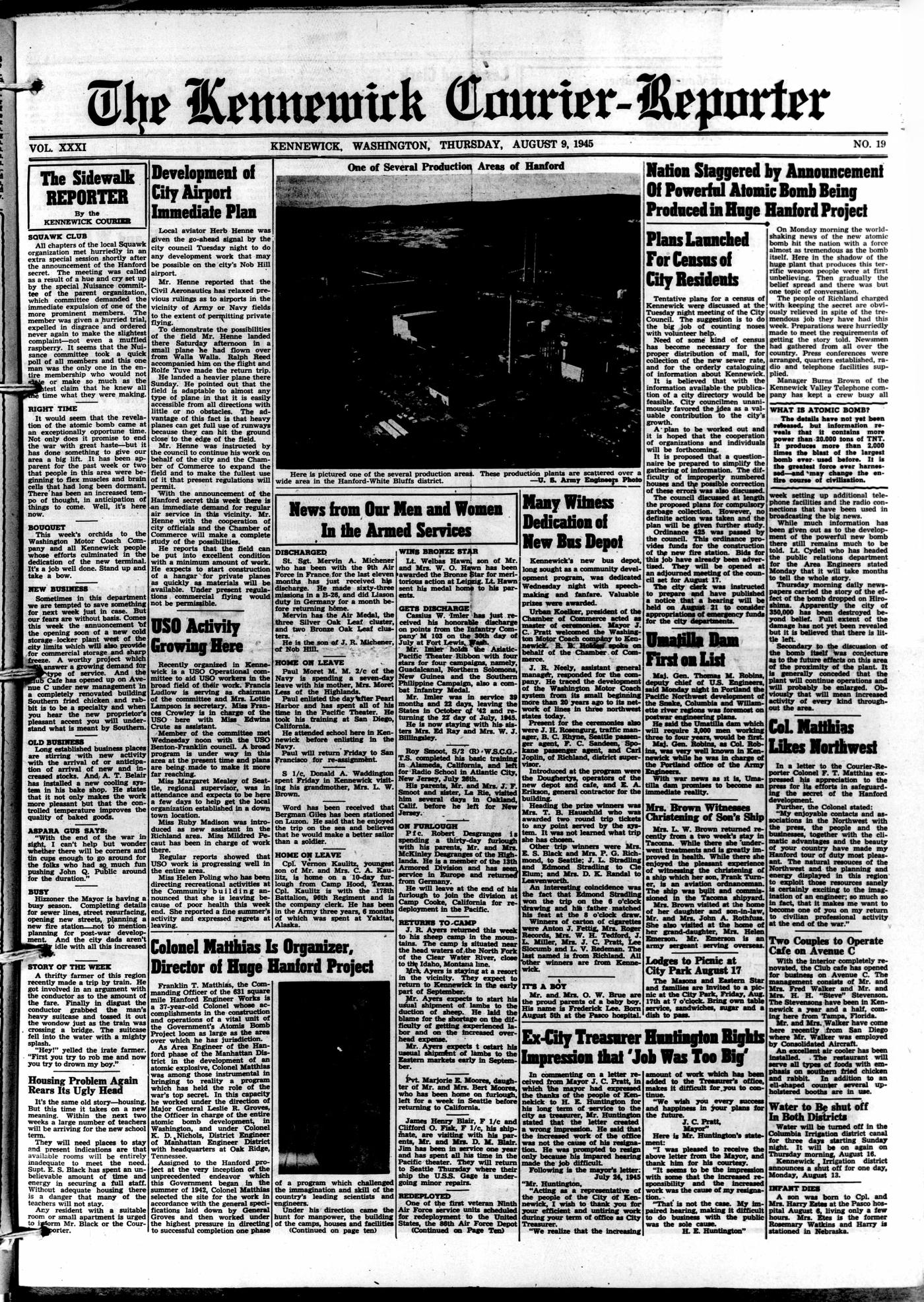
View the original at the Library of Congress →
On May 27, 1943, the front page of the Kennewick Courier-Reporter, a weekly in the Washington desert, told a few hundred of its neighbors to be gone in four days.
“White Bluffs Residents Must Leave by May 31,” the headline read. The story explained: “The entire community, consisting of 193,833 acres, condemned by the federal government, for war purposes, must of necessity be vacated by all local residents by May 31. Many families have made their home for years going as far back as 1893.”
Fifty years on that land, and four days to go. For war purposes.
That phrase — war purposes — is the whole story. Read the Courier-Reporter through 1943 and you will find it, or its cousin government project, in nearly every account of the largest construction undertaking in the history of the state. What you will not find is a noun. Something enormous was happening thirty miles up the Columbia, and the paper covered it faithfully, week after week, without ever once being able to say what it was.
Reporting a hole
The paper reported the taking as it happened, in pieces, the way a small weekly reports anything.
In April: “The community hall in Hanford where grange meetings were held was taken over with little or no notice, owing to the immediate utilization of the building by the federal government.” A grange hall, gone between meetings.
In May, on page one, the courts: with property being taken as sites for government projects, Federal Judge Lewis B. Schwellenbach demanded from government attorneys an explanation of why appraisal reports are being delayed. People had been ordered off their land and were waiting to be told what it had been worth.
By autumn the arithmetic reached the county budget. Benton County’s revenue was down, the commissioners reported, because roughly eight hundred thousand dollars in valuation had come off the tax rolls in the north end the government had taken over. Meanwhile the jail needed enlarging — the court had ordered it — “since the new people came in.” More deputies. A bigger prosecutor’s office. The trailer camps were full.
The new people. Not workers on a named project; the new people. Tens of thousands of them, and no explanation of why they were there.
And in August, this, on page one: “175 Evacuees Attend Picnic at Prosser Park.” The evacuated residents of White Bluffs and Hanford, holding a reunion in a park in another county, because the towns they would have held it in no longer existed.
The same page carried the school vote. Vernita, White Bluffs, Hanford, and Richland were being folded into a single new district — “Richland School District No. 400 … which carried by the narrow margin of one vote.” The tally: “A total of 65 votes was cast … proposition No. 1 … carried 32-31.”
Sixty-five votes, to consolidate four school districts, two of whose towns had been erased that spring. Thirty-two to thirty-one.
What was actually there
Here is what the Courier-Reporter could not tell its readers, because it did not know, and could not have known.
The federal record — the Army’s own Manhattan District History, declassified and published by the Department of Energy, and Henry Smyth’s official 1945 report, which the government had written expressly to be reproduced — says what the ground was for. The site was the Hanford Engineer Works. Its business was plutonium: bred in a line of reactors along the Columbia, purified in canyons of concrete, and shipped out. Roughly six hundred square miles — on the order of four hundred and twenty-eight thousand acres — were taken in early 1943. Around fifteen hundred people were removed from it, along with land and fishing sites belonging to the Wanapum and other tribes. The construction workforce peaked near forty-five thousand. The government’s own town, Richland, grew to about seventeen thousand.
The B Reactor went critical on September 26, 1944 — about thirteen months after the picnic at Prosser Park.
Groves knew exactly what he was doing to the Courier-Reporter, and said so, in the foreword to the report he published the week the secret broke: “Obviously military security prevents this story from being told in full at this time.”
That is the arrangement. The paper printed the evictions, the appraisals, the jail, the tax roll, the picnic, the one-vote merger — every visible consequence, accurately. The cause was classified. It reported the crater and not the meteor, for two and a half years, and it did it well.
Thursday, August 9, 1945
Then the noun arrived.
The banner ran the width of the front page: “Nation Staggered by Announcement Of Powerful Atomic Bomb Being Produced in Huge Hanford Project.” Beside it, a U.S. Army Engineers photograph, captioned One of Several Production Areas of Hanford — a picture of the place next door, released at last by the people who had taken it.
The paper explained the thing to itself in a box on page one, in the tone of a man reading a press release he has just been handed. The details had not yet been released, it said, but the bomb contained more power than twenty thousand tons of TNT — more than two thousand times the blast of the largest bomb ever used before — the greatest force ever harnessed, and it “may change the entire course of civilization.”
And it finally had a name for the man in charge. Franklin T. Matthias, “the Commanding Officer of the 631 square mile Hanford Engineer Works,” who as “Area Engineer of the Hanford phase of the Manhattan District in the development of an atomic explosive” had worked under Major General Leslie R. Groves and Colonel K. D. Nichols, “District Engineer of Manhattan Engineer District with headquarters at Oak Ridge, Tennessee.”
Oak Ridge, Tennessee. The Courier-Reporter’s readers learned, on August 9, 1945, that their valley had been one end of something that had another end in Tennessee.
Elsewhere on that same front page, the town got back to business: “Plans Launched For Census of City Residents.” And, inevitably: “Housing Problem Again Rears Its Ugly Head."
"An exceptionally opportune time”
The paper’s columnist, in “The Sidewalk Reporter,” wrote the sentence this story is named for. Under the sub-head RIGHT TIME:
“It would seem that the revelation of the atomic bomb came at an exceptionally opportune time. Not only does it promise to end the war with great haste—but it has done something to give our area a big lift.”
The Courier-Reporter was a booster paper and had never pretended otherwise. It ran a column handing out orchids to deserving locals. It cared about the payroll, the housing, the census, the future of the Tri-Cities. And what it had just been told was that the hole punched through its county — the evictions, the grange hall, the vanished tax base, the two towns that now existed only as a hundred and seventy-five people eating lunch in a park in Prosser — had a reason. Not just a reason: the reason. The thing that was going to end the war. And it was theirs.
A big lift.
That issue is dated Thursday, August 9, 1945. It was written in response to the announcement of three days earlier, when the first bomb fell on Hiroshima and Washington finally named the project.
The bomb that staggered the nation on August 6 was not Hanford’s. That one ran on uranium, from Oak Ridge — the other end of the thing.
Hanford’s plutonium was used on August 9, over Nagasaki. The day of the issue.
What the paper was built to see
It would be easy, and cheap, to read that editorial as a small town’s moral failure. It wasn’t. Nobody in Kennewick was celebrating Nagasaki; the Courier-Reporter did not know about Nagasaki, and did not know that the reactors up the river had made what fell on it. Nobody had told them anything for two and a half years, and then everybody told them everything at once, and what they felt in that first hour was relief and pride — that the war was ending, that their neighbors’ evictions had bought something, that the desert they lived in had turned out to matter.
That is what the paper was built to see. It was built to see the payroll and the housing and the census, and to find the silver lining, and when the silver lining turned out to be the most consequential weapon ever built, it reported the lining. It had no other equipment. What it lacked was not decency. It was information — and the withholding of that information was a federal policy, executed on purpose, by men whose names it was finally permitted to print on August 9.
Two and a half years of war purposes, and then a noun, and the noun was already falling.
The consequences had been on the front page the whole time. The cause arrived last.
The pages of the Kennewick Courier-Reporter are in the public domain via the Library of Congress and are shown or linked above. This is a single-newspaper account: the comparison here is between one small weekly and the federal record, not between newspapers. What the site produced, when its reactors began operating, the acreage and population removed, and the use of Hanford plutonium at Nagasaki are taken from the federal record — the Army’s Manhattan District History and related U.S. Department of Energy material, which are U.S. government works in the public domain, and H. D. Smyth’s Atomic Energy for Military Purposes (1945), which carries a 1945 copyright in Smyth’s name together with an express grant that “reproduction in whole or in part authorized and permitted.” Those facts are never attributed to the newspaper, which could not know them. Where the paper printed its own figures — “193,833 acres” in May 1943, the “631 square mile Hanford Engineer Works” in August 1945 — they are given as the paper’s contemporaneous and partial numbers. The “What Is Atomic Bomb?” passage is transcribed from the page image, its machine-read text being unreliable.
“An Exceptionally Opportune Time,” The Kennewick Courier-Reporter, August 9, 1945, p. 1. Library of Congress, Chronicling America. loc.gov/resource/sn87093044/1945-08-09/ed-1/?sp=1