The Paper Turned to Face the Police
In June 1943, as Detroit counted its dead, the city's Black weekly did not lead with the mob. It led with the men in uniform.
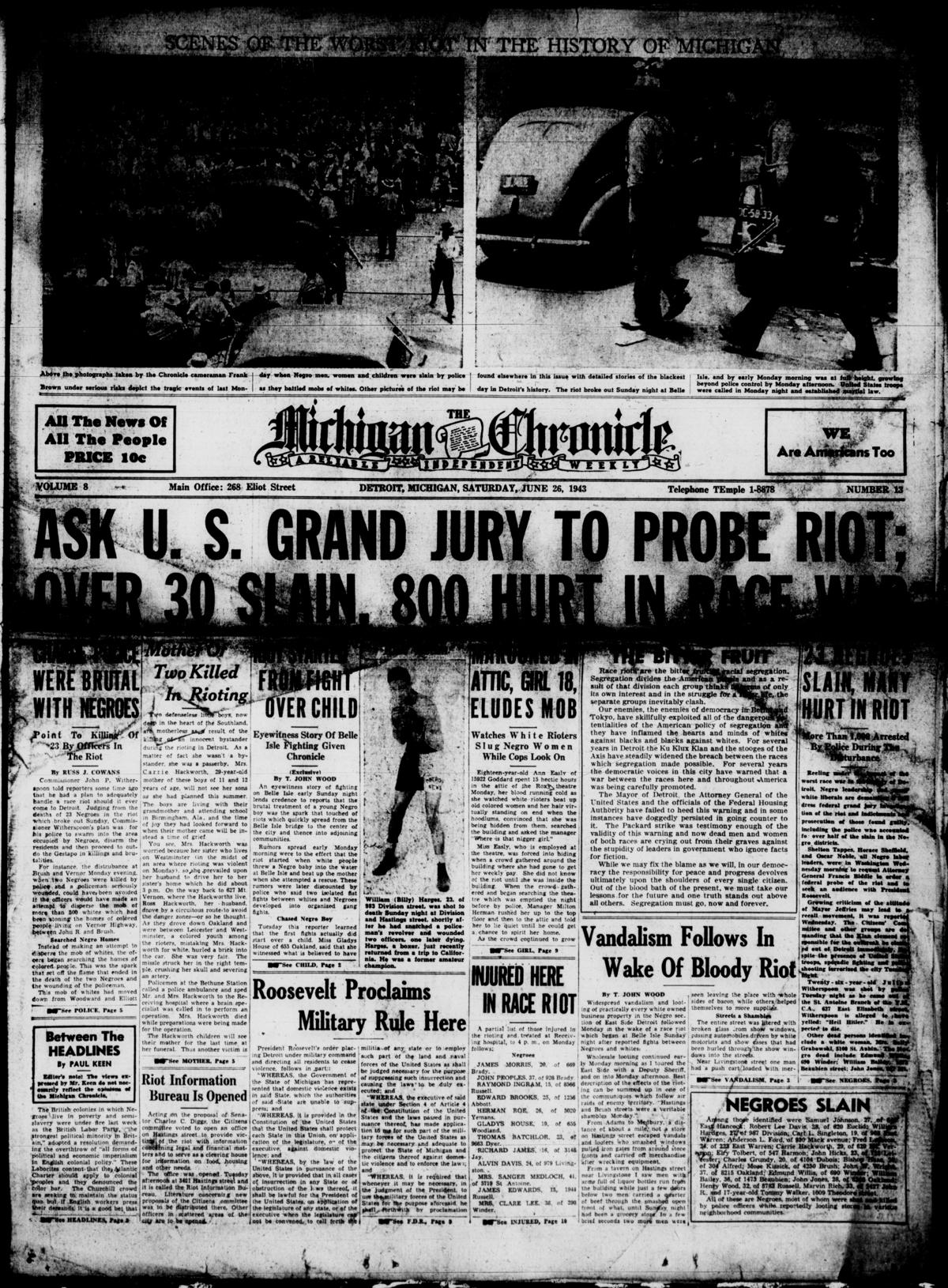
View the original at the Library of Congress →
It is Sunday evening, June 20, 1943, and the heat has pushed much of Detroit onto Belle Isle. On the bridge back to the city, fights break out — Black and white Detroiters packed shoulder to shoulder in a war-boom town that has grown faster than it can house, police, or cool itself. The fighting follows the crowds ashore. Rumor does the rest. For three days, the arsenal of democracy is at war with itself.
When it ends, thirty-four people are dead. Twenty-five of them are Black.
What the riot was, that week, depended on which front page you read. Same city, same seventy-two hours, three papers. Two read like war bulletins. One reads like an indictment.
The bulletins
On Tuesday, June 22, the Detroit Evening Times banners the toll across page one: “10 KILLED, 261 INJURED, 434 JAILED IN RIOTS.” The numbers are a press-time snapshot — the dead alone will more than triple — but the more telling choice is what gets the lead column. It is not the riot. It is the coal strike: “530,000 Idle — Await Action by Roosevelt.” In Detroit’s own mass-market daily, a racial explosion killing Detroiters by the dozen shares the front page with John L. Lewis, and Lewis gets the narrative.
Twenty miles up the lake that same day, the Mount Clemens Daily Monitor-Leader prints the wire-service verdict: “DETROIT RACE RIOT ENDS WITH 23 DEAD” — set directly beneath “Americans Bomb Ruhr; RAF Blasts Krefeld.” Read the layout the way a subscriber did: the riot is one more war-week casualty line, counted and concluded, filed between the bombing runs. Ends with. Tidy, terminal, next item.
Neither paper is lying. Both are choosing what the story is. On the third front page, the choice looks different — because it is being made from inside.
The indictment
The Michigan Chronicle is a weekly, written and read in Black Detroit. By the time it goes to press on Saturday, June 26, it has had the week to watch the city burn and to count its own dead — and it does not lead with the mob. It leads with the police:
“Commissioner John P. Witherspoon told reporters some time ago that he had a plan to adequately handle a race riot should it ever come to Detroit. Judging from the deaths of 23 Negroes in the riot which broke out Sunday, Commissioner Witherspoon’s plan was for his police to swarm into the area occupied by Negroes, disarm the residents, and then out-do the Gestapo in killings and brutalities.”
The reporter, Russ J. Cowans, does not leave the charge abstract. He names an intersection. At Brush and Vernor, the paper reports, a mob of more than five hundred white rioters had been stoning the homes of Black families along Vernor Highway — and the police who came did not disperse the mob. They “began searching the homes of colored people” instead. Two Black men died there. “This,” the Chronicle writes, “was the spark that set off the flame.”
The phone call
Page 2 of the same issue carries the week’s most chilling artifact: a telephone call to the newsroom, printed in the first person.
“That the Klan was the instigator of the trouble was made evident Monday afternoon when someone called the office of the Michigan Chronicle. The voice said: ‘Is this the Michigan Chronicle?’ When I told him it was, he said, ‘Well, we had plenty of trouble today, and this is not the last of it. This is the Klan calling just to give you a warning that we will drive every [racial slur] out of Detroit.’”
The slur is the caller’s own word, printed by the paper as evidence; it is bracketed here. The same story reports Walter White, executive secretary of the NAACP, already en route from New York, and traces the fuse back through the Sojourner Truth housing project — where, sixteen months earlier, white crowds had fought to keep Black war workers out of homes built for them.
What the fix looked like
Deeper in the same issue, the Chronicle prints what repair would look like — and it comes from organized labor. R. J. Thomas, president of the United Automobile Workers, the union at the center of Detroit’s war industry, is quoted demanding “immediate and effective community action.” The paper reports the rest as his program: a special grand jury, with a competent Negro attorney appointed as an assistant prosecutor; recreation facilities; and rehousing for the “Negro slum dwellers” the war boom had packed into Paradise Valley. It is no surprise, the Chronicle reports him arguing, that the riot started at Belle Isle Park. In June 1943, a labor leader is arguing in a Black newspaper that the riot is a policy failure — policing, parks, housing — and not a mystery.
The wounded outrun the war
Detroit’s second Black weekly, the Tribune, closes the week with a photo page from Receiving Hospital, and one caption catches the collision in a sentence: “Blood-covered victims began swarming into Receiving Hospital from the time the race riots broke out at Belle Isle bridge Sunday evening… Examinations for potential draftees were cancelled because all doctors were busy administering to the injured, which totaled well over 600.” The army’s paperwork stopped so the doctors could treat the riot’s wounded. In the arsenal of democracy, the war had to wait its turn.
The mainstream pages were not wrong about the numbers; they were answering a smaller question. How many is a count. Who killed them, and why was no one protecting them is a story — and in June 1943 it ran in exactly one kind of paper. That is still the difference between counting a tragedy and explaining one.
Sources
All pages from the Library of Congress, Chronicling America Digital Newspaper Archive:
- “[Police] Were Brutal With Negroes,” The Michigan Chronicle, June 26, 1943, p. 1 — loc.gov/resource/sn83045324/1943-06-26/ed-1/?sp=1
- Klan threat call reported by Russ J. Cowans, The Michigan Chronicle, June 26, 1943, p. 2 — loc.gov/resource/sn83045324/1943-06-26/ed-1/?sp=2
- R. J. Thomas statement, The Michigan Chronicle, June 26, 1943, p. 4 — loc.gov/resource/sn83045324/1943-06-26/ed-1/?sp=4
- “10 Killed, 261 Injured, 434 Jailed in Riots,” Detroit Evening Times, June 22, 1943, p. 1 — loc.gov/resource/sn88063294/1943-06-22/ed-1/?sp=1
- “Detroit Race Riot Ends With 23 Dead,” Mount Clemens Daily Monitor-Leader, June 22, 1943, p. 1 — loc.gov/resource/sn96077289/1943-06-22/ed-1/?sp=1
- “Rioters Flout Law and Order in Detroit” (photo page), The Detroit Tribune, June 26, 1943, p. 16 — loc.gov/resource/sn92063852/1943-06-26/ed-1/?sp=16
Death, injury, and arrest totals, and the accounting of deaths at police hands, follow Thurgood Marshall, “The Gestapo in Detroit,” The Crisis, August 1943, and subsequent historical studies of the riot.
Quotations are restored from the original 1940s OCR and checked against the raw scans; figures reflect what each paper printed at press time and are not silently corrected to the modern count. The Chronicle’s page as printed reads “John P. Witherspoon”; the commissioner’s name in the surviving record is John H. Witherspoon.
“The Paper Turned to Face the Police,” The Michigan Chronicle, June 26, 1943, p. 1. Library of Congress, Chronicling America. loc.gov/resource/sn83045324/1943-06-26/ed-1/?sp=1