A Day for Mourning as Well as for Thanksgiving
In November 1942 a New York Yiddish daily printed a column in English on its front page. It said the extermination of the Jews of Europe was underway, and that it had been checked. Elsewhere the same news ran as a letter to the editor.
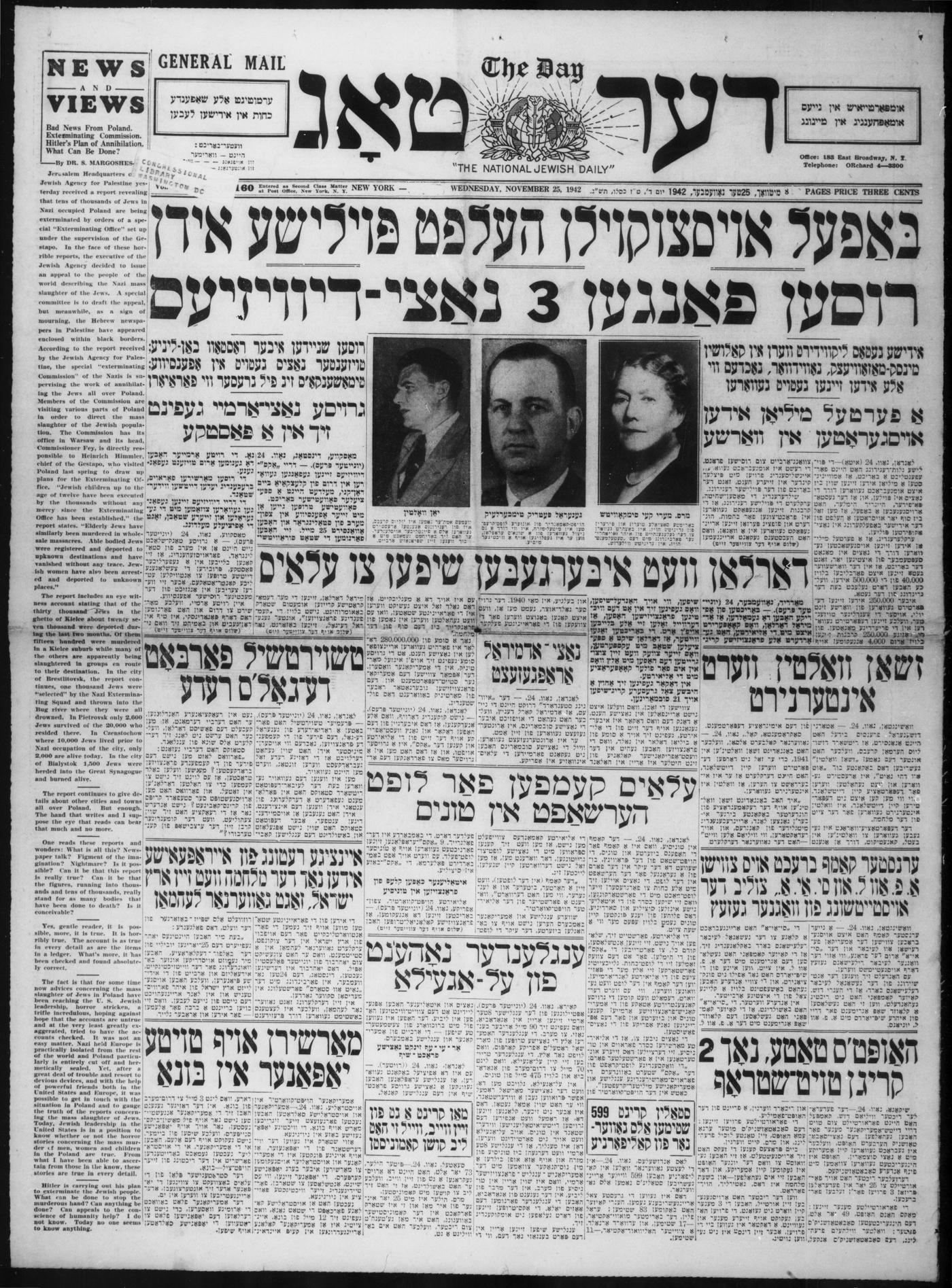
View the original at the Library of Congress →
On Wednesday, November 25, 1942, the front page of Der Tog — a Yiddish daily published at 183 East Broadway in New York, eight pages, three cents — carried its news in Hebrew script, right to left, the way it had every morning for twenty-eight years. And running down the gutter of that page, in English, left to right, was a column.
The column had a byline: Dr. S. Margoshes. It ran under the standing title “News and Views,” and on that morning it ran under this headline: “Bad News From Poland.” Beneath that, three more lines of standfirst, the last of which was a question: “Hitler’s Plan of Annihilation. What Can Be Done?”
The date matters. This was the morning after Rabbi Stephen Wise held the press conference at which the State Department confirmed what had until then been rumor, report, and the kind of thing careful people declined to repeat. So on a Yiddish front page in New York, in English, a named journalist sat down to tell his readers that the extermination of European Jewry was underway — and to tell them how he knew.
”Yes, gentle reader”
What Margoshes printed that morning was not an editorial. It was a report, with an apparatus.
He laid out what the Jewish Agency for Palestine had received: that Jews in occupied Poland were being killed on the orders of a special office established under the Gestapo, that the office had its headquarters in Warsaw, that its head reported directly to Heinrich Himmler. He quoted the report’s own language — that “Jewish children up to the age of twelve have been executed by the thousands” since the office was established. He went city by city. Thirty thousand Jews in the ghetto of Kielce; a thousand in Brest-Litovsk driven into the Bug river and drowned; twenty thousand in Piotrków down to 2,600; ten thousand in Częstochowa down to 2,000; in Białystok, fifteen hundred people herded into the Great Synagogue and burned alive.
And then he stopped, because he could not do it any longer. “The report continues to give details about other cities and towns all over Poland,” he wrote. “But enough. The hand that writes and I suppose the eye that reads can bear that much and no more.”
What follows is the most extraordinary passage on the page, because it is a journalist arguing with his own readers about whether to believe him:
“One reads these reports and wonders: What is all this? Newspaper talk? Figment of the imagination? Nightmare? Is it possible? Can it be that this report is really true? Can it be that the figures, running into thousands and tens of thousands, really stand for as many bodies that have been done to death? Is it conceivable?
Yes, gentle reader, it is possible, more, it is true. It is horribly true. The account is as true in every detail as are the items in a ledger.”
He then explained the verification — that American Jewish leadership had been receiving these reports for some time and had been “horror stricken, a trifle incredulous, hoping against hope that the accounts are untrue,” and had tried to have them checked; that Poland was “entirely cut off and hermetically sealed”; that it had taken “a great deal of trouble and resort to devious devices” and help on both sides of the Atlantic to confirm them. And having confirmed them, he wrote the four sentences that end the column:
“Hitler is carrying out his plan to exterminate the Jewish people. What can be done to stop the murderous hand? Can anything be done? Can appeals to the conscience of humanity help? I do not know. Today no one seems to know anything.”
That was printed in English, on a New York front page, on November 25, 1942.
The next morning was Thanksgiving
Der Tog published again on Thursday. It was Thanksgiving Day, and Margoshes wrote the column a Thanksgiving requires. This is where the story stops being about Europe and becomes a story about America.
“It’s a day for mourning as well as for thanksgiving,” he began. The mourning first: the dead in Poland, in the occupied sections of Russia, everywhere “Hitler’s murderous hand has reached out to kill and maim the remnants of the Jewish people.” Then, in the same column, the thanksgiving — and it is worth reading slowly, because of what it is doing:
“A remnant, a brand saved from the fire, we are secure on this continent. Our rights as citizens are intact. Our position as Jews has remained inviolate. Alone among the great Jewish communities of the world we continue in our ways with little disturbance. Our workers, our businessmen, our doctors and lawyers go about their business unhampered. There are no laws separating us from the rest of the population. There are no invidious distinctions made anywhere in the United States between Jew and Gentile. Anti-Semitism, still extant, lurks in the corners, but fears to raise its head in the open.”
Set that beside the year it was written in. 1942 in America meant restricted hotels and restricted neighborhoods, university quotas, covenants written into deeds, employment advertisements that specified Christian. It meant Father Coughlin’s audience. Within seven months of that column, Detroit and Beaumont and Harlem would each produce a race riot. “No invidious distinctions made anywhere in the United States” is not a description of the country. It is a description of what the country looked like from the deck of the only lifeboat still afloat — and gratitude, in that position, is not the same emotion as accuracy. Both things on that page are true at once: the safety was real, and the account of it was a kindness the writer was extending to his own community, and possibly to himself.
That is the home front, in one column. Not what Americans suffered. What they held in their heads while they went to work.
Ten minutes
The following Wednesday, December 2, was fixed as a day of mourning and fasting, and Margoshes’ column that morning is a set of instructions. It tells the reader, occupation by occupation, exactly what to do:
“If you are a worker belonging to one of the so-called Jewish unions, you will stop work for about ten minutes today in commemoration of those of our kith and kin who were murdered by the Nazis in Hitler-occupied Europe… If you are a shopkeeper, you are expected to pull up your shutters and close your store for ten minutes as a sign of grief… If you are a white-collar employee, you may lean back in your seat and ruminate for ten minutes on the fate of European Jewry.”
Ten minutes. A shopkeeper’s shutters. A clerk leaning back in his chair. This is what protest looked like when the thing being protested was happening three thousand miles away and there was, as the column had already admitted, nothing anyone could think of to do about it.
Margoshes knew how small it was, and said so — including about his own community. Through the months and years of Jewish suffering, he wrote, many American Jews had “remained strangely calm and indifferent.” Jewish banquets and parties had gone on while Poland fell. Before American Jews could ask their neighbors to shout, he argued, “we Jews of America must prove to ourselves and the rest as well that we care.”
The next day’s column reported what had happened. Hundreds of thousands fasted. Over five hundred thousand Jewish workers in New York City alone stopped work, “filling the streets around the garment center in a great demonstration.” And then the line that hands this story its test:
“All the Yiddish dailies appeared in black borders and even the New York Times printed an editorial commenting on the Jewish day of sorrows.”
Even the Times. The word is doing something. It is a man measuring his community’s grief by whether the newspapers of the country it lives in noticed.
Where the same news ran everywhere else
So: what did the other papers print?
The honest answer requires a boundary. The New York Times, the Chicago Tribune, and the Washington Post are not among the titles digitized in Chronicling America — so Margoshes’ claim about the Times cannot be checked here, and this account cannot speak for the American press as a whole. What can be examined is the mainstream dailies that are digitized. And they did report it. Not silence — that would be the easy story, and it would be false.
The Waterbury Democrat, a daily in a Connecticut brass town, ran a news story on December 1 reporting that local stores would close at the noon hour — the headline’s own words — “in Protest of Nazi Extermination Drive,” carrying the State Department’s confirmation and Hitler’s order to kill “every Jew under his domination by December 31st.” On December 2 it ran the observance as news. On the same day, on its editorial page, it published a leader about “men who countenance, encourage, and direct such atrocities as those visited on the hapless Jews of Europe,” concluding: “one wonders if we haven’t descended far down the ladder of civilization.” And on the page after that, a paid advertisement, taken out by someone who had bought the space: “IN MEMORY of TWO MILLIONS OF JEWISH MEN, WOMEN and CHILDREN ALREADY MURDERED BY HITLER DECREE and IN PROTEST Against THE DECREE.”
A small Connecticut daily ran an editorial and a paid protest advertisement.
Now the capital. The Evening Star — Washington’s paper of record, nearly nineteen thousand pages that year — carried the extermination of European Jewry on December 5. It ran on page 12, under the standing rubric that begins “Letters to the Editor must bear the name and address of the writer.” It was correspondence. A reader named Claus Halberstaedter had written in:
“The Jews of Europe are doomed to die by the end of the year, 1942. This unbelievable news has been brought to us by authentic sources and has been confirmed by the Department of State.”
He asked that December 13 be made a day of prayer not only for Jews but for everyone, because “the extermination of the European Jews is not only a Jewish tragedy, but a world tragedy.” Directly beneath his letter on the page ran the next one, headed “Joins in Protest Against Wasted Wood.”
In the Marion Progress of Marion, North Carolina, the wire story ran on December 3 — “SAYS NAZI PLANNING EXTERMINATION OF JEWS,” Wise, the State Department, four million — dropped into a column of items that also covered store decorations, free concerts, instruction classes, and air-conditioning. And in the Waterbury Democrat of the same day, the follow-up on the observance — “Special prayer services were held in local synagogues yesterday in observance of the day of mourning” — sits directly above a notice headed “WASTE FAT GOAL SET.” A half billion pounds of waste fat per year was the goal of the conservation division. Urban residents were expected to contribute 4.5 pounds per capita.
Whose news it was
Nobody suppressed this. That is the finding, and it is stranger than suppression.
The difference between Der Tog and the mainstream dailies digitized in Chronicling America is not that one printed it and the others didn’t. It is whose news it was. In Der Tog the annihilation of European Jewry is the banner headline and the front-page column, every single day, for six weeks. In the mainstream papers it is real, it is accurate, it is sometimes even eloquent — and it is someone else’s: a local religious observance, a wire item among the store decorations, a reader’s letter between the Pacific and the wasted wood, a notice above the waste fat.
Margoshes saw it happening in real time. In the same December 3 column where he counted the half-million who stopped work, he delivered his own verdict on the day: it had achieved “only a small part of its purpose.” And of the people he had hoped to reach, he wrote the sentence this whole story turns on:
“And as far as our non-Jewish neighbors and friends are concerned, we have hardly succeeded in ruffling their equanimity.”
Two weeks later, on December 18, Der Tog’s front page carried the joint declaration of the Allied governments at length — “OFFICIAL STATEMENT OF THE UNITED NATIONS” — which stated that the German authorities were carrying into effect Hitler’s intention to exterminate the Jewish people of Europe, that Poland had been made “the principal Nazi slaughter house,” and that of the Jews taken from the ghettos, “None of those taken away are ever heard of again.”
It was said out loud, by the governments, in December 1942. And the country went back to work.
The front page of Der Tog (The Day) and the pages of the Waterbury Democrat, the Marion Progress, and the Evening Star are in the public domain via the Library of Congress and are shown or linked above. All quotations from Der Tog are taken verbatim from the English-language column that ran on its front page; the paper’s Yiddish text is shown here as an image and is not translated. This account examines the mainstream dailies digitized in Chronicling America — a set that does not include the New York Times, the Chicago Tribune, or the Washington Post — and therefore cannot speak to Dr. Margoshes’ claim about the Times, or for the American press as a whole.
“A Day for Mourning as Well as for Thanksgiving,” Der Tog (The Day), November 25, 1942, p. 1. Library of Congress, Chronicling America. loc.gov/resource/sn83045861/1942-11-25/ed-1/?sp=1