Unanimous Save For One
Within hours of Pearl Harbor, American newspapers began describing a calm and united nation. They printed it on the same pages that carried the blackouts, the arrests, and the one member of Congress who voted no and was not allowed to say why.
On the morning of December 9, 1941, the Daily Alaska Empire printed instructions for the children of Juneau.
If the horn sounded at school, they were to put on their wraps at once, leave the building, and go home — “singly and not in groups,” the youngest walked by high-school students assigned as escorts. A “system of horns” would be set up in every school building, controlled from the superintendent’s office. The town had spent the night before in the dark: a blackout signal at 10:40 had “plunged the city into complete darkness until 8:30 a.m.” Two days after Pearl Harbor, Juneau had had, the paper said, “a rapid initiation into total war.”
On the same page, a cartoon counted “13 Shopping Days till Christmas,” and a small notice reported that Mr. and Mrs. H. L. McDonald had “sailed south on the steamer Mount McKinley to spend the holidays” with relatives in Seattle and Spokane.
That is the American home front on one page on one day: a plan for getting children out of school under air attack, and a couple leaving for Christmas. Three days earlier, none of it would have made sense.
The last ordinary Saturday
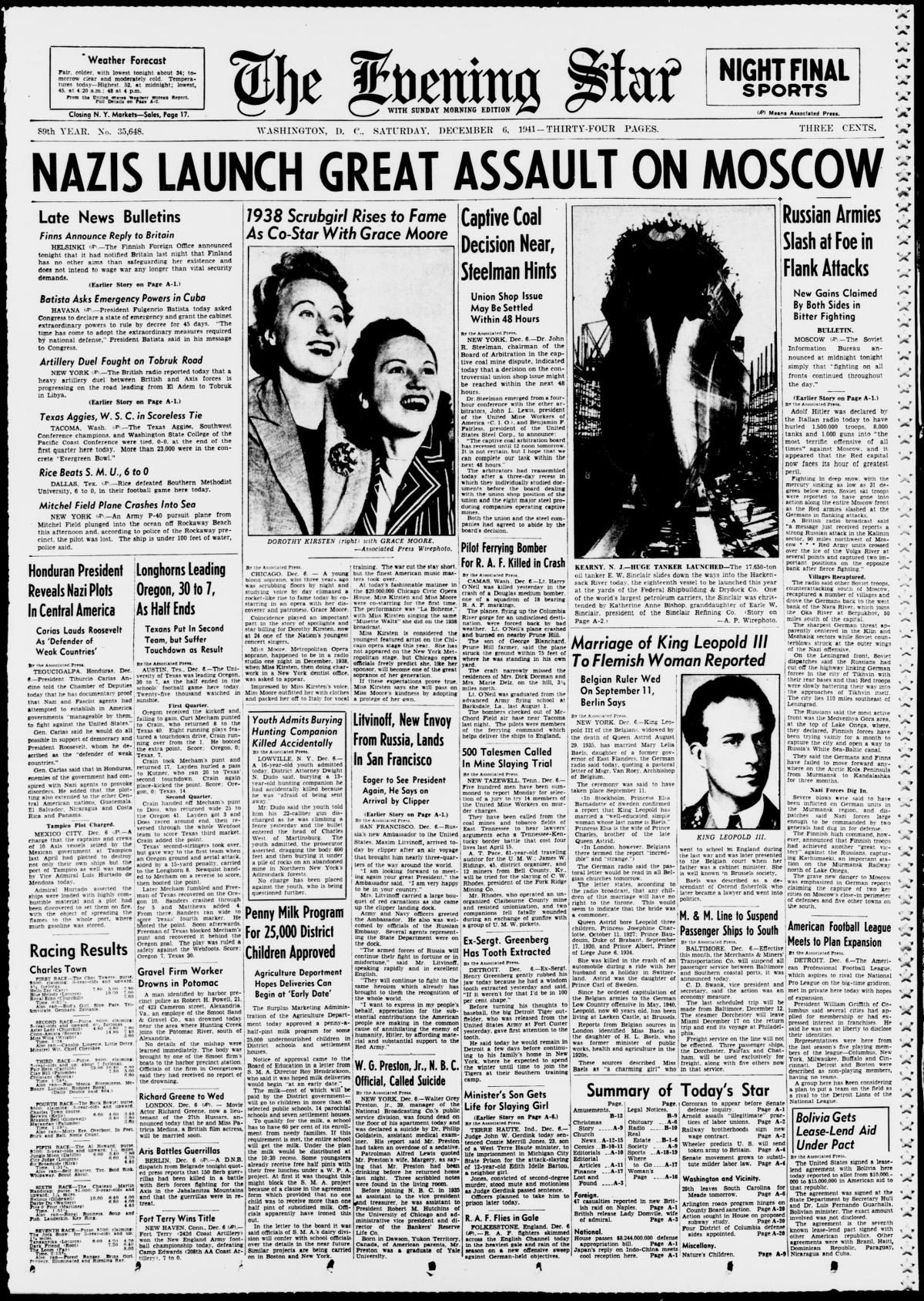
On Saturday, December 6, the capital’s paper of record led with a different war. “NAZIS LAUNCH GREAT ASSAULT ON MOSCOW,” ran the banner across the top of the Evening Star, and beneath it, “Russian Armies Slash at Foe.” The Pacific was on the page only as diplomacy — a cool exchange over Japan and Indo-China, low and inside. The rest was a Saturday: college-football scores, a Christmas story listed in the index, a feature headlined “1938 Scrubgirl Rises to Fame As Co-Star With Grace Moore.” The war belonged to Moscow.
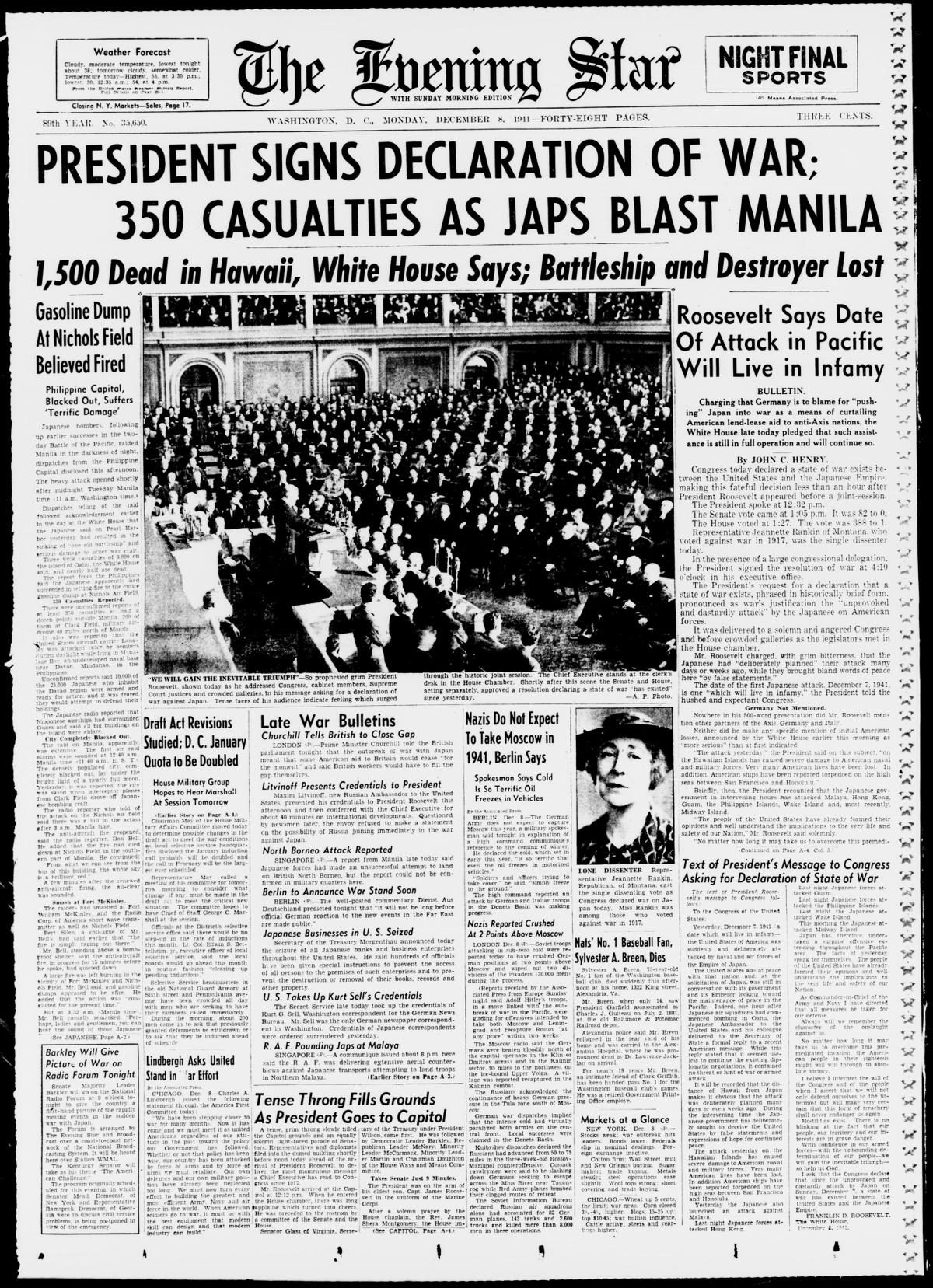
By Monday it belonged to everyone. “PRESIDENT SIGNS DECLARATION OF WAR,” the Evening Star’s banner read on December 8; “1,500 Dead in Hawaii, White House Says.” Forty-eight hours had turned the paper inside out.
The story the papers began to tell
In those hours the newspapers began, very fast, to describe the country to itself. The country they described was calm and of one mind. They described it on the same pages that recorded something else.
Take the vote. The House passed the declaration of war 388 to 1, the Senate 82 to 0. The Detroit Evening Times gave the session a full page of photographs, and under one of them — the President at the rostrum — the caption read that the House and Senate had given him his declaration, “unanimous save for the negative vote of one Congresswoman Jeannette Rankin.”
Unanimous save for one. The exception is inside the sentence.
Two more photographs sat on that page. One showed “The House on its feet (save for Miss Rankin and Michigan’s Clare Hoffman, shown in the circle)” — two members not risen for the ovation. One was Rankin, the lone no vote. The other, Representative Clare Hoffman of Michigan, was not a dissenting vote at all — the roll call recorded a single no — but a man who, whatever his ballot, would not stand. The other showed Rankin herself, “telephoning immediately after she voted nay.” The caption called the vote unanimous. The pictures on either side of it named the people who were not.
What the photographs could not show is that Rankin was never allowed to explain her vote. The Congressional Record for December 8 has her rising as the resolution reached the floor — “Mr. Speaker, a point of order” — and Speaker Sam Rayburn refusing her: “A roll call may not be interrupted.” She cast the only no vote in the Capitol and was not permitted to say why. The record kept her ballot and lost her voice. Popular memory later gave her a line — a sentence about being a woman who would not send others to war — that appears in none of the newspapers of that week and may never have been spoken. The silence is on the record.
Calmly, but ready
The Wilmington Morning Star made the same move twice on a single front page. Over its account of the vote: “Senate Approves Measure Unanimously While Woman Solon Casts Only Negative Vote In House” — the unanimity and its exception, once more, in one breath. And across the top, the city’s own temper: “Transformation Made Without Furore As City Greets War Declaration Calmly, But Ready.”
Calmly. That week the record kept saying otherwise — Juneau’s all-night darkness and its horns for the schoolchildren, the false air-raid alarms over San Francisco Bay, the partial blackout set for Washington itself. And on Wilmington’s own front page, a few inches from the word calmly, ran another headline: “MANY WILMINGTON MEN IN WAR ZONE,” eighteen local men believed on duty at Honolulu and Pearl Harbor, and a photograph of one of them — Clyde Moore, “In Hawaii With Two Brothers.” A city said to be taking the news calmly was a city waiting to learn whether its sons were alive.
Citizens, except that they were aliens
The tidying reached even the question of who was being arrested. On December 8 the Evening Star reported, back on page 21, that the government had begun seizing people. The headline: “F.B.I. Rounding Up Japanese Citizens Throughout Nation.” The story beneath it: “the arrest of 736 Japanese aliens under a presidential proclamation,” two hundred of them in New York.
Citizens in the headline; aliens in the text. In December 1941 that was the distance between a person with the protection of the Constitution and a person with none, and the paper crossed it in the space of one column. The press that could report 388 to 1 and still call the vote unanimous could not keep straight whom it was arresting. What those arrests became — the mass incarceration that followed — is the subject of another piece on this site.
The same page
None of this was conspiracy. It was speed and reflex: newspapers reaching, within hours, for the story a frightened country wanted to be true — that it was calm, that it was united. The reach is human. What is worth noticing is that the papers preserved the evidence against their own story, in the next column, on the same page. Unanimous, except for her. Calm, except for the blackouts. Citizens, except that they were aliens. The myth and the record that contradicts it went to press together.
The front pages of the Evening Star (December 6 and December 8, 1941) are shown above; these, along with the Daily Alaska Empire*, the* Detroit Evening Times*, and the* Wilmington Morning Star*, are in the public domain and digitized in the Library of Congress’s Chronicling America collection. The scans shown are self-hosted; the links point to the originals. The House vote (388–1) and the exchange in which Speaker Sam Rayburn declined to recognize Representative Rankin (“A roll call may not be interrupted”) are quoted from the primary federal record — the* Congressional Record*, 77th Congress, 1st session, volume 87, December 8, 1941 (House proceedings on S.J.Res. 116, beginning at p. 9519); the declaration itself is Public Law 77-328, 55 Stat. 795. The declaration caption and the photograph captions are the Detroit Evening Times’s own wording, on a page of International News photographs. Clare Hoffman of Michigan was not a dissenting vote — the roll call records one no, Rankin’s; the photograph shows him seated during the ovation, and his ballot (yea or not-voting) is not resolved here. The Rankin remark that popular memory attaches to this vote — about being a woman who would not send others to war — is not present in the contemporaneous papers reachable here, is of contested provenance, and is deliberately not quoted anywhere in this piece. This piece does not attempt to tell the story of Japanese American incarceration, which the site treats separately (linked above); the roundup is cited only for what the Evening Star’s own page reveals about the press’s language. Period terms — “Japanese Citizens” and “Woman Solon” — are quoted as printed and are not the language of this publication.*
“Unanimous Save For One,” The Evening Star, December 6, 1941, p. 1. Library of Congress, Chronicling America. loc.gov/resource/sn83045462/1941-12-06/ed-1/?sp=1