No Explanation of the Cause
On May 5, 1945, a woman and five children were killed near Bly, Oregon, by a Japanese balloon bomb. The country had not been told the balloons existed. Seventeen days later, the government lifted the ban and told it everything.
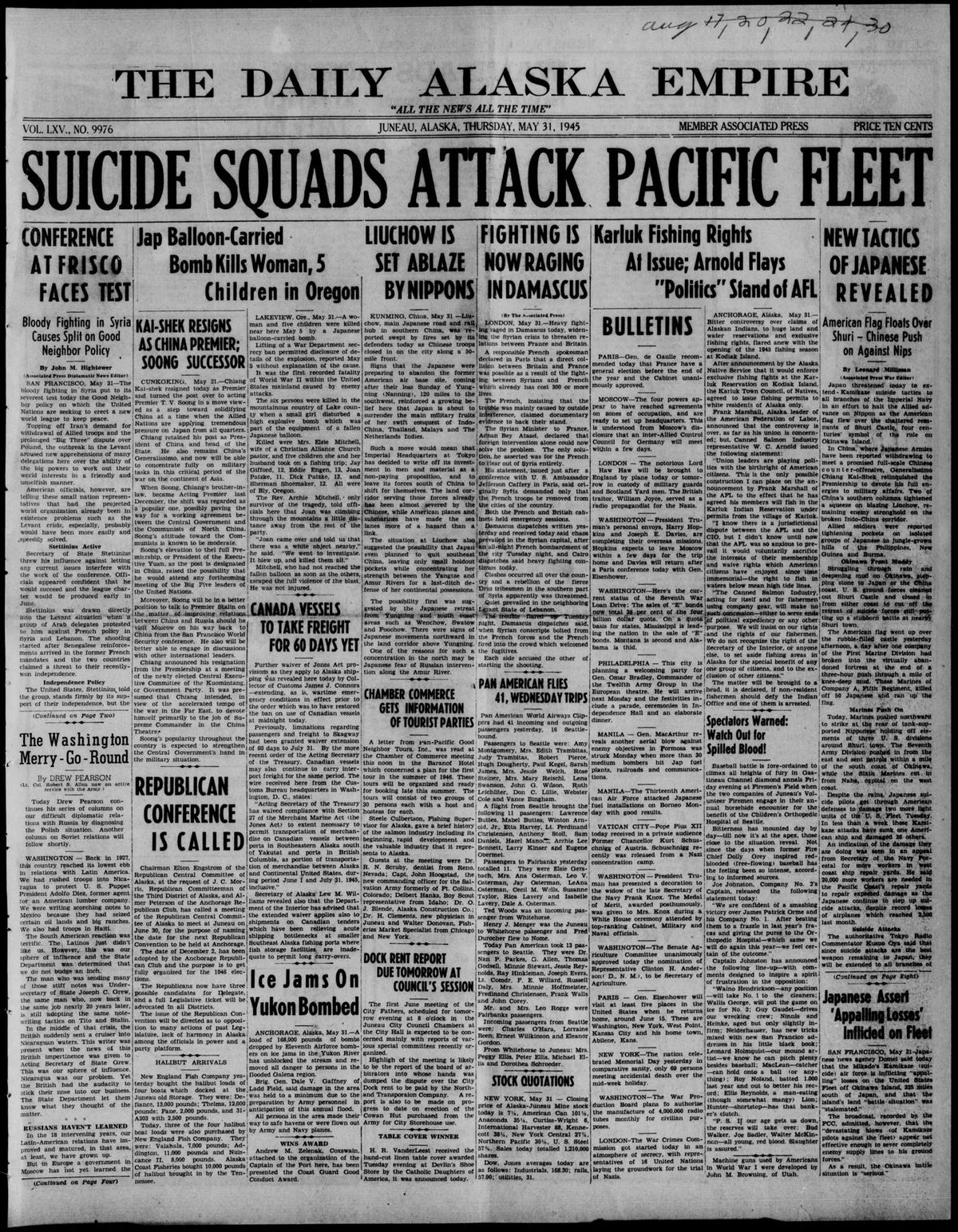
View the original at the Library of Congress →
On a Saturday in May, in the mountains of southern Oregon, a girl walked a little ahead of the others and found something. She came back to tell them. What she had found was a fallen Japanese balloon, and attached to it a bomb.
The only adult who lived was the one who had lagged behind. The Rev. Archie Mitchell, a Christian Alliance Church pastor, had brought his wife and five children on a fishing trip near Bly on May 5, 1945. He had not reached the balloon as soon as the others when it went off. “Joan came over and told us that there was a white object nearby,” he told officials, as the wire carried his words weeks later. “We went to investigate. It blew up and killed them all.”
The dead were his wife, Mrs. Elsie Mitchell, and the five children with her: Jay Gifford, 12; Eddie Engen, 13; Joan Patzke, 11; Dick Patzke, 13; and Sherman Shoemaker, 12. All were of Bly. They were, the reports said, the first recorded fatalities of the Second World War within the United States mainland caused by enemy attack.
What the country had been allowed to know
By the time they died, the balloons had already been in the American papers once — and then not again for months.
The story had surfaced the previous December, in Montana. A Japanese balloon came down in the timber south of Libby, and a local paper, The Western News, ran the mail carrier’s account of pulpwood cutters finding it, with a bomb that had failed to explode. A wire photograph went out — army officers and an F.B.I. man holding parts of the balloon “found recently in Montana” — and ran in papers from Nebraska to Georgia.
Then the frame shifted, and the story went quiet. The director of the Federal Bureau of Investigation, J. Edgar Hoover, mentioned the Montana balloon in the same breath as a pair of Nazi saboteurs recently captured on the East Coast, and raised the possibility that such balloons were carrying enemy agents into the country. There were matters about them, he said, that he could not disclose, for reasons of security. After that the balloons largely left the papers. What little the country had been allowed to know about them was a curiosity and a possible espionage plot in a Montana forest — not a weapon, scattered across the West, that could kill a child who picked it up.
The day it was all told
The government went public on May 22, 1945, and the papers that carried the announcement described their own silence.
The army and the navy, the announcement said, paid tribute to the newspapers and radio stations for withholding what they had learned about the bombs from time to time. The Springfield Weekly Republican put it plainly for its readers: the balloons had been the talk of the West for months, but until that day the Office of Censorship had forbidden any mention of them in the press. The attacks, the war and navy departments said, had been scattered and aimless and posed no military threat, but detailed facts might help the Japanese correct their methods. The military was making the announcement, the papers explained, as a warning to the public — that unexploded bombs might be found in isolated places, and that people, and especially children living west of the Mississippi, should be cautioned under no circumstances to touch or approach any unfamiliar object.
Seventeen days after the deaths near Bly, the warning came.
It was in the same disclosure that the six people were finally named. The Daily Alaska Empire, in Juneau, ran the account across a middle column of its front page on May 31 — beneath a banner about kamikaze squadrons attacking the Pacific fleet, the only Americans killed by the enemy on their own mainland appeared as one column among the day’s war news. The lifting of a War Department secrecy ban, the paper reported, had permitted disclosure of details of the explosion, which had been reported on May 5 without explanation of the cause. The town’s worst day, more than three weeks old, reached the country only when Washington released it — and the only papers in the reachable record that named the dead were in Alaska, more than a thousand miles from Oregon.
The question a senator asked
One man had already put a hard question to the War Department, in public.
The columnist Drew Pearson reported that Senator William Langer of North Dakota had written a scorching letter to Secretary of War Stimson, criticizing the Army’s secrecy about the balloons and asking whether innocent persons had been killed — and, if so, whether that was what had finally moved the War Department to lift its censorship ban. According to Pearson, Langer had written Stimson back in January, urging that the public be warned; Stimson had sent an officer to see him and pressed him to say nothing, and Langer had yielded. Langer’s own view, in the words Pearson quoted, was that “the people, when aware of any danger, are the first to help the armed services guard against it.”
Whether the six people near Bly would have lived had they been warned is a question no one can answer, and Langer, in period, asked it as a question. The sequence is what the papers show: the balloons surfaced in December and were hushed; a woman and five children died on May 5; the warning to the public came on May 22.
The people, and the place
The Forest Service keeps the site now. Its account calls the ground near Bly the only location in the continental United States where Americans were killed as the result of enemy action during the Second World War, and it records that the pastor’s wife was pregnant — a detail the newspapers of 1945 did not print. A stone monument lists the names.
The papers of the war gave them ages and a town and, once, the words of the one who lived. They found a white object in the woods, and no one had told them what it was.
The source shown is the front page of The Daily Alaska Empire (Juneau) of May 31, 1945, self-hosted; the link points to the original in the Library of Congress’s Chronicling America collection, where it is public domain. The deaths, the names, the ages, and the Rev. Archie Mitchell’s account are drawn from that page and from the identical wire text in the Wrangell Sentinel of June 1, 1945; the ages are given as those papers printed them, and other accounts differ (the children’s ages are commonly recorded as Joan Patzke 13, Dick Patzke 14, Sherman Shoemaker 11, Jay Gifford 13, and Edward Engen 13). The government’s acknowledgment that the press had withheld the story is reported as the papers carried it — the Imperial Valley Press of May 22 and the Springfield Weekly Republican of May 24, 1945 — and is rendered as those papers’ reported narration, not as a direct quotation of any official. The December 1944 Montana coverage and J. Edgar Hoover’s remarks are from The Western News of December 14, the Evening Star of December 31, 1944, and the Imperial Valley Press of January 2, 1945. Senator Langer’s January request, and the account of Secretary Stimson sending an officer to dissuade him, come from a single syndicated Drew Pearson column carried in The Daily Alaska Empire of May 29, 1945; they are Pearson’s reporting, not an official record, and are attributed to him throughout — a search of the Congressional Record for January–February 1945 did not confirm Langer’s request independently. That the pastor’s wife was pregnant, and that the site is the only place Americans were killed by enemy action on the mainland, are from the U.S. Forest Service’s Mitchell Monument account, a federal public-domain source; the Forest Service does not name the children. No Oregon newspaper near Bly is digitized in Chronicling America for 1945, so the record consulted here is national and regional wire coverage.
“No Explanation of the Cause,” The Daily Alaska Empire, May 31, 1945, p. 1. Library of Congress, Chronicling America. loc.gov/resource/sn83045499/1945-05-31/ed-1/?sp=1