Six Million May Be Needed
In fifteen pages of mainstream coverage of women entering war work, Black women appear exactly once — as a hundred beds in a segregated dormitory wing. In the same months, the Black press was reporting what it took to get hired at all.
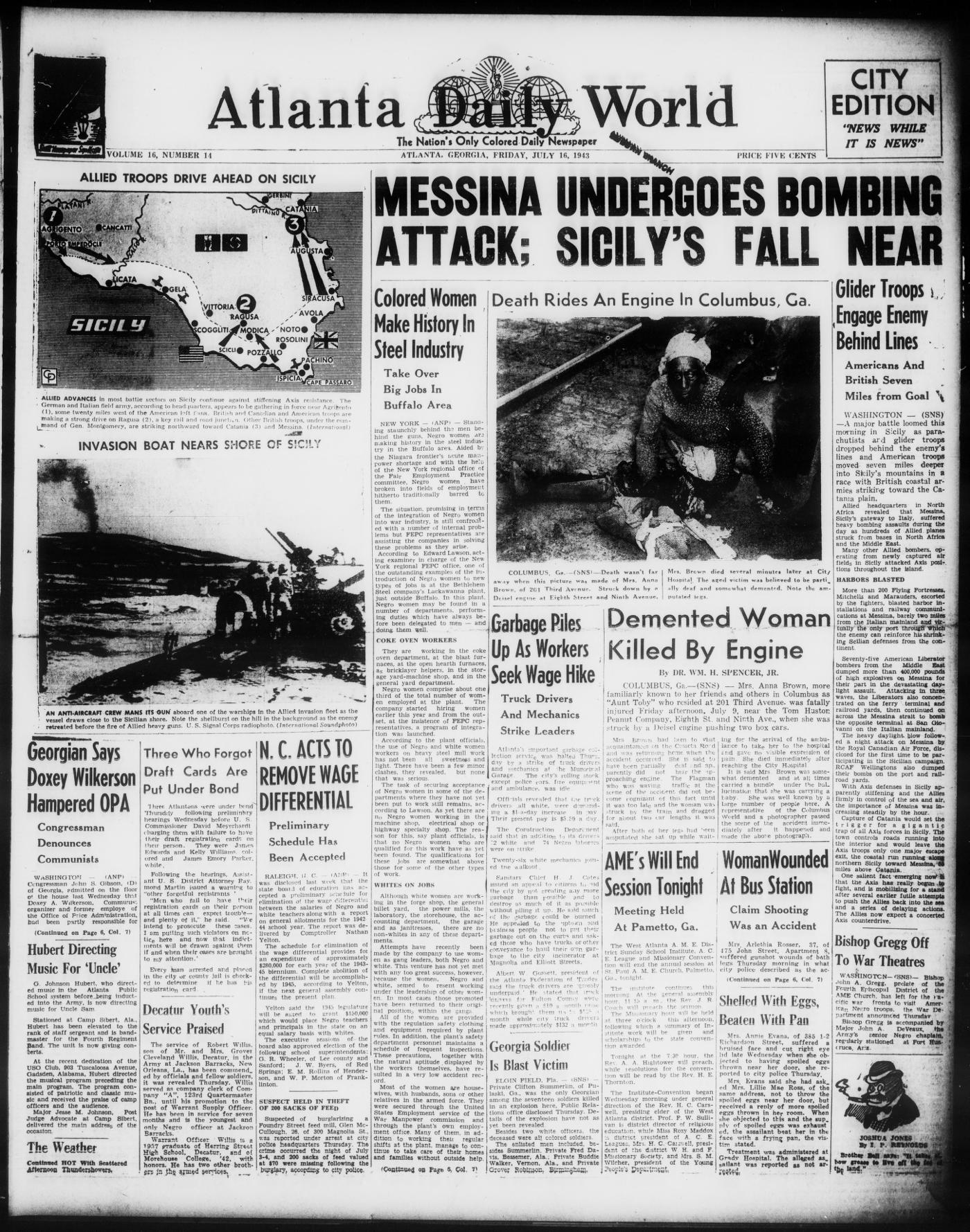
View the original at the Library of Congress →
On July 16, 1943, the front page of the Atlanta Daily World — which called itself, in its own masthead, “The Nation’s Only Colored Daily Newspaper” — ran this across the top: “Colored Women Make History In Steel Industry / Take Over Big Jobs In Buffalo Area.”
History. Not news, not progress — history. The paper explained why in the story: “Negro women have broken into fields of employment hitherto traditionally barred to them.”
That is what it took to make the front page. Not building something remarkable. Being allowed in.
What the country was told
By the summer of 1943 the American home front had a story about women and war work, and it was everywhere. It went roughly like this.
The country needs women. In June 1942 the Waterbury Democrat, a daily in a Connecticut brass town, carried the number: registration of women for industry should wait until the time was ripe, but “Six Million May Be Needed in 1943.” Six million.
The women who answer are heroic, and they are tired. That November the same paper ran a feature on the “TWO-JOB WAR WORKER,” the woman who “Does a Man-Sized Job On Production Line Plus ‘Women’s Work’ of Maintaining a Home.” In Washington that October, the Evening Star’s home columnist put a face on it: “IF YOU think women are in war work for a lark or an adventure, let me introduce Mrs. C., of Bridgeport, Conn., mother of four children” — a worker on the assembly line of an electrical-equipment plant “from 7 a.m. to 4 p.m.”
And they will still be women when it’s over. In February 1943 the Washington Daily News reported, with a straight face, that “women war workers are required to refurbish their physical appearance at regular intervals to heighten their morale and reduce infections.”
Every word of that is true. Six million women were needed. Mrs. C. of Bridgeport was working two shifts, one of them unpaid. The story the country told itself about Rosie was not a lie.
It was just missing something.
The count
This project has, in its corpus, five mainstream dailies from the war years, digitized by the Library of Congress: the Evening Star and the Washington Daily News in the District, the Waterbury Democrat in Connecticut, the Imperial Valley Press in California, and the Ypsilanti Daily Press in Michigan. From those five, fifteen pages about women entering war work were pulled and read — recruitment, training, the double shift, the plants, the housing.
In all fifteen pages, Black women appear exactly once.
It is in the Washington Daily News of July 3, 1942, on page seven, reporting a congressional hearing on dormitories for the flood of war workers arriving in the capital. The proposed dorms, the paper reported, would house about a thousand workers, “including a special section of 100 beds for Negro women.”
That is the whole of it. One clause. A bed count.
Every other apparent reference in those fifteen pages dissolves on reading: a yacht race, a lemon colored frosting in a recipe, a negro sentenced in the crime blotter. The Rosie of the mainstream dailies in this corpus is white — and nobody had to say so. She is white the way a default is white: by not being mentioned.
Two things need saying plainly here. This is five newspapers, not the American press — the New York Times, the Chicago Tribune, and the Washington Post are not among the titles digitized in Chronicling America, and this account cannot speak for them. And the hearing in question was Representative Fritz Lanham’s — the same congressman whose name was about to go on the Lanham Act, the law that funded federal childcare so that mothers could take those jobs. In the one mainstream page in this corpus where Black women war workers appear, they appear in his hearing, as a hundred beds in a segregated wing.
What the other papers were printing that year
Now read what the Black press was running in the very same months. It is not a different emphasis on the same story. It is a different story.
The Atlanta Daily World, October 1942: “Sorority Seeks To Have Colored Women Employed As Meter Readers.” Members of the Delta chapter of Iota Phi Lambda Sorority, the paper reported, were “making an effort to have colored women employed as meter readers for the Atlanta Gas Light Company and the Georgia Power Company.”
Meter readers. Not riveters, not welders, not the assembly line at an electrical-equipment plant — meter readers, a job requiring the ability to read a number off a dial and walk to the next house. While the Waterbury Democrat was telling Connecticut that six million women would be needed, a sorority in Atlanta was organizing a campaign to get Black women permission to read gas meters.
New Year’s Day 1943, same paper — a complaint about what happened to Black women who did get inside a plant: the employer was assigning “the colored women exclusively to this type of work and other work just as [or more] laborious while the white women are assigned to all of the clerical or administrative and supervisory duties.” The work in question, the statement noted, “is exceedingly laborious, and in fact it should be assigned as a duty for men.”
August 1943: “Refuses To Employ Negro Women, Rapped By NAACP.” The Cudahy Packing Company’s South St. Paul plant, criticized by the local NAACP branch, in the fourth year of a labor shortage, for declining to hire Black women at all.
Six million may be needed. Cudahy would rather not.
Seattle
The sharpest version is in a Black weekly published in Seattle, the Northwest Enterprise — a city whose mainstream daily is not in this corpus, so what follows is not a comparison between two Seattle papers, but a single voice reporting on a single plant. That plant was Boeing.
In June 1942 the Enterprise ran a small item on page one under the headline “Miss K. Marshall Is Boeing Machinist.” The scan reads: Miss Kathryn Marshall of Ellensburg, Washington, daughter of Mrs. Sarah Marshall, has accepted a position as machinist at Boeing Aircraft Company. Miss Marshall is a graduate of Ellensburg Normal.
A Black woman took a job as a machinist building bombers, and her hometown Black weekly put her name on the front page — her name, her town, her mother’s name, her school — because a Black woman becoming a machinist at Boeing was a thing that had to be recorded. Two weeks later the same paper carried a call for five hundred women to take a three-week training course for Boeing sub-assembly work, through the Seattle schools.
Recruited. Trained. Hired.
And then, in February 1943, the Enterprise reported what the aeronautical mechanics’ union local at Boeing was doing to the Black workers it would not admit: charging them a monthly fee — three dollars and fifty cents — for the right to work, with no privilege of joining the union and no security in the job. Dues without membership. Rent, for a seat at the bench. That October, the paper reported the union giving ground under public pressure.
The country needed six million women. It recruited Kathryn Marshall to build bombers, and then charged her for permission to stay.
The government counts, three years late
In April 1945 — the war in Europe three weeks from over — the Women’s Bureau of the U.S. Department of Labor published Bulletin No. 205. It was titled “Negro Women War Workers.”
It is a federal document, in the public domain, and it contains the count that no newspaper in this corpus published at the time. Over the four years from April 1940 to April 1944, it reports, the employment of Negro women rose from 1.5 million to 2.1 million. In the Detroit–Willow Run area alone — the arsenal, the bomber plant, the housing crisis, the same square miles where a white mob had blocked Black families from a federal housing project in 1942 — the number of nonwhite women employed rose from 14,451 in March 1940 to 46,750 in June 1944.
Nearly a tripling, in one metropolitan area, in four years.
They were there the entire time. Six hundred thousand more of them nationally by 1944; three times as many in Detroit. They were reading meters in Atlanta because that was the campaign, and running machines at Boeing while paying a union for the privilege, and doing the laborious work in plants where white women got the clerical desks. The Women’s Bureau counted them in 1945, when it was almost over, in a bulletin that had to be titled Negro Women War Workers because otherwise nobody would know that was who it was about.
What each paper was built to see
There is no villain in this story, which is what makes it worth reading. No mainstream editor in this corpus wrote that Black women were not war workers. The Waterbury Democrat was not lying about the six million; the Evening Star was not lying about Mrs. C. of Bridgeport and her four children and her seven-to-four shift. They printed what they saw.
That is the point. What a paper is built to see is not a policy anyone announces. It is a habit, and habits are invisible from the inside. Fifteen pages about the women America needed, and the only Black woman in any of them is a hundred beds in a segregated dormitory wing — not because someone excluded her, but because nobody thought to include her, which is the more durable arrangement of the two.
The Atlanta Daily World and the Northwest Enterprise were advocacy papers. They had a stake. They were not neutral, and they never claimed to be — the World put “Colored” in its own masthead and the Enterprise ran a Double V on its front page. And precisely because they had a stake, they printed a fact the neutral papers did not have room for: that in the middle of the largest labor shortage in American history, a sorority had to organize to get Black women hired to read gas meters.
Making history, in the World’s headline, meant taking a job. That is how far the bar had been set.
The pages of the Atlanta Daily World, the Northwest Enterprise, the Waterbury Democrat, the Evening Star, the Washington Daily News, and the Ypsilanti Daily Press are in the public domain via the Library of Congress and are shown or linked above. The mainstream sample is the five wartime dailies in this project’s corpus — it is not “the American press,” and this account makes no claim about the New York Times, the Chicago Tribune, or the Washington Post, which are not digitized in Chronicling America. This is a thematic comparison of how two presses framed the same national phenomenon, not a same-city pairing: no mainstream daily for Atlanta or Seattle is in the corpus. Employment figures are cited from the Women’s Bureau’s Bulletin No. 205, Negro Women War Workers (1945), a U.S. Department of Labor publication in the public domain; the bulletin’s own note warns that its April 1944 figures are sample estimates carrying greater sampling error than the 1940 totals. The Northwest Enterprise item on Kathryn Marshall is transcribed from the page image, its machine-read text being unreliable. Period racial terms appear here as the sources printed them.
“Six Million May Be Needed,” Atlanta Daily World, July 16, 1943, p. 1. Library of Congress, Chronicling America. loc.gov/resource/sn82015425/1943-07-16/ed-1/?sp=1