Four Papers, Four Riots
In June 1943, the same forty-eight hours in Beaumont, Texas produced four incompatible newspapers. The distance between them is the story.
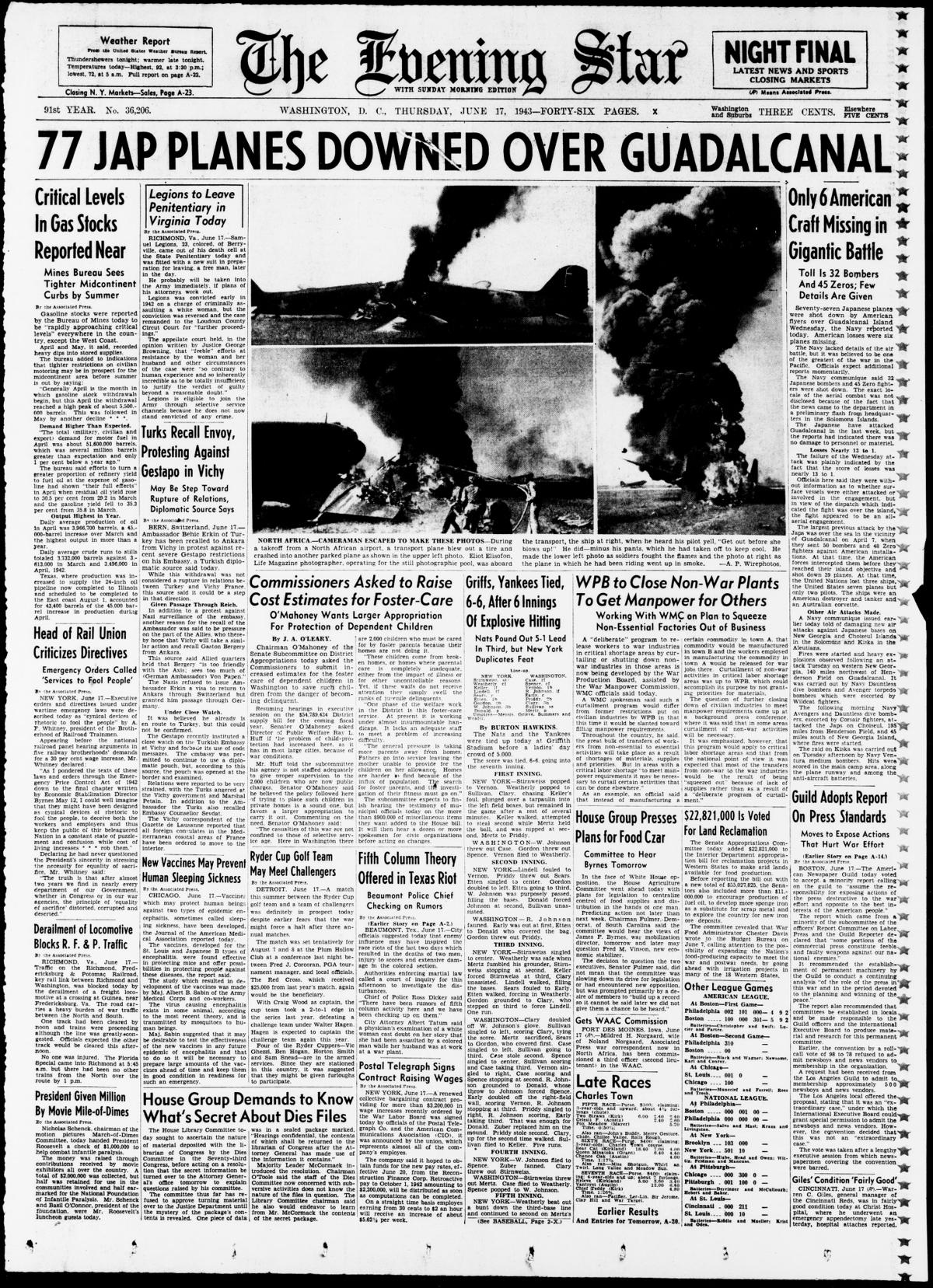
View the original at the Library of Congress →
On June 17, 1943, the Evening Star in Washington told its readers what had happened in Beaumont, Texas, and who might be to blame. The headline was a theory: “Fifth Column Theory Offered in Texas Riot.” The dateline was Beaumont. The sourcing was official.
City officials, the paper reported, “suggested today that enemy influence may have inspired the race riots of the last two days which resulted in the deaths of two men, injury to scores and extensive damage in the colored section.” The police chief, Ross Dickey, was quoted directly: “There have been rumors of fifth column activity here and we have been checking up on them.”
It is a remarkable sentence to run under martial law. Two people were dead. More than a hundred homes and businesses in the Black district had been destroyed. And the account a reader in Washington received first was that the real culprit might be a Nazi saboteur — that the riot was less a thing Beaumont had done to itself than a thing done to Beaumont, by an enemy hand.
Four papers covered those forty-eight hours. Each of them reached, at some point, for Hitler. But they pointed him in four different directions — and the distance between the four accounts is a record of what each newspaper was built to see, and what it was built to look past.
The spark that three papers doubted
Every version of Beaumont begins the same way: a white woman told police a Black man had assaulted her while her husband was at a war plant. That claim moved a mob. By the time it was spent, the Gary American would count “a white man and a Negro” killed, “60 Negroes hospitalized and more than 100 homes and business houses in the Negro district destroyed.”
That count was itself provisional. The June 17–18 papers reported two dead; by June 26 the Dallas Express put the toll at three — two white men and one Black man — the number the historical record has kept. The story was still changing shape days after the streets went quiet.
But read the papers side by side and something else surfaces that the mob never waited for: the claim that started it did not hold.
The Evening Star — the mainstream daily leading with the fifth-column theory — reported it in the same column, lower down. The city attorney, Albert Tatum, said a physician’s examination of a white woman cast doubt on her story that she had been assaulted by “a colored man” while her husband was at work at a war plant. The paper that opened with sabotage rumors carried, a few lines later, the fact that unmade the riot’s own pretext.
A thousand miles north, the Minneapolis Spokesman — a Black weekly — was not covering the riot so much as covering the coverage of it. In an editorial titled “Trial By Newspaper,” it took apart a single United Press sentence that had run in the June 16 Minneapolis Star-Journal: “One white man was killed in rioting between mobs of white men and Negroes which started last night after a Negro had assaulted the young wife of a defense worker.” The problem, the Spokesman argued, was two words: had assaulted. “The fair thing,” it wrote, “would have dictated that the story read: Negro is alleged to have assaulted — not the incontrovertible ‘had assaulted.’” And then the paper named the machinery: “Intelligent readers can imagine what disservice repetition of this type of news handling in a hundred newspapers in a hundred cities does to race relations all over the country.”
And in Texas, the Dallas Express — the state’s Black paper — put the doubt plainly, folded into a resolution its Dallas NAACP branch had sent to President Roosevelt: “it is now discovered according to the daily press that no crime was committed against this white woman.”
Three papers, three cities, three presses. One buried fact. The mainstream daily reported the physician’s finding but led with the saboteur. A Black weekly in Minnesota built an entire media critique around the wire service’s refusal to write the word alleged. A Black paper in Texas cited the daily press’s own eventual admission. The fact was available to everyone. What differed was where each paper filed it — at the top, or beneath the theory.
Four papers reach for Hitler
Here is the strange thing that binds the four accounts together: all of them invoke fascism. But the word does different work in each.
For the mainstream daily, Hitler is an exit. The Evening Star’s fifth-column theory — “enemy influence may have inspired the race riots” — points the reader away from Beaumont itself and toward an outside agent. If a saboteur lit the match, then the shipyard town, its police, and its white workers are the setting of the crime rather than its authors.
For the national Black press, Hitler is an indictment — and the charge is that the riot handed the enemy a gift. The Minneapolis Spokesman ran the headline “Nazis and Japs Laugh as Negroes and Whites Riot in Beaumont, Texas,” reporting that “short wave listeners report that Berlin and Tokyo radio stations broadcast gleefully news of the race riots.” This is the Double V argument in its sharpest form: a country fighting fascism abroad while producing race riots at home was losing the propaganda war in its own streets. The Gary American set Beaumont in a single week’s grim ledger on its front page — a lynching in Marianna, Florida; five men shot at a Chester, Pennsylvania shipyard; a military policeman killed at Camp Stewart, Georgia — riot and lynching and clash stacked one on the next, the home front coming apart in a dozen places at once.
For the Texas Black press, Hitler is an accusation with a name attached. The Dallas Express headline did not reach for a distant saboteur: “Shipyard Workers Give Hitler Boost In Staging Riot.” The culprits were local and specific — “several hundred white workers from the Pennsylvania shipyards stopped work on ships so much needed by this Government to defeat the axis.” The paper set that betrayal against a Black war-bond buyer whose office the mob burned: “Less than one month ago Sol White purchased $11,000 worth of War Bonds, doing his bit in trying to assist in defeating the Axis. They set fire to the Excelsior Life office, destroying many of the records.” Where the mainstream daily floated an enemy influence, the Dallas Express pointed at war workers who had walked off war production to loot a Black neighborhood — and, describing the wreckage on Gladys Street, wrote that “Hitler and his gestapo in the height of their connivance would look like babes in the woods with this group of thugs.”
For the Communist left, Hitler is literal — an organized plot. The Daily Worker, the newspaper of the Communist Party, folded Beaumont into a national theory of fascist sabotage. It is worth being precise about what the paper actually claimed, because the Daily Worker is a partisan source and its framing is an argument, not a finding: in a June 24 article primarily about Detroit, it reported that failure of the Department of Justice to prosecute known fifth columnists was blamed by Congressman Vito Marcantonio, president of the International Labor Defense, for the disruption of unity and production through race riots in Detroit, Beaumont, Texas, and elsewhere. It quoted a telegram from Transport Workers Union president Michael Quill to Roosevelt: “The pattern of race riots in key industrial centers of our nation shows that a well-laid plot to defeat America from within is being directed by domestic traitors in alliance with the enemy.” Notice the move. The mainstream daily used the fifth column to explain the riot away; the Daily Worker used a mirror-image fifth column to explain it as deliberate treason. Same specter, opposite purpose — one an alibi for the town, the other a conspiracy indictment of the nation’s failure to prosecute the far right.
And three days earlier, the same paper had answered the riots with a photograph. On June 21, under the headline “Stage Door Canteen Open Doors Wide to Negroes” and the subhead “Democracy Laughs at Fascism,” the Daily Worker ran a picture story from the New York canteen where Black and white servicemen ate and danced together, and made the contrast explicit: “Hitler wants it to be different. Take a look at his work the other day in Beaumont, Texas.” Where the town’s own paper reached for a saboteur to explain the riot, the Communist paper set Beaumont beside its opposite — an integrated room — and wrote that “the Stage Door gave old Jim Crow a poke in the eye.” It is the same partisan argument in a warmer key: Beaumont as the fascist’s work, the canteen as the answer to it.
What the four accounts protect
Lay the four papers flat and the pattern is not really about who was right. It is about what each account was constructed to protect.
The Evening Star’s fifth-column theory protected Beaumont — its police, its shipyards, its white workers — by locating the cause offstage. The national Black press protected the war effort’s moral claim, insisting that a nation cannot credibly fight fascism abroad while its own cities burn. The Dallas Express protected the specific truth of who did what to whom, naming the shipyard workers and the war-bond buyer they robbed. The Daily Worker protected a political thesis, reading every 1943 riot as one coordinated fascist assault on the home front.
And underneath all four sat the same small, stubborn fact that the mob had not waited for: a physician’s examination that “cast doubt on her story.” The mainstream daily printed it beneath the saboteur. The Black press put it at the center and named the machinery that had buried it. The distance between those two decisions — where to file a fact — is the distance between four Beaumonts.
There was one Beaumont, Texas, in June 1943. There were four in the newspapers. Reading them against each other does not tell you only what happened. It tells you what each paper needed the story to mean.
The full front pages of the Evening Star, the Gary American, and the Minneapolis Spokesman are in the public domain via the Library of Congress and are shown and linked above. The Dallas Express (Portal to Texas History) and the Daily Worker (Internet Archive) are quoted here under fair use with links to the originals; their pages are not reproduced. The Daily Worker is the newspaper of the Communist Party USA; its framing is presented as that paper’s interpretation, not as established fact.
“Four Papers, Four Riots,” The Evening Star, June 17, 1943, p. 1. Library of Congress, Chronicling America. loc.gov/resource/sn83045462/1943-06-17/ed-1/?sp=1