Something Like a Balloon
On the night of February 24–25, 1942, Los Angeles fired hundreds of anti-aircraft shells at the sky for an hour. The next morning the wire told the country it had beaten off waves of Japanese planes. Then the Navy said false alarm and the War Department said fifteen aircraft. The fear was real; the enemy was not.
View the original at the Library of Congress →
The enemy came in over the coast before dawn, and for the better part of an hour the anti-aircraft batteries of Los Angeles County fired at it. Shells burst over a blacked-out city from Santa Monica to San Diego; searchlights swept the sky; shrapnel came down “like rain,” the authorities at the municipal airport told police. A shell exploded in the backyard of Mr. and Mrs. Hugh Landis, tore down the telephone and light wires, and peppered a bed that had been vacated minutes before by Mrs. Landis’s sister, Blanche Sedgwick, and her fourteen-year-old niece, Josie Duffy.
An air-raid warden at Gardena, ten miles southwest of the city, watched the guns concentrate their fire on what he described as “a big bag that looked something like a balloon.” He said he saw the bag, torn to shreds by the gunfire, settle slowly to earth.
That was the enemy: something like a balloon.
Beat off waves
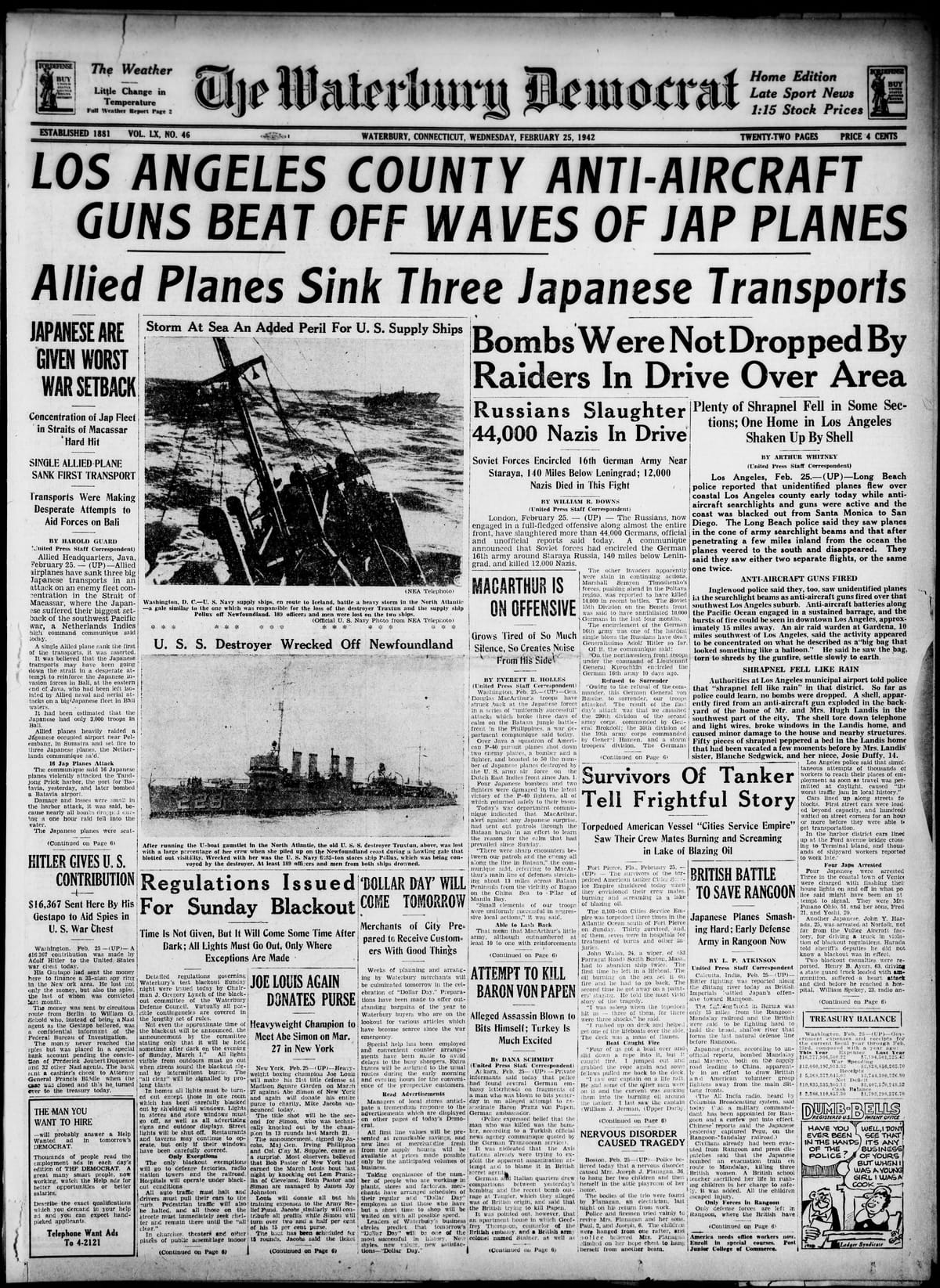
You would not have known it from the front pages the next morning. “LOS ANGELES COUNTY ANTI-AIRCRAFT GUNS BEAT OFF WAVES OF JAP PLANES,” ran the banner across the top of the Waterbury Democrat in Connecticut on February 25 — the paper’s own headline, the period’s own word for the enemy. The country three thousand miles away read that its west coast had fought off an air raid.
On the same page, directly beneath the banner, the Democrat printed the thing that undid it: “Bombs Were Not Dropped By Raiders In Drive Over Area.” No bombs, no wreckage, no enemy plane ever found — a raid that dropped nothing, over an area it never reached. The banner and its own refutation shared one sheet of newsprint.
We are reading this at a distance, and the distance is the point. No Los Angeles newspaper is digitized in the Library of Congress’s Chronicling America collection; the city that fired the guns cannot, here, be heard describing its own night. What can be reached is the wire copy that carried Los Angeles to the rest of the country — a United Press account in a Connecticut daily, an editorial in a small California paper two hundred miles inland at El Centro — and so this is the story of an event that existed, for almost everyone, only as it was reported.
The dead of a raid that never came
The raid that dropped nothing still killed. The Democrat reported “two blackout casualties”: Henry B. Ayers, sixty-three, driving a state-guard truck loaded with ammunition, “suffered a heart attack and died before he reached a hospital”; and William Spokey, twenty-three, a radio announcer, whom the front page named without giving the cause before the story jumped inside. At daylight, when driving was permitted again, the simultaneous attempts of thousands to reach work caused what the paper called “the worst traffic jam in local history” — the ordinary machinery of a frightened city, moving again. (The figures that later circulated — five dead, some in blackout car crashes — are not in the reachable papers; only Ayers and Spokey are.)
The neighbors who signaled to nothing
The same front page that announced the phantom carried, in a single column, the arrest of real people. Under a subhead that is the paper’s language and not this publication’s — “Four Japs Arrested” — the Democrat reported that four Japanese Americans in the coastal town of Venice had been “charged with flashing their house lights on and off in what police said might have been an attempt to signal.” An attempt to signal to whom? To the planes that were never there. The paper named a mother and her two sons, Fred and Yoshi; a fifth man, John Y. Harada, twenty-five, was arrested for driving with his lights on and told the sheriff’s deputies he had not known a blackout was in effect.
The enemy overhead was imaginary. The suspicion that fell on these families was not. The mass removal of Japanese Americans from the coast was, in these same days, already beginning: the same week’s papers carried it as its own thread, reporting whole blocks of families uprooted from restricted areas. It is a policy this site treats in its own piece. But the arrests on the Venice pier belong to this night — a city firing at a balloon, and booking its neighbors for signaling to it.
A false alarm; fifteen aircraft
Then the government tried to say what had happened, and could not agree with itself. On February 26 the Secretary of the Navy, Frank Knox, called the whole thing “a false alarm.” The same day, the Secretary of War, Henry Stimson, said the opposite: “as many as 15 aircraft,” he told a press conference, “probably commercial planes operated by enemy agents,” had been over Los Angeles — “other than American Army or Navy planes.” One cabinet officer said nothing had flown; the other said fifteen somethings had, piloted by the enemy.
The two statements did not even keep the same prominence. The claim had run as a banner; the doubt ran inside. In the Detroit Evening Times, Knox’s “false alarm” and the headline “Barrage Baffles West Coast / Los Angeles Wonders Whether Enemy Aircraft Really Flew Over City” appeared not on page one but on page three. The phantom was front-page news; the correction was something you had to turn to find.
The condition made known
The confusion did not stay in Washington. The Democrat reported the next day that the anti-aircraft guns had fired hundreds of rounds. A civilian-defense group decried “the very great damage done to civilian defense morale” by Knox’s “false alarm.” And on February 27 the Imperial Valley Press, in El Centro, ran the editorial that named what the night had exposed. Its headline was a kind of grim thanks — “Thank God We’ve Still Got Time” — and its argument was that the phantom had been useful:
The alarm, it wrote, “brought forcefully to public attention a state of confusion and lack of cooperation between the top men of army and navy departments as bad as that which prevailed at Pearl Harbor.” Knox and Stimson stood “at opposite ends of a question upon which there should have been no disagreement from the outset.” Better to learn it now, from a raid that wasn’t, than later from one that was.
Something like a balloon
Years afterward, the Army’s own official history settled the question the two secretaries had split. It attributed the Battle of Los Angeles to “war nerves” — a stray meteorological balloon, some flares, and shell bursts cascading into an hour of false reports. There had been no enemy. It was the verdict of the record, delivered at leisure, and it said in retrospect exactly what a civil-defense warden in Gardena had said on the night, watching the guns tear the thing to shreds: something like a balloon.
A city had fired hundreds of shells at the sky, killed two of its own, arrested four of its neighbors for signaling to it, and told the nation it had beaten off waves of enemy planes — over a target that drifted slowly to earth. The fear was real. The enemy was not. The machinery of civil defense, built to see danger, had seen it with perfect certainty where there was none.
This account is drawn from the wire coverage of February 25–27, 1942 as it appeared in The Waterbury Democrat (Connecticut; United Press), The Washington Daily News*, the* Detroit Evening Times (International News Service), and the Imperial Valley Press (El Centro, California) — all public-domain and digitized in the Library of Congress’s Chronicling America collection; the scan shown is self-hosted and the link points to the original. No Los Angeles newspaper is in that collection, so the city’s own reporting of the night could not be consulted; the events are given as the national wire and one inland California paper carried them. The banner “LOS ANGELES COUNTY ANTI-AIRCRAFT GUNS BEAT OFF WAVES OF JAP PLANES” and the subhead “Four Japs Arrested” are quoted as the Waterbury Democrat printed them and are not the language of this publication; the surname of the Venice family is garbled in the original print and is not reproduced. Only two deaths (Ayers and Spokey) are in the reachable coverage; the larger toll sometimes cited is from later secondary sources and is not printed here. The official “war nerves” verdict is from The Army Air Forces in World War II (Craven and Cate, eds.), the U.S. Office of Air Force History’s account written after the war — the record’s retrospective judgment, not a contemporaneous statement. The popular association of this night with the mass incarceration of Japanese Americans is not borne out by the papers of the week: Executive Order 9066 was signed on February 19, five days before the raid, and the coast-removal stories ran as a separate thread that does not cite the alarm.
“Something Like a Balloon,” The Waterbury Democrat, February 25, 1942, p. 1. Library of Congress, Chronicling America. loc.gov/resource/sn82014085/1942-02-25/ed-1/?sp=1