We Are Going to Be Tough About This
In January 1942 the enemy-alien rules reached one Connecticut city twice — as an order the English daily carried from the U.S. attorney, and as instructions the Italian weekly printed for its Italian-speaking Waterbury readership. The original December federal text has not been located in the Federal Register. The earliest text this research has found that states the deadline is the weekly's.
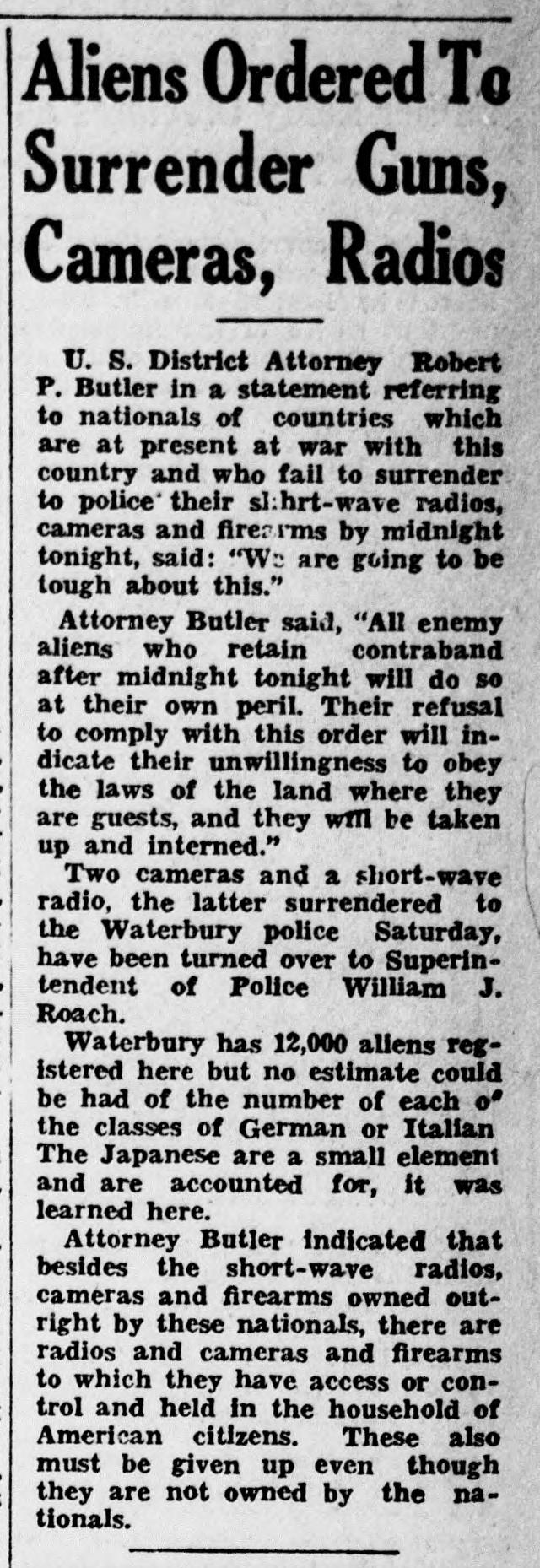
On Monday, January 5, 1942, the Waterbury Democrat put a three-line head on page three:
Aliens Ordered To Surrender Guns, Cameras, Radios
The story under it ran five paragraphs, and it quoted Robert P. Butler, the United States Attorney for Connecticut, twice — three sentences in all, printed in quotation marks.
“We are going to be tough about this.”
The second was longer, and it named the penalty.
“All enemy aliens who retain contraband after midnight tonight will do so at their own peril. Their refusal to comply with this order will indicate their unwillingness to obey the laws of the land where they are guests, and they will be taken up and interned.”
Guests. The word is Butler’s, printed as he said it.
The rest of the story is the paper’s own. Two cameras and a short-wave radio had already come in, all three turned over to Superintendent of Police William J. Roach; the radio was surrendered on Saturday. The city had twelve thousand aliens registered — all aliens, of every nationality, a figure the paper attributes to nobody and immediately qualifies: “no estimate could be had of the number of each o’ the classes of German or Italian.” The Japanese, it adds, “are a small element and are accounted for.” And the order reached further than the people it named. Firearms, radios and cameras in the homes of American citizens, if a national had access to them, had to be given up too.
Another Waterbury paper had printed the rules three days earlier, in Italian.
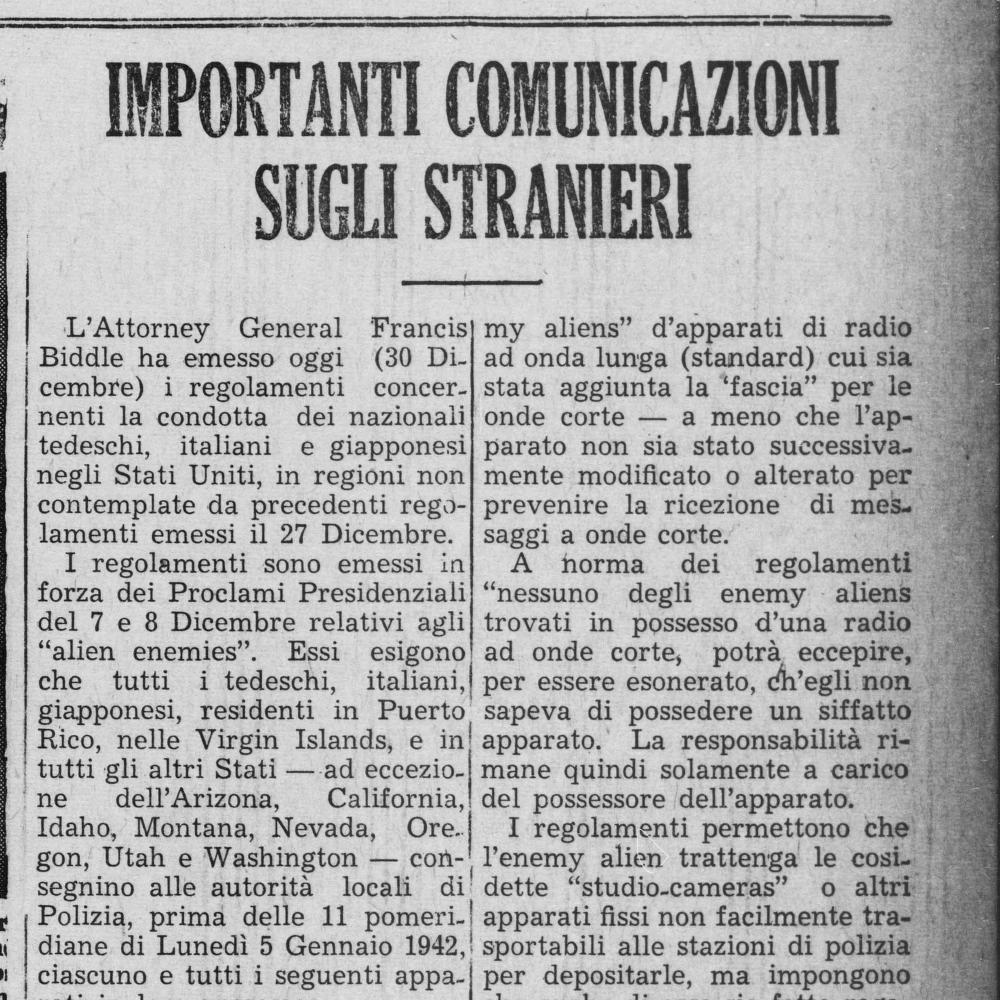
On Friday, January 2, La Verità — Corriere del Connecticut, Waterbury edition, ran them across the top of its front page under a two-line head: IMPORTANTI COMUNICAZIONI SUGLI STRANIERI. The weekly was detailed where the daily was brisk.
L’Attorney General Francis Biddle ha emesso oggi (30 Dicembre) i regolamenti concernenti la condotta dei nazionali tedeschi, italiani e giapponesi negli Stati Uniti, in regioni non contemplate da precedenti regolamenti emessi il 27 Dicembre.
[Attorney General Francis Biddle today (30 December) issued the regulations concerning the conduct of German, Italian and Japanese nationals in the United States, in regions not covered by earlier regulations issued on 27 December.]
Then a lettered list — transmitting radios, short-wave receiving sets, hand cameras — and then the hour. The weekly gives it as “prima delle 11 pomeridiane di Lunedì 5 Gennaio 1942” [before 11 p.m. on Monday 5 January 1942]. The daily gives it as midnight. The two papers are an hour apart on the same deadline, and neither page is in a position to correct the other.
The Italian prose repeatedly keeps English legal terms, in quotation marks, as printed: “alien enemies”, “short wave radio receiving set”, “enemy aliens”, “studio-cameras.”
The regulations the weekly printed were issued, it says, under the presidential proclamations of December 7 and 8. Those are 2525, 2526 and 2527. Only 2527, the Italian one, has been read for this piece, in the Federal Register at 6 F.R. 6324. Proclamation 2527 reaches “all natives, citizens, denizens or subjects of Italy being of the age of fourteen years and upwards … not actually naturalized”, and charges the Attorney General with carrying it out. Not the naturalized. Not children under fourteen. It incorporates the regulations of Proclamation 2525 — the contraband list that both Waterbury papers would print.
The December 27 and December 30 regulations themselves have not been located. The Federal Register issues from December 30 through January 17 were searched and do not hold them. A later federal text preserving rules of this kind exists — 28 CFR Part 30, at 7 F.R. 844, dated February 5, 1942, a month after the deadline had passed and the surrendered cameras were already in police custody — but that is the February text, not the December one. An order filed elsewhere, or never filed, would not have turned up in the search that was run.
So the earliest text this research has found that states the deadline is the version a Waterbury weekly printed for its Italian-speaking readership.
A month earlier, the same paper had been writing about the war from a very different position.
On December 5, 1941 — the last issue before Pearl Harbor — two of La Verità’s four front-page columns argued about the war in North Africa, and the argument was against the British. Churchill had told the Commons about the new offensive in Libya and had reached for Waterloo. The editorial, signed IL CORRIERE, took the allusion and turned it around.
Cosi’ riconquistarono la loro indipendenza nazionale e la loro unita’ politica; perche’ quella spirituale fu sempre viva ed operante; cosi’ vinsero a Vittorio Veneto, distruggendo il secolare nemico; cosi’ conquistarono l’Impero e cosi’ termineranno l’attuale guerra, che e’ decisiva per la loro esistenza e per l’avvenire delle generazioni italiane.
[…so they won at Vittorio Veneto, destroying the age-old enemy; so they conquered the Empire, and so they will end the present war, which is decisive for their existence and for the future of the Italian generations.]
They is gl’Italiani. The enemy is Britain. Two days later Japan attacked Pearl Harbor; the United States declared war the following day, and Italy declared war on the United States on the eleventh. None of it is on this page, because on December 5 none of it had happened. A column over, under the head “FINANCO GL’ITALIANI!…”, the paper was taking apart a New York Times military critic for condescending to the Italian army.
The next issue is dated December 12. It is the same paper, one week later, and the front page is about America.
Avevamo già scritto l’editoriale, quando s’è verificata la dichiarazione di guerra tra l’Italia e gli Stati Uniti, che ha addolorato profondamente i nostri cuori.
Quella di Giovedì. 11 Dicembre, è stata una giornata nerissima per gli Americani di origine italiana.
[We had already written the editorial when the declaration of war between Italy and the United States occurred, which has grieved our hearts profoundly. Thursday, 11 December, was a blackest day for Americans of Italian origin.]
The first sentence matters for what it rules out. The paper says its own editorial — L’AMERICA IN GUERRA, running down the left of the same page — was already written when Italy declared war. The shift was under way before the eleventh.
What follows in the next column is not the paper’s prose. La Verità reprinted Generoso Pope’s editorial from Il Progresso Italo-Americano entire. It introduced the reprint in bold, endorsed it — “sottoscriviamo toto-corde” [we subscribe wholeheartedly] — and said it stood for the paper’s present and future orientation.
A week later, on December 19, the rules arrived with Connecticut’s name on them.
L’United States District Attorney per il Connecticut, Robert P. Butler, ha ricevuto delle istruzioni sulla condotta degli stranieri nemici, residenti nello Stato, di nazionalità italiana, tedesca e giapponese…
[The United States District Attorney for Connecticut, Robert P. Butler, has received instructions on the conduct of enemy aliens resident in the State, of Italian, German and Japanese nationality…]
RESTRIZIONI PER GLI STRANIERI NEL CONNECTICUT. Eight paragraphs follow it. Six set out prohibitions and two state what follows from breaking them. Firearms and anything connected with munitions; bombs, explosives, and the material used nelle fattorie to make them; short-wave receiving sets, signal devices, cameras. Books, special paper and documents that can be written on invisibly; photographs, maps and drawings of naval or military sectors, of industrial plants where arms and ammunition are made, of camps and stations. No flying in any aircraft, public or private, without the permission of the Attorney General or the Secretary of War. No entering or leaving national territory except by presidential order. No going into military areas, camps, arsenals, ports, airports, hydroelectric plants or shipyards, or into the fattorie engaged in the work of defence. “Non debbono cambiare d’indirizzo o viaggiare, senza il permesso del Dipartimento di Giustizia” [They must not change address or travel without the permission of the Department of Justice]. No membership or office in an organisation the Attorney General has designated, no political acts, no prohibited literature.
Butler is reported here, not quoted; the paper had the instructions and set them out. Many of the same restrictions reappear in the Democrat pages used for this piece over the following weeks, and the weekly’s page is dated December 19.
The city’s temper that month is legible in three items, and none of them is simple.
The same December 19 issue carries a Waterbury Republican editorial that La Verità reprinted in English under the head True Americanism and the sub-head LET’S BE DECENT, with an Italian translation alongside, introducing it as “the fair American point of view.”
This melting-pot nation has large segments of population derived from the countries with which we are now at war. Ninety-nine out of a hundred of these citizens are loyal Americans whose intensity of gratitude for what this country has given them will often put to shame the pride of a Mayflower descendant. Nothing cheaper and more unfair than to miscall them.
And then, two paragraphs on, closing the same plea:
Let’s remember that in the first place the apprehension of spies and saboteurs is properly the work of the duly constituted authorities. Let them do the job. In the case of any weaker degree of suspicion, forget it. And guard your tongue. Remember that the Japs we’re fighting are in Japan. The Germans we’re fighting are in Germany. The Italians we’re fighting are in Italy.
The plea for decency and the slur occupy the same editorial. The Italian weekly chose that editorial, reprinted it whole, translated it, and told its readers it was the fair American point of view.
On December 26 the Democrat ran a short item in its Spotlighting Brass City News box. George H. Freeman, the superior court clerk, was spiking a rumour that aliens of German or Italian birth could no longer file for first citizenship papers. Reports of that kind had been “recently having much currency.” They were without basis, Freeman said; applications would be accepted as always. At the last examination of candidates, held after American entry into the war, many persons classified as “enemy aliens” had appeared and been examined.
That is a rumour, a denial, and the fact that the denial was needed.
And on its own Waterbury page the same week, La Verità began a standing list — in English, set in italics — headed ALL FOR AMERICA — HONOR ROLL.
We begin here a list of our Associations and Clubs that have gone on record with FULL SUPPORT of the United States. Also listed here are the amounts of GOVERNMENT DEFENSE BONDS bought by each Association.
Aviglianese, ten thousand dollars. Civiltà Progresso, five thousand. Dritti e Doveri, two thousand. Foggia, fifteen hundred. Caiatina, Sorellanza, a thousand each. The Daughters of Italy, the Sannita, the Piemonte, the Corte Verdi, five hundred apiece. Provincia Avellino and Lucito Provincia, a hundred. Total to date $22,700.
Twelve societies, named, with the sums they had put up. A week earlier the same paper had printed the restrictions on enemy aliens. Nothing on either page says which of the societies’ members were subject to them; the honour roll names organisations, and the restrictions name a legal class.
By the first week of January the rule had become cameras, radios and guns surrendered to the police.
The Democrat reported on January 7 that Roach’s office was taking in cameras — about seventeen of them — along with two short-wave sets and two shotguns already received. Among the cameras was a motion-picture camera with a projector, deposited by a Japanese alien; the head ran JAPANESE ALIEN GIVES UP CAMERA, generalising one deposit into the whole story, which the text underneath does not do. Many people, Roach said, had called in for information about the ban.
Two days later the Democrat carried a longer list from Butler’s office. Weapons or implements of war. Ammunition of all kinds. Bombs. Explosives. Signal devices. Codes or ciphers. “Papers, documents or books in which there may be invisible writng” — the page’s own typo — along with photographs, sketches, drawings and maps of any military or naval installation. A camera had come in from a non-citizen the night before. Earlier in the week, the paper says, there had been a large number of cameras, several guns and radios. It does not say how many, and the count it gave on Wednesday and the count it gives on Friday are not the same kind of number. Nobody at the time reconciled them, and nothing on either page allows it now.
Each person who handed something in got a receipt. The articles went on to the federal authorities. Not one private person surrendering property in those three Democrat stories is named.
La Verità kept arguing. On January 16 its front page reported that the President had condemned “ingiuste e stupide” discriminations [unjust and stupid] — the Italian is the paper’s own rendering of words the President spoke in English, which this piece has not seen — against employees dismissed for being foreigners or the children of immigrants. Then the paper went on in its own unsigned voice, and reached one of the sharpest sentences in the pages read for this piece.
Certo è più patriota il soldato che difende la Patria contro l’aggressione del nemico, che l’industriale il quale licenzia il padre del soldato, perchè porta un nome straniero.
[Surely the soldier who defends the homeland against the enemy’s aggression is more a patriot than the industrialist who fires the soldier’s father because he bears a foreign name.]
Not the President’s sentence. The paper’s own, unattributed and unquoted.
Four days later the Democrat reported that a man had walked into the Waterbury police station on his own. Saverio Longo, thirty-one, of 33 Violet Street, told Superintendent Roach he had stowed away from Italy a year before and that his conscience bothered him. The Democrat says the alien registration law and the draft, “both of which affected him,” had left him in a quandary; he had not complied with either, fearing discovery and deportation. Three days after that, La Verità carried him on its Waterbury page under the head CLANDESTINO CHE SI COSTITUISCE — and gave a different reason: “con tutte queste restrizioni per gli stranieri” [with all these restrictions on foreigners], to put an end to his growing agitation.
Neither paper calls Longo an enemy alien. Neither mentions a proclamation, the Attorney General, or contraband. He was a stowaway, and the statutes the English paper names are the 1940 registration and the draft, not the December orders. What the two accounts disagree about is what had brought him to the police station — a named pair of laws and his conscience, or the whole weather of restriction — and the record does not say which paper was closer.
On January 31 the Democrat put registration on its front page.
Local Enemy Aliens Will Be Registered From Feb. 9 to 28
Room 203 of the post office, Postmaster Charles A. Babin said. Identification cards issued under William J. Phelan, who had supervised the fingerprinting and registering of all Waterbury’s aliens in 1940. Every enemy alien over the age of fourteen to appear with three passport photographs taken within the previous thirty days, to give a fingerprint of the right index finger, and to carry the resulting card at all times. Each had to bring the registration card from 1940 to get the new one.
The Democrat writes over the age of 14. Proclamation 2527 reaches those “of the age of fourteen years and upwards”. At exactly fourteen the two do not draw the same line, and nothing on the page says which the post office would apply.
A great many residents of Waterbury, the paper adds in its own voice, particularly Italians, would be affected. It gives no number, and no page read here does.
The corpus ends there. February 1942 is not in it, and this account does not follow the people in these pages into the post office, or say what the cards were later used for, or how many came.
The order was national. What this record shows is its local life in one city, in two languages: an hour’s disagreement about when the deadline fell; twelve societies and their bond subscriptions on one page and the list of prohibited articles on another; seventeen cameras, more or less, surrendered to the police; and a man on Violet Street whose reasons his city’s two papers could not agree about.
The December text has not been located. The earliest text this research has found that states the hour is the version a community weekly printed for its Italian-speaking Waterbury readership.
Sources. Both papers are digitised by the Library of Congress in the Chronicling America collection and are free to read there. La Verità published in Italian. Its Italian passages were transcribed from the page images and translated for this article by an AI model; neither the transcriptions, the translations, nor the article’s English descriptions of what the Italian pages say have been independently checked by a reader of Italian. The original Italian is printed beside each direct translation. One word, fattorie, is left untranslated because its intended meaning in this context remains uncertain. The Attorney General’s regulations of December 27 and 30, 1941, which La Verità reports, were not found in the Federal Register issues searched for this piece; an order filed elsewhere, or never filed, would not have turned up in that search.
“We Are Going to Be Tough About This,” Waterbury Democrat, January 5, 1942, p. 3. Library of Congress, Chronicling America. loc.gov/resource/sn82014085/1942-01-05/ed-1/?sp=3