We Cannot Sell New Dunlop Tires!
Before sugar, there were tires. Days after Pearl Harbor, Washington froze new-tire sales. What followed appeared in dealer ads, empty shops, congressional hearings and classifieds as Americans discovered what rationing actually meant.
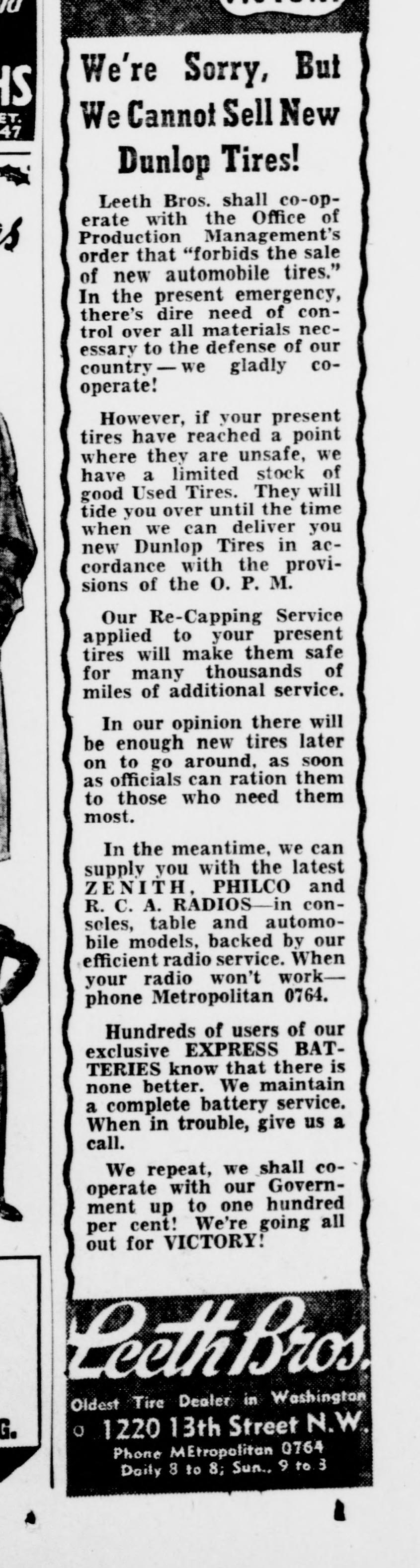
On December 12, 1941, five days after Pearl Harbor, a Washington tire dealer bought space in the Evening Star to say what it could not sell.
“We Cannot Sell New Dunlop Tires!” the advertisement announced. Leeth Bros. would co-operate with the Office of Production Management’s order that “forbids the sale of new automobile tires.” It had a limited stock of used tires. It could recap the ones you had. And it could sell you a radio — Zenith, Philco or R.C.A., in console, table and automobile models.
The ban had taken effect two days earlier. Tires were the first thing the United States rationed in the war, and the earliest place the order becomes visible in this story is not a regulation but a dealer’s paid space.
The reason was rubber. Warfare in the Pacific had cut off Far East imports, and Price Administrator Leon Henderson told a press conference the country would cut its crude rubber processing by 80 percent — civilian consumption from 47,000 tons a month to 10,000. Manufacture of new passenger tires would be eliminated almost entirely for the present. Rubber in toys, rubber balls and bathing suits would probably be halted altogether.
What was left would be rationed. As the Star reported it on December 18, new tires would be sold only to people holding ration cards, and local boards would decide who got one. Rationing would begin January 4.
The trade split at once. In Akron, the president of B. F. Goodrich called rationing “the fair way to deal with this country’s complex rubber problem.” In Hartford, the head of the independent dealers’ association called the plan “a little too severe” and said “we can’t fight a war hiring mules and riding around in buckboards.” Washington dealers who had promised customers new tires the following Monday said they would have to tell them to “wait and pray that they can get a ration card.”
Washington did its own arithmetic. On December 27 the Star reported Traffic Bureau figures of about 141,000 pleasure cars, 4,600 taxicabs and 15,000 trucks in the District, and concluded that “upward of 150,000” vehicles could end up in storage. The traffic director thought congestion would solve itself and commuting would get worse; work hours “will have to be staggered even more drastically, as I see it.” The FBI had already warned owners to safeguard the tires they had.
The next day the paper ran the rules as questions and answers. Milk and bakery trucks fell under the ban. Bicycle tires did not, though none were being made except for defense. Retreads in dealers’ hands were put at about 200,000, used tires at a “very rough” 1,500,000, new tires at 8,000,000 — two months at normal demand.
The regulations came on December 30, “effective immediately.” No person, they said, “shall sell, lease, trade, lend, deliver, ship, or transfer new rubber tires, casings, or tubes,” except as the Office of Price Administration provided.
The program also changed hands: an OPM order published in the Federal Register at the end of December passed tire rationing to the OPA, which is why the dealer’s advertisement credits one agency and the January news columns the other.
The local boards began work in the first week of January. Who was essential enough to get a certificate is a story this publication has already told, from two counties in Michigan and North Carolina. This one is about what happened to everything else.
On January 8 the Star sent a reporter out to buy a retread. Retreaded tires that “a few weeks ago cluttered store windows and stock rooms” had all but disappeared. In nearly twenty stores, eight retreads in a small-car size were found for sale. One dealer with three wanted $10.95 apiece and admitted that was an increase of more than 100 percent. Another had nothing — no tires, no tubes, no rubber to patch with. “I am even out of casings I used to sell for junk.”
An official of the American Automobile Association didn’t believe it. “I hate to ruin a good story,” he said, and named a firm whose branch plant he had seen packed with made-over tires two weeks before. The Star called. “We are sold out,” the firm said. “In fact, we are 8,000 or 9,000 orders behind.”
Used tires that dealers had been taking in trade for next to nothing — one motorist had been offered eight cents apiece for his, two months before — were now $3.50 to $10. Retreading ran $6 to $9 a tire, and only two dealers in the survey could do it within a week. A motorist who complained that a dealer wanted $12.99 for a small retread, “several times the price of a month ago,” was told that next month he would be glad to pay $15.
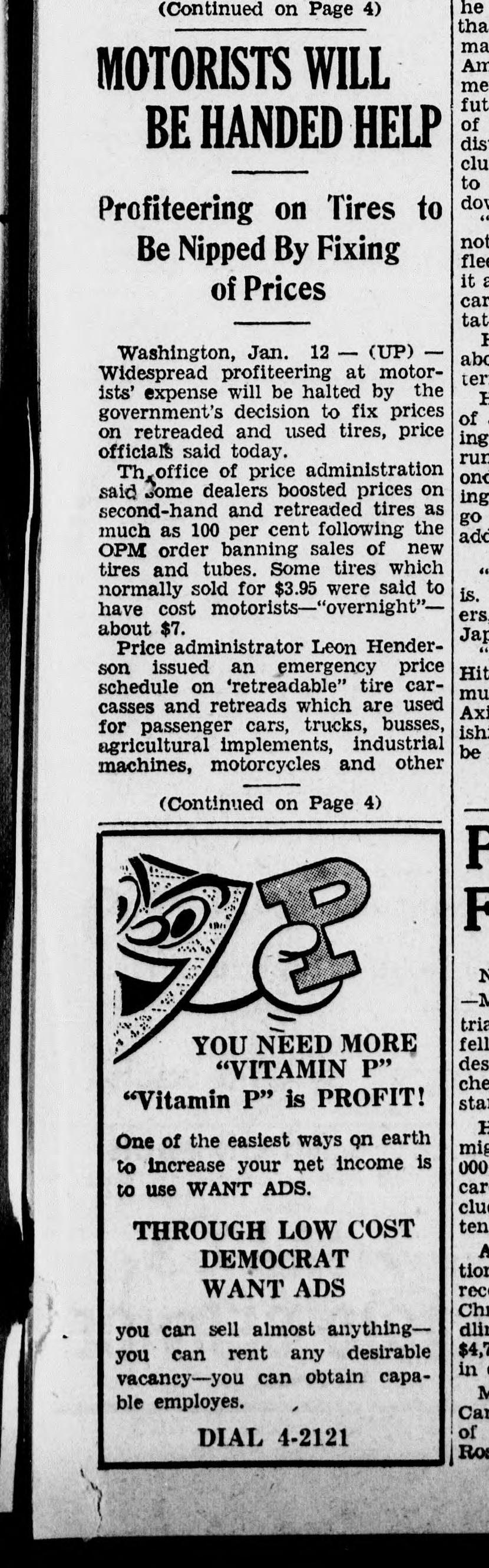
Four days later the government fixed the prices. The story ran on the front page of the Waterbury Democrat: dealers had boosted prices on second-hand and retreaded tires “as much as 100 per cent following the OPM order banning sales of new tires and tubes,” and Henderson had issued an emergency price schedule. Tires that normally sold for $3.95 had gone to about $7 — “overnight.”
The order came four days after the Star’s survey. The policy had been made in Washington in December; by the second week of January it could be read in a dealer’s window, a retreader’s order book and a wire story on a Connecticut front page.
The dealers went to Congress on January 15. George G. Berger of New York asked the House Small Business Committee to save the trade from “total economic extinction” — 15,000 to 20,000 independent retailers and 57,000 workers. J. L. Girard of Newark said that at the rate his firm was selling, its stock “will last 30 years” — two tires in the first eight days of rationing, against a hundred a day before. Thomas Graham of Chicago had sold one.
Henderson answered the next day, and the fight was over Washington’s taxicabs. They were not on the eligible list. Even though they were important, he said, they were not important enough to go on a list of indispensable uses. Taxis ran empty on return trips, cruised for fares, carried sightseers; they were “a symbol of luxury transportation,” and “beyond the reach of the ordinary worker.” Then the sentence the program rested on: “Can we expect widespread public support for a program which denies tires to various needy persons, for basic uses, at the same time that we allow tires for luxury and wasteful uses?”
The OPM, he said, was “besieged.” “Mail bags full of letters and briefs have poured in.” Defense workers, farmers, milk delivery companies, retail grocers, social workers, insurance agents, traveling salesmen — all wanted on the list. Give the taxicabs a hearing and thousands of others would be entitled to one.
Representative Schulte of Indiana was not persuaded. “We have the most damnable system of transportation in the country,” he said. “The Burma road is a pleasure compared with riding on our street cars.” Take away the cabs and make their riders board that system? “I agree,” Henderson replied, “but that doesn’t make any more rubber.” Schulte then noted that the president of the Capital Transit Company sat on the District’s tire board, and that his company had 500 new buses on order. “My God, Mr. Henderson,” he said, “if they add 500 buses and streetcars here you won’t be able to get through on your bicycle.”
In Waterbury the price order ran on page one. Inside, the same day, a syndicated column told readers what the country would do if it could not get autos or tires: it would learn to get along without them. “Courting is going back to the parlor.” The bicycle “may come back with a rush.” Streetcars would carry twenty men on one set of tires instead of one.
Four days after that, on January 16, the Democrat’s classified page carried a new kind of notice among the lost passbooks and the day nurseries. “WILL BUY ANY SIZE USED TIRES FOR CASH,” it read, over the name of Joe’s Tire Shop. Down the column, the used-car dealers had changed their pitch. A 1937 Studebaker was offered by model and then, in the same capitals, “ALL NEW TIRES.” A 1934 Pontiac, “Nearly new tires,” $145.
The government had rationed the new tires. The classifieds show what that did to the price of the old ones.
“We Cannot Sell New Dunlop Tires!,” Evening Star, December 12, 1941, p. 63. Library of Congress, Chronicling America. loc.gov/resource/sn83045462/1941-12-12/ed-1/?sp=63