Not Loud Enough
Washington adopted an air-raid warning in December 1941. The next day's test barely drew notice; ten days later wardens still couldn't hear the sirens. The Evening Star had predicted the problem before the first blast.
In the first week of the war the blackouts came before the signals. On the Pacific Coast they were ordered by military authorities; the Waterbury Democrat put the word in quotation marks in its headline, and in Seattle a crowd of more than a thousand smashed store windows to enforce the city’s first. Two nights later the Army’s Fourth Interceptor Command darkened Southern California for three hours: “There are planes over and south of Los Angeles that are unidentified. This is not a practice blackout.” New York had its night of sirens on the 9th — “all a bad dream,” the Associated Press wrote the next morning — and Waterbury held a warden school.
“Civilian defense, as now constituted, is ‘partial defense,’” the Evening Star’s editorial read on December 10 — “a part-time job by the Mayor of New York, who is being given the part-time assistance of Mrs. Roosevelt.” In the District it was the Commissioners’ part-time job, and they had no money. Then the sentence the next six weeks would prove: “Here in Washington we lack an adequate air-raid signal alarm. People would not recognize one if they heard it.”
The next day the District adopted one. The Star’s headline was Washington Air-Raid Signal Is 15 Short Whistle Blasts — five short blasts at half-second intervals, repeated three times.
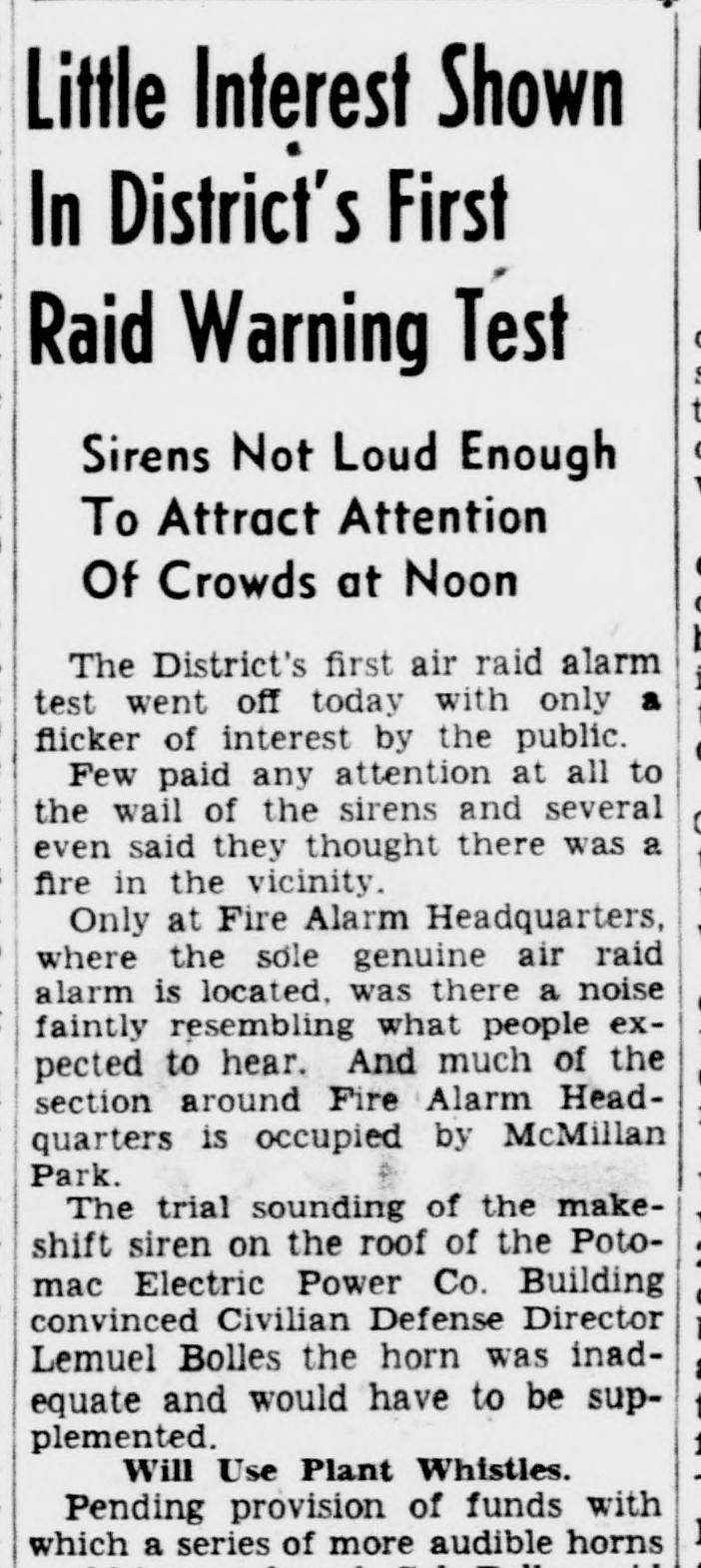
On December 12 it was tested at noon. On page 25 the story ran under a three-line head, Little Interest Shown / In District’s First / Raid Warning Test, and a deck that said why: Sirens Not Loud Enough / To Attract Attention / Of Crowds at Noon. “The District’s first air raid alarm test went off today with only a flicker of interest by the public. Few paid any attention at all to the wail of the sirens and several even said they thought there was a fire in the vicinity.” Only at Fire Alarm Headquarters, where the sole genuine air raid alarm was located, was there “a noise faintly resembling what people expected to hear.”
The federal handbooks did not prescribe a single national sound. They left the public warning to local commanders. In A Handbook for Rescue Squads, dated December 1941 and signed by F. H. LaGuardia as U.S. Director of Civilian Defense, the alert works like this: “the Commander of the local Citizens’ Defense Corps orders the alert, has the public warning sounded usually short blasts on air horns, power horns or steam whistles or on the wailing sirens— and if the bombers arrive overhead, directs the operation of passive defense.” Horns, whistles, or sirens; short blasts or wailing; no duration and no national tone. The same sentence appears in A Handbook for Fire Watchers.
On December 21 the District tested the whole apparatus, and the Star’s account the next day gave the internal stages first. At 9:07 the “blue” signal, the alert, was flashed and cleared to all points in two and a half minutes; at 9:17 the “red,” meaning a raid was on. Only then did the sirens throughout the area give the public its first warning. A hospital reported the alarm went unnoticed. “Only the watchers on the roof of the Shoreham Hotel detected the alarm, and air raid wardens at the Wardman Park couldn’t hear it at all. Even the Willard Hotel, only four blocks from the make-shift siren atop the Potomac Electric Power Co. Building, reported hearing the alarm only faintly.”
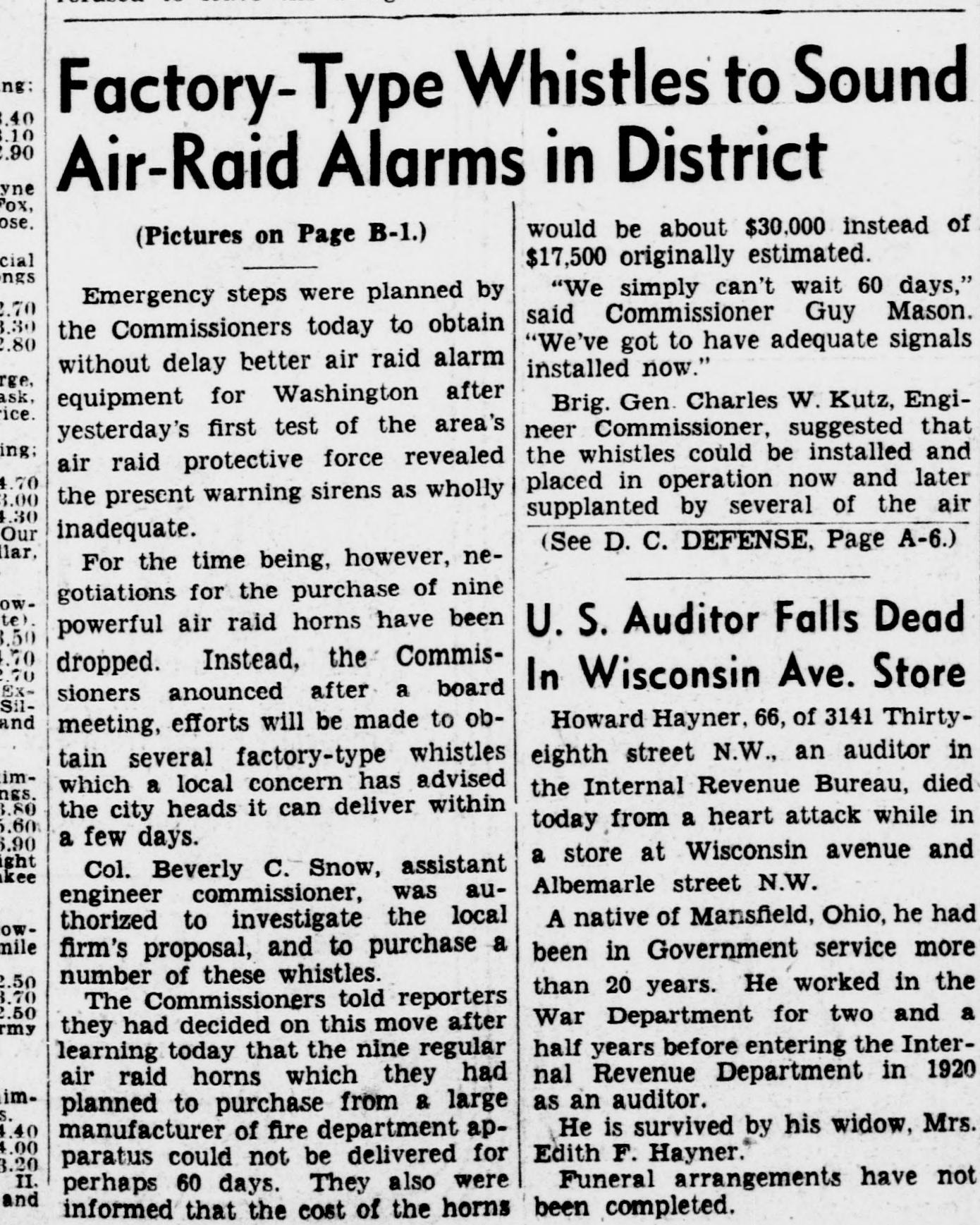
It was on the front page that Monday under the headline Factory-Type Whistles to Sound / Air-Raid Alarms in District. The test “revealed the present warning sirens as wholly inadequate.” The nine air raid horns the Commissioners had planned to buy could not be delivered for perhaps sixty days; a local concern said it could deliver factory whistles within a few days, and an assistant engineer commissioner was authorized to buy them.
Two days after the admission, on the letters page, a reader named Edward Strauss answered it. He had waited in the street for the siren, had not found anyone in his neighborhood who heard it, and had finally called the police, who told him it was all over. “At least if I could hear the siren, I would have an opportunity to make a mad rush to the basement with my wife and two children. If I cannot hear it when knowing and waiting for it, how am I going to be awakened if we have a real raid?” And then: “If it is money that is holding up the sirens, I for one am willing to contribute and I am sure a lot of others would also.”
By January the newspapers were showing the regional machinery in action: on the 2nd the Star carried a Boston dispatch crediting Dean Landis, regional director for the first civilian defense area, which was New England, with the region’s preparations for raids by enemy bombers. On January 18 the Star reported that the Federal Office of Civilian Defense, “in publishing instructions for local defense organizations, recognized the functional limitations of sirens.” Its suggestion: an air-raid signal “be either a continuous, wavering wail lasting about two minutes or that it be a series of five-second blasts, with three seconds of silence between blasts. The all-clear should be a continuous, steady sound.” A siren, the Star noted, isn’t like a whistle, which can be shut off instantly; it takes a while to run down. Washington had adopted one public signal in December and was now being offered another. The blue and red of the December 21 test had been internal stages, relayed to all points before any siren sounded, not the sound meant to tell the public — and the two tests of that sound had drawn a flicker of interest and a hospital that noticed nothing.
Two days later, on page 20, the Star showed what one neighborhood had done instead. Franklin Kendrick, the Kent sector warden, had put the idea to the sixty-eight families living in Kent: “He asked each one to contribute $5—and told them he’d be back for more if more were needed.” The owner of the development offered the land. “An architect, Oscar Vatet, volunteered to draw up plans for the station, and work soon was under way.” When the builder could not get carpenters, a building firm loaned four. The equipment, the caption said, was for fighting incendiary bombs; Kendrick had collected the money and “stayed on the job till it was done.” In equipping the station he had followed the District’s instructions, the Star reported, and then gone ahead on his own initiative and added some ideas of his own.
The official warning system was still being revised. In Kent, sixty-eight families had already built their own post.
“Not Loud Enough,” Evening Star, December 12, 1941, p. 25. Library of Congress, Chronicling America. loc.gov/resource/sn83045462/1941-12-12/ed-1/?sp=25