A Sort of Goodwill Court
Congress gave one city statutory rent control a month before it gave the country the power to impose it. The day the District's office opened, the first complainant heard was a registered nurse who said her landlady had turned off the heat. Nearly seven hundred people reached the office before the day was out.
On January 2, 1942, the first complainant heard at Washington’s new rent control office was a registered nurse. Mrs. Robert P. Smith rented an apartment on North Capitol street, where she lived with her husband and son. In the fall she had taken in a destitute mother and baby who had been deserted. Several weeks ago, she said, the landlady ordered them to move, wanting to fix up the apartment and raise the rent. When she refused because there was “no place to go,” the landlady threatened to freeze them out. For the past two weeks, Mrs. Smith said, they had had no heat or hot water: the landlady had refused them heat, she said, and had told her the water heater was broken. Earlier in the fall the baby had fallen ill with pneumonia and nearly died; it had been sick since, and she had nursed it while its mother worked as a waitress.
She was, the Evening Star reported that afternoon, the first complainant heard by Administrator Robert F. Cogswell as the District emergency rent control law went into effect.
The law had been signed a month earlier. On December 2 President Roosevelt approved the District’s rent control measure, and the Star’s headline that day was about the calendar: Rent-Control Bill / Signed; Operation by / January 3 Likely. Its deck was about a vacancy — Commissioners Still / Undecided on Choice / For Administrator. The statute set the salary at $7,500 a year and gave the appointment to the Commissioners of the District of Columbia, who insisted they had made no commitment. Commissioner Young, back that day from a Florida vacation, said he had “an open mind.”
The Act’s own finding was that the emergency and the defense program had “aggravated the congested situation with regard to housing accommodations existing at the seat of government” and would lead to “profiteering and other speculative and manipulative practices by some owners of housing accommodations.” On and after the thirtieth day following its enactment — January 1, 1942 — rents in Washington were frozen at what landlord and tenant had been entitled to a year earlier, on January 1, 1941. A landlord or a tenant could petition to adjust the ceiling. A landlord could not recover possession of an apartment from a tenant paying the lawful rent, lease or no lease, except in the circumstances the Act set out — among them a landlord seeking the place in good faith for his own immediate use, or to remodel on plans the Commissioners approved. And a tenant overcharged could sue for double the excess or fifty dollars, whichever was greater, in the municipal court of the District of Columbia — which the Act gave “exclusive jurisdiction,” regardless of the amount involved.
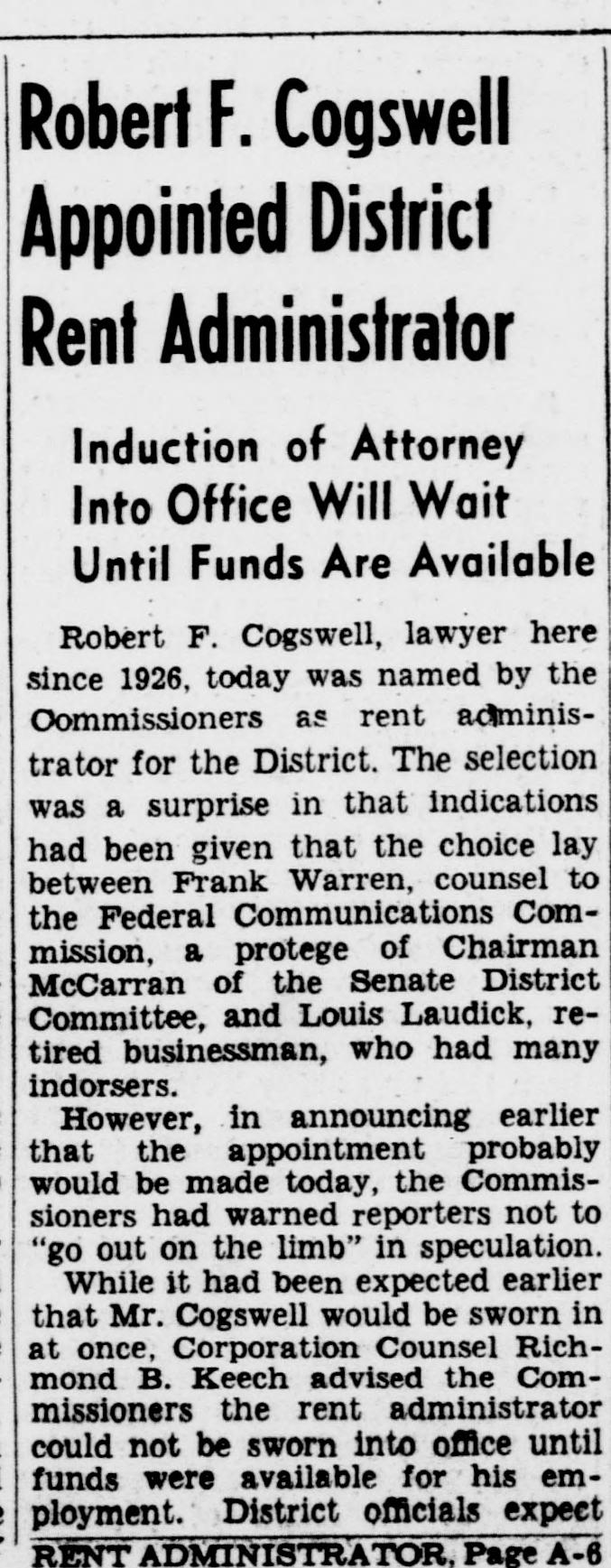
On December 17 the Commissioners chose. Robert F. Cogswell, a lawyer in the city since 1926, was named on the Star’s front page under a three-line head — Robert F. Cogswell / Appointed District / Rent Administrator — over a deck that said he could not yet start: Induction of Attorney / Into Office Will Wait / Until Funds Are Available. The Corporation Counsel had advised that the administrator could not be sworn in until there was money to employ him. The choice was a surprise; the Commissioners had told reporters not to “go out on the limb” about it. A photograph of the swearing-in ran on the 22nd, the secretary of the Commissioners administering the oath while Guy Mason, John Russell Young and Charles W. Kutz looked on.
The Star’s editorial page approved, and in approving it remembered something. “District Commissioner Mason spoke with a sincerity born of his own rent-fixing experiences when he told reporters that Mr. Cogswell faces ‘a tough job,’” the paper wrote on December 18. Mason had been a rent commissioner himself, after the first World War, on what the Star called the ill-starred District Rent Commission — handicapped, it said, by “an impracticable law that called for endless investigations, hearings and red tape.” In passing this one, it added, “Congress made it plain that it wished to avoid the ponderous machinery of the old Ball Act.”
The ceilings bound from January 1. The office opened on the 2nd. By the end of that first day nearly 700 landlords and tenants had called in person, telephoned or written in, and the next day’s paper ran the arithmetic under Rent Control Office’s / Pace Slackens After / Hectic Opening Day. Complaining tenants outnumbered landlords by more than two to one, Cogswell said, and there were many on both sides in need of relief. For want of clerical help he had answered nearly all of about 400 telephone calls himself.
The Star’s own real-estate column saw the same office and described a different problem. Washington rents and services were now “under strict Government control,” it noted, but time had been so short that the administrator had not had the chance to clear up points “which would relieve real estate interests of a great deal of worry.” He had had no office at all until he moved into “permanent” quarters at the old Force School. He was badly in need of assistance. His day had gone in telephone calls, “and there were a lot from cranks in the crowd.” He would not be issuing a general statement to ease the worries of the hundreds of landlords with “peculiar cases” to put before him; he would take them one at a time.
By the third day the Star’s reporter had a phrase for what the office had become. “After two days in office, Rent Administrator Robert F. Cogswell finds himself conducting a sort of goodwill court where people come to spill their woes, due largely to public misconception of what the District’s new rent control law is all about.” Numerous landlords, he found, had not heard of the law at all, while tenants arrived saying they were threatened with eviction unless they paid more.
An elderly woman broke down and cried in his office. A tenant had cursed her over a misunderstanding about last July’s rent; she believed the month had gone unpaid and wanted the administrator’s help collecting it. He sent her to Municipal Court, and listened to the rest of her story anyway, with the outer office full of people waiting. Another woman telephoned: “Are you the rent administrator? Well, I certainly am having a terrible time finding a house. Do you have anything down there for about $50?” Cogswell looked at the line, said he had worries of his own, and added that he was very happy the job of finding houses wasn’t his.
Nine days after the ceilings bound, the office’s formal adjustment machinery was still not fully operating. Cogswell would name three examiners later that week, the Star reported on January 11 — trial lawyers who knew local practice and knew District housing — and only when they were sworn would the office start formally hearing cases of tenants and landlords seeking adjustment. Until then he had been “acting only in an advisory capacity except in several flagrant cases demanding immediate attention.” The complaint forms had finally arrived and gone out to hundreds of people who had asked for them.
In Waterbury they were watching. “Washington, the capital, is in the lead in rent control,” the Waterbury Democrat told its readers on January 5, “a problem which has struck almost every city in greater or less degree” — and the capital could be regulated in ways that “may be impracticable in most communities,” being directly under Congress. The act going into effect January 1 pegged rents at the level of a year before and would run until 1945. Washington had tried this before, during and after the last war, with varied success. Now, the paper wrote, “its experiment will undoubtedly be watched as a laboratory test by other communities in which rent boosts have fallen all too often on the part of the people least able to bear them.”
On January 30 Congress gave the country the power. The Emergency Price Control Act let the Price Administrator recommend that rents be stabilized, and only if a defense-rental area had not stabilized them itself “by State or local regulation, or otherwise” within sixty days could he set maximum rents. Its benchmark was April 1, 1941, three months later than the District’s. And in its definitions: “The term ‘defense-rental area’ means the District of Columbia and any area designated by the Administrator.” Other defense-rental areas had to be designated by the Administrator. Washington was named in the statute itself.
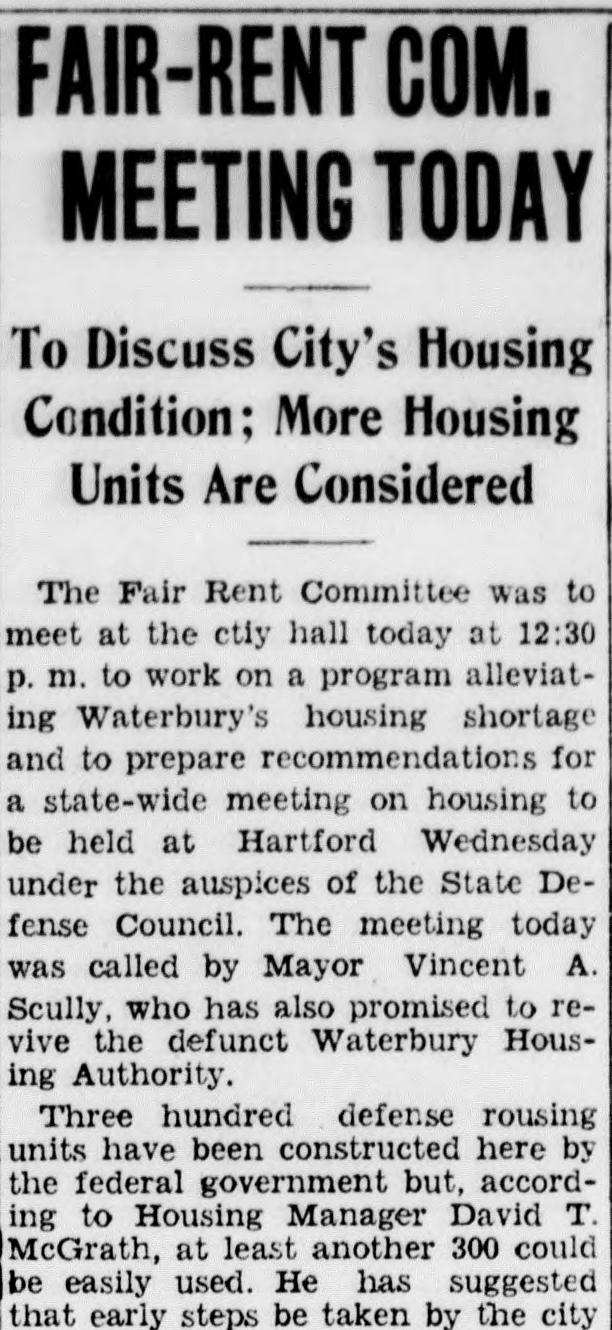
On the last day of January, Waterbury’s Fair Rent Committee was to meet at the city hall at half past twelve, to work on a program for the city’s housing shortage and to prepare recommendations for a state meeting in Hartford. The mayor had called the meeting; he had also promised to revive the defunct Waterbury Housing Authority. Three hundred defense housing units had been built there by the federal government. In Washington there was a statute, an administrator at $7,500 a year, three examiners about to be sworn, and a court with exclusive jurisdiction. In Waterbury there was a committee, due at the city hall that afternoon.
“A Sort of Goodwill Court,” Evening Star, December 17, 1941, p. 1. Library of Congress, Chronicling America. loc.gov/resource/sn83045462/1941-12-17/ed-1/?sp=1