The Deciding Vote
Five weeks before the President wrote that he hoped night games could be extended, the commissioner of baseball had personally cast the deciding vote against them. The letter was addressed to him — and he called the meeting that would decide how far the leagues would go.
On December 9, 1941, two days after Pearl Harbor, the seventy-two-year-old president of the Washington Baseball Club asked the major leagues’ winter meeting in Chicago for the lights.
“Our country finally and definitely is placed on an emergency basis,” Clark Griffith said. “In no other city will the pressure of national defense work be felt more than in Washington. What I am asking is permission to play night baseball from June 15 through at least September 15, Saturdays and Sundays excepted.”
He had come to Chicago meaning to ask for fourteen night games instead of the seven each club was allowed. The Evening Star’s man at the meeting reported that the news from the Pacific changed his mind: “As he took in the first news flashes of the Japanese-United States War, Griffith changed his mind,” and he asked instead for lights on everything after the middle of June. The same paper noted that he had once been the arch-enemy of night baseball.
His argument was about who was working, and when.
“Nobody is more behind President Roosevelt and the Nation than I am,” he said, “but at the same time there is no way of laughing off the importance of entertainment. The Government is very lenient and understanding about this matter. As I see it, Washington people will be working night and day on national defense—and national offense. Why shouldn’t baseball collaborate, making it possible for day workers to see ball games during the night, and night workers to see the week-end games?”
Two days later he lost.
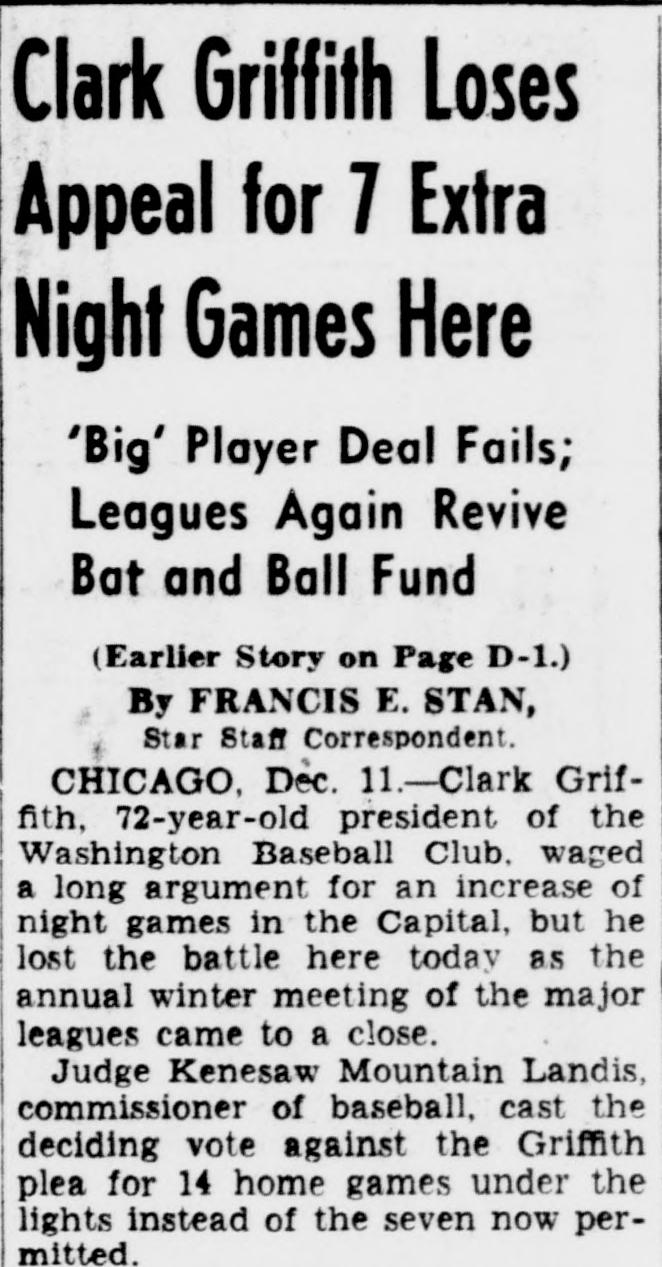
“Clark Griffith Loses / Appeal for 7 Extra / Night Games Here,” the Star’s headline ran on December 11, over a story datelined Chicago. Griffith “waged a long argument for an increase of night games in the Capital, but he lost the battle here today as the annual winter meeting of the major leagues came to a close.” The American League had voted Washington, St. Louis and Philadelphia permission to double their night games. Connie Mack of the Athletics declined it, on the ground that the Phillies were held to seven by National League rules and it would be unfair. The National League refused to allow more than seven. And so the matter went to one man.
“Judge Kenesaw Mountain Landis, commissioner of baseball, cast the deciding vote against the Griffith plea for 14 home games under the lights instead of the seven now permitted.”
It was not the first time. Deeper in the same day’s paper, in the sports section, the Star’s Sports Mirror column marked an anniversary. “Today a year ago—Commissioner Landis cast deciding ballot as major leagues voted to limit night games to seven for each club; American League wanted increase.” The seven-game limit Griffith had just failed to escape was one Landis had set, in a vote that had lined up the same way.
The increase was already expected to fail before there was a war. A United Press correspondent had written from Chicago on December 6 — the day before the attack — that a proposal to raise the limit from seven to fourteen “apparently faces a quick defeat in the leagues’ chambers.” What the war changed was Griffith’s case for expanding it.
At the meeting itself, the same correspondent reported on December 11, the owners were shrugging off the particular wartime changes that might be asked of them. “Since they asembled Monday for their annual sessions,” he wrote, “league and club officials have spoken of the war only in general terms, shrugging off suggestions of night baseball blackouts, schedule curtailments or revision of training camp plans.”
Griffith took the loss with a door left open. If night ball turned out to be absolutely necessary, he said, he could take the matter up again with the Advisory Council, Judge Landis, and the two league presidents.
He did not have to raise it. On January 14 Landis wrote to the President, and got his answer the next day.
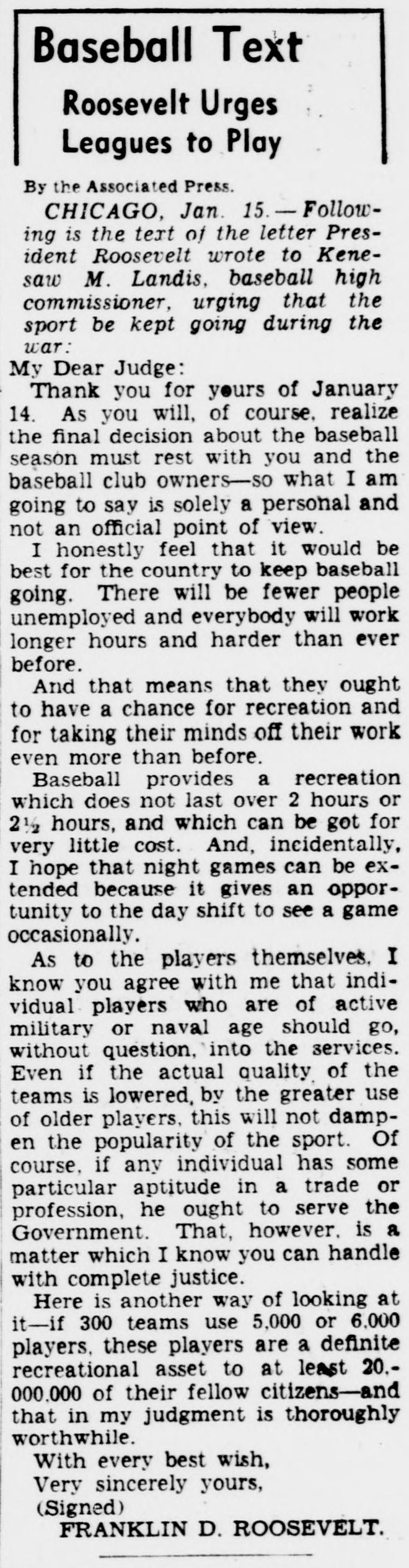
The Evening Star printed the whole of it on January 16, boxed on page three beside the jump of its own front-page story, under the heading Baseball Text.
Most of it is about keeping baseball going at all. One sentence is about the lights.
“And, incidentally, I hope that night games can be extended because it gives an opportunity to the day shift to see a game occasionally.”
Set that beside what Griffith had told the meeting five weeks earlier — night baseball, so that day workers could see a game — and it is the same argument, in nearly the same terms, made by a man who had been voted down for making it. The letter was addressed to the man who cast the vote.
The President was careful about what the letter was. “As you will, of course, realize the final decision about the baseball season must rest with you and the baseball club owners — so what I am going to say is solely a personal and not an official point of view.”
The Star’s front page that day ran the head Roosevelt Tells / Baseball Clubs / To Carry On, and under it a deck that singled out the night-games clause: Sport Aids Morale, He Says, Urging More Night Games. The only club reaction on that page came from St. Louis — Browns’ President Rejoices at Prospect. Griffith’s own did not reach page one.
In Connecticut, the Waterbury Democrat ran the same wire under a different question. Its front-page head was PLAY BASEBALL / SAYS PRESIDENT, over a deck reading Game Must Not Be Stopped / Is Advice of U. S. Chief / Executive. In Washington the news was night games. In Waterbury it was whether there would be a season at all.
Griffith read the sentence with what the Star’s columnist called pardonable glee. Had he written the letter himself, Francis E. Stan wrote on January 18, he could not better have expressed his own sentiments — and then added, in a parenthesis: “(Incidentally, Mr. G. says he had no finger in this particular pie.)” Stan went further than the letter did. “President Roosevelt has ordered night ball!” he wrote. “The stubborn National League foemen of Griffith capitulated yesterday.”
They had not. What the National League did on January 17, according to the Associated Press wire of that day, was agree “that each club should be permitted to play more than seven night games” — and Ford Frick pointed out that doing it would require changing the league’s constitution. How far the majors would actually go “will be decided at a joint meeting with the American League here the first week in February.”
By then a second problem had entered the argument: steel and copper. The Cubs had begun wiring Wrigley Field for lights in 1942 and gave it up after Pearl Harbor: a hundred and sixty-five tons of steel, thirty-five thousand feet of copper wire and other equipment went to the government instead. “We felt this material could be more useful in lighting flying fields, munition plants or other defense plants under construction,” P. K. Wrigley said. If the consensus was that they should play at night, the club’s general manager said, they would try to rent Comiskey Park from the White Sox. Both men said it would be a blow to their pride to play anywhere but their own park, and the only sane thing to do. In Boston, Bob Quinn of the Braves put it plainly on January 20. “The Braves can’t have night ball in Boston at present,” he said, “unless the way is made clear how we can secure the materials to build the new plants.”
The letter had already left baseball. On January 24 a labour weekly in New Haven reported that Local 273, the motion-picture operators, had cancelled its annual banquet, bought defense bonds with the money, and opened a drive to organise every theatre in the city. “The local’s skilled manpower is at the disposal of all theatres in the area for the duration of the war,” the paper reported. “This is in line with President Roosevelt’s letter to Judge Kenesaw Mountain Landis, High Commissioner of Baseball, which stressed the need on the part of defense workers for relaxation in these critical times.” Eight days after it was printed, a letter about baseball was being cited in a campaign to organise a city’s theatres.
And on January 20, Landis called the meeting. The Star reported it the next day: the President had suggested that more night games be played, and the commissioner “yesterday called a joint meeting of major league club owners for February 3 in New York to discuss such action.” The National League had agreed to an increase, the paper noted, while hoping the maximum would not exceed fourteen — the number Griffith had asked for in December. Some American League clubs would prefer fourteen as a minimum. A decision was expected on February 3.
The man who had twice cast the deciding vote against more night baseball had now received the President’s personal hope that night games be extended — and had called the meeting that would decide how far the leagues would go.
“The Deciding Vote,” Evening Star, December 11, 1941, p. 2. Library of Congress, Chronicling America. loc.gov/resource/sn83045462/1941-12-11/ed-1/?sp=2