We Can't Sell the Cars We Have
On New Year's Day 1942 the government stopped the sale of new automobiles. The Evening Star carried the alarm on its front page the next day and sent readers inside for the order itself — where three Washington dealers counted up what it would cost them, and the paper set out the wrong order.
On January 2, 1942, on page twenty-one of the Evening Star, three Washington automobile dealers said what the new year had cost them.
Joseph Cherner, president of Cherner Motor Co., said his firm would probably have to dismiss between fifty and sixty employees immediately, and that he might eventually be forced to close for the duration. His firm had about a hundred and twenty new cars in stock. “We’re not complaining, though,” he told the paper. “The primary thing is to win this war, and we’ve got to expect things like this.”
J. J. Blank of Arcade Pontiac had a hundred and eleven employees, and predicted that perhaps as many as ninety of them would have to be dismissed. Most of the sales force was already discharged. He would have to shut down, he said, “unless we can get the Government to rent part of our building.” His stock was a hundred and twenty cars too, and he had worked out what he would have done with them. “We have about 120 new cars in stock and had planned to ration ourselves to, say, 10 cars a month. That would enable us to keep going for a year. We wouldn’t make any money, but we wouldn’t have to close shop. But as the order stands, we can’t sell the cars we have.”
Arnold McKee had sold his out. Acting “on a hunch,” he had disposed of his new cars a week before, and nobody at McKee Auto Service would be dismissed for the time being; the men in new-car sales had already been moved to the used-car department.
The order had taken effect on New Year’s Day, prohibiting the sale, lease, trade, loan or delivery of new passenger cars, and the dealers had not seen it coming. They were “surprised by the suddenness” of it, the Star reported, and puzzled that it applied to the cars already sitting in their lots — cars they were paying interest on. “What are we to do,” they asked, “let them stand here and rot?”
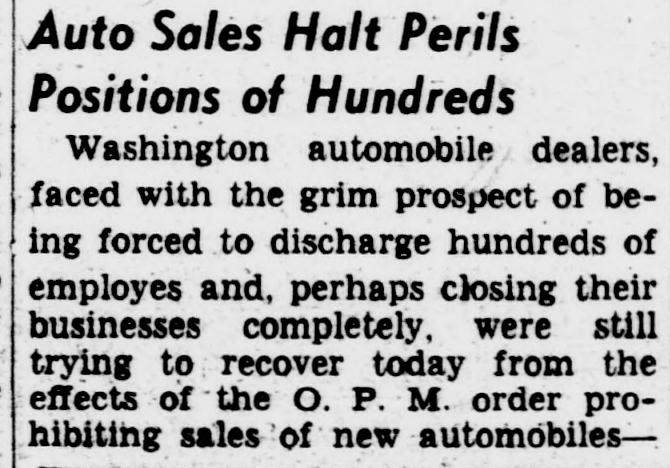
The Star had put that on its front page, low in a column under a modest two-line head: Auto Sales Halt Perils / Positions of Hundreds. The banner that day belonged to the war — twenty-six nations pledging not to make a separate peace. The dealers’ own words, and the explanation of the rationing system meant to replace the ban, ran inside on page twenty-one. The people were on page one; a reader who wanted the governing order was sent to page twenty-one to find it.
Directly above them on the front page was the man who would have to ration what was left. Leon Henderson, the price administrator, told a press conference he could not see “any passenger car production for the duration” beyond the two hundred thousand cars the industry would be allowed to finish before assembly stopped at the end of January. About four hundred and fifty thousand cars were frozen in dealers’ hands, and rationing would begin around the fifteenth. Asked whether the government might end up commandeering privately owned automobiles, he called it a “hot” question and one of several “gloomy prospects” facing the country.
What page twenty-one printed was not that order. “The text of the O. P. M. order prohibiting purchase, sale or delivery of new passenger cars follows,” the Star wrote — and set beneath the promise Supplementary General Limitation Order L-3-e, which prohibits the sale of light motor trucks. It ran to the end: the definition of a light truck, the address for communications, the effective date, and the signature of Donald M. Nelson, Director of Priorities. Beneath it the paper set a note — separate orders, worded almost identically, had been issued for light motor trucks and for medium and heavy motor trucks and truck trailers — a sentence that makes sense under the order the Star had promised and not under the one it printed. The passenger-car order is not on the page, and its own language, passenger automobile, does not occur anywhere else in that day’s Evening Star.
The contraction had begun three weeks earlier. On the afternoon of December 11 the Office of Production Management cut the December quota for passenger cars and light trucks by a quarter and January’s by half — 51,212 cars off the 204,848 originally set for December, and January’s ceiling down to 102,424. The Star ran it as a boxed item on the front page, five sentences long, with no byline and no dateline.
Two days later the Associated Press reported from Detroit that Ford and General Motors would put all war operations on a seven-day, twenty-four-hour basis. The same story carried the other half: “thousands of G. M. employes throughout the Nation were idle and thousands more face imminent layoffs as a result of the drastic cut in automobile production ordered by the Government as a war measure.” Ford expected to close its factories the following week; General Motors could give no figures, though its president, Charles E. Wilson, had estimated that between ninety thousand and three hundred thousand would be laid off on the basis of a fifty-four per cent cut in new-car output. “We have taken this action in response to the Government’s declaration of all-out effort in the war,” Edsel Ford said.
By December 23 the question of who would manage the changeover, and who would pay for it, was before a House committee, and the War Department opposed handing war production to a civilian board. “The pains we have been undergoing are due to the partial transition from a peacetime economy to a war economy and not to inefficiency of the armed forces,” Undersecretary of War Patterson said in a statement; now that the country was at war, some of those pains would be alleviated.
A few minutes earlier the United Automobile Workers had endorsed the board and put a five-point program before the same committee. Its third point asked for “O. P. M. action to transfer and train displaced auto workers at Government expense,” its fourth for federal money to supplement unemployment payments. Its president, R. J. Thomas, called the refusal of some manufacturers to prepare for war work “a crime against the Nation which must no longer be tolerated,” and criticized them, the story said, for failing to adopt the CIO’s plan of a year earlier to use unemployed labor to convert automotive plants for aircraft production: “That was either poor judgment or actual sabotage.” Under a subhead reading Layoff of 250,000 Men, the same story reported that industry spokesmen and representatives of Gov. Van Wagoner had said the day before that more than a quarter of a million workers would lose their jobs — temporarily at least — through the curtailments already ordered.
On January 3 the Waterbury Democrat reported full-page advertisements in which the CIO criticized the OPM for failing to convert the industry months earlier — a letter addressed to “Mr. OPM,” signed by Philip Murray and by Thomas and George F. Addes of the auto workers. Half the nation’s automobile plants were closed, it said, and four hundred thousand workers would be idle by the end of January: “the nation has lost 2,000,000 man days every week in war production through failure to put the 400,000 automobile workers to work.”
On January 6 the President told Congress what the plants would be making instead. The Evening Star printed the message’s text: sixty thousand planes in 1942 and a hundred and twenty-five thousand in 1943; forty-five thousand tanks, then seventy-five thousand; twenty thousand anti-aircraft guns, then thirty-five thousand; and eight million deadweight tons of merchant shipping against 1941’s one million one hundred thousand.
On page seventeen of the same issue, an Associated Press writer counted the people. Between a hundred and fifty thousand and two hundred thousand men had worked as automobile salesmen, more than half of them already laid off and the rest to follow. More than three hundred thousand factory workers were affected, slightly more than half of them recalled to build the two hundred thousand cars still to be assembled in January, with idleness facing all of them when that ran out. The industry was converting as fast as it could, the story said, though “some quarters say not all the equipment can be so adapted even under the most intensive effort.” The most optimistic prediction the writer said he had heard in authoritative quarters was that some of the workers would be back on arms production by the middle of March, and that not all of them would be fully employed by the end of the year.
A week later the job got a name. On the evening of January 13 the President announced that Donald M. Nelson would head a new War Production Board — “His decisions will be final.” The Waterbury Democrat gave it the width of its front page the next afternoon: Generalissimo Nelson Is Supreme; Only President Outranks Him. The executive order creating the board was signed three days later, on January 16. It names nobody.
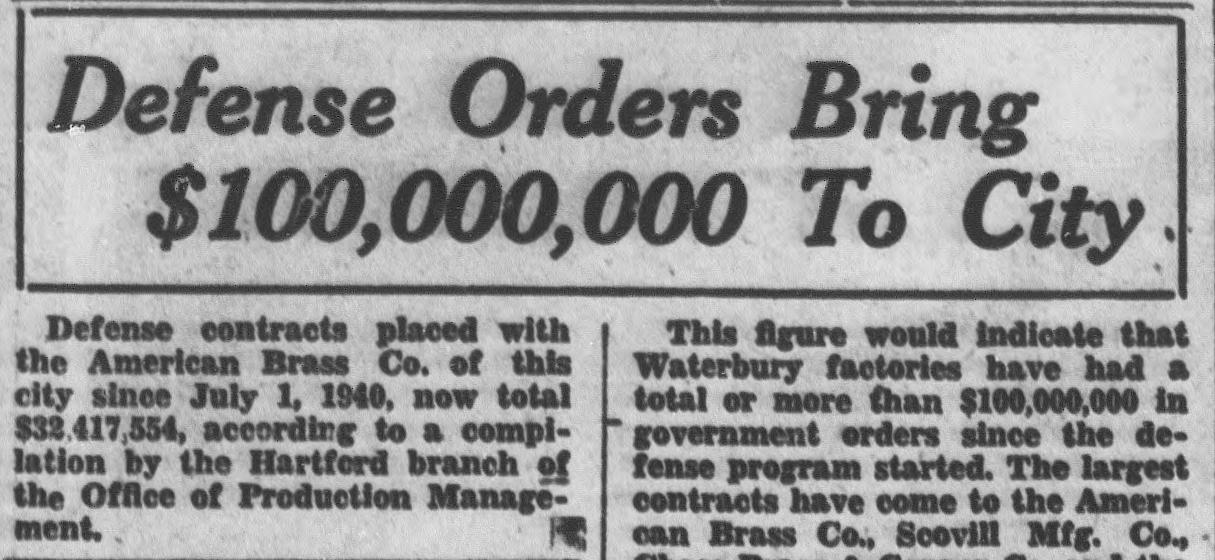
Some cities were on the other side of it. In Waterbury, a month before the ban, the Democrat had run a boxed headline three times the size of its body type: Defense Orders Bring $100,000,000 To City. The figure under it was smaller and firmer. Defense contracts placed with the American Brass Co. since July 1940 now totaled $32,417,554, the paper reported, according to a compilation by the Hartford branch of the OPM — twenty-seven contracts to that one firm. The hundred million was the Democrat’s own reckoning of what the whole city had taken in, extrapolated from that one company’s share — the page said as much. Local factories were making ready to go to seven days a week, twenty-four hours a day; plants with identification badges were checking them at every shift change. “Change-over” of the smaller factories, the paper wrote, was thought likely within a few months.
On January 31 the automobile industry stopped making cars for civilians for the first time in its forty-year history, and the Evening Star put the count in the headline: 300,000 Face Idleness. Assembly lines would carry war work as soon as retooling was done — the job that union and company officials called the “kernel” of the whole armament problem. The bulk of the laid-off workers would not be recalled until midsummer. Thomas had asked Congress for a “trainee wage” of up to twenty-four dollars a week for idle auto workers; he thought the shutdown would leave many of them out of work for months, and some for a year.
Blank had reckoned he could last a year at ten cars a month. The order did not let him sell ten.
“We Can't Sell the Cars We Have,” Evening Star, January 2, 1942, p. 1. Library of Congress, Chronicling America. loc.gov/resource/sn83045462/1942-01-02/ed-1/?sp=1