First, Last and Always
Three days before Pearl Harbor, the Waterbury chapter of the America First Committee sent a delegation to Hartford to hear Senator Nye argue against the war. Twelve days later it voted itself out of existence and gave its treasury to the local boys already in uniform. The papers recorded the reversal almost day by day.
On Thursday, December 4, 1941, the Waterbury Democrat told its readers that the local chapter of the America First Committee “will be represented by a large delegation tonight at an anti-war rally at Bushnell Memorial hall in Hartford.” The speakers were Senator Gerald P. Nye of North Dakota, “who addressed a capacity crowd at Buckingham hall a few weeks ago,” and John Cudahy, the former ambassador to Belgium. The chapter had just re-elected John Festa as its president.
The same day, from Chicago, the national committee announced it would take part in the 1942 congressional elections. Fascism, its statement said, results when a legislature surrenders to one man its power to decide for the people; in the face of “this same trend toward Fascism in America,” the people’s duty was to return only those members “who have kept faith with the people’s mandate to avoid participation in the war.” It was not, the committee said, an attempt to build a third party.
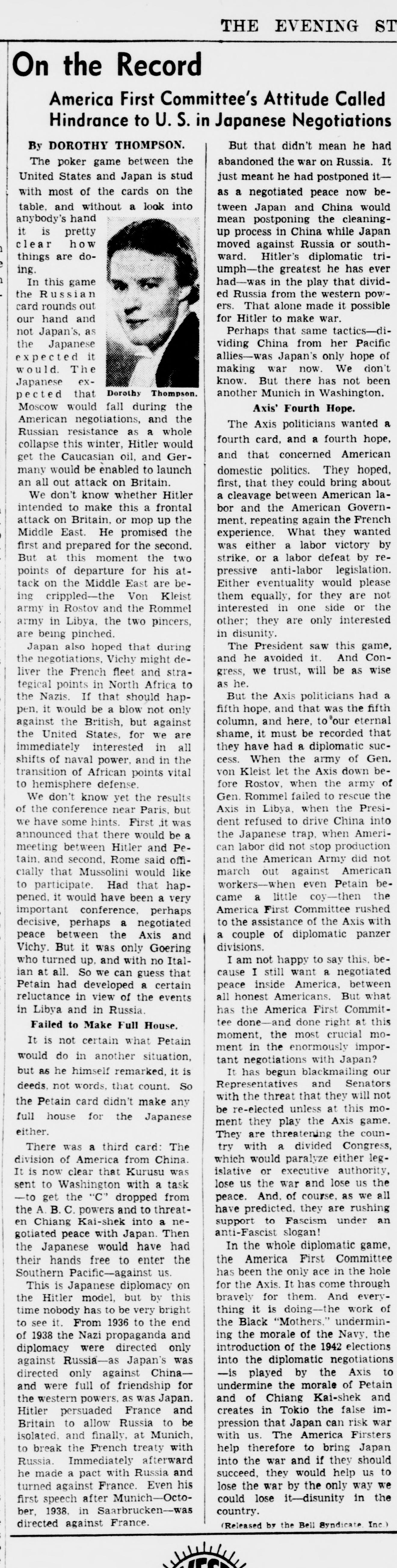
Dorothy Thompson had answered it the day before. The committee, she wrote in the column the Evening Star carried on December 3, “has begun blackmailing our Representatives and Senators with the threat that they will not be re-elected unless at this moment they play the Axis game.” It was “the only ace in the hole for the Axis,” and it was “rushing support to Fascism under an anti-Fascist slogan!”
Each side had the other down as the road to fascism. That was Wednesday and Thursday. On Sunday, Japan attacked Pearl Harbor.
Monday’s wire from Washington reported what Nye had said “in a speech at Pittsburgh”: that “if the facts are as presented, there is only one thing for Congress to do—declare war.” He was still critical of the negotiations. The administration had been “doing its utmost to provoke a quarrel,” he said. “At every turn, our negotiations denied the Japanese representatives a chance to ‘save their face.’ They wouldn’t give them a chance to agree with the United States.” The Evening Star that afternoon named the occasion — Nye “addressing an America First Committee meeting at Pittsburgh” — and carried a different sentence: “If Congress were to declare war, I’m sure that every America Firster would be co-operating and supporting the Government in the winning of that war in every way possible.”
The wire’s lead was the sentence that lasted. “Isolationist sentiment in Congress disappeared today almost without a trace,” John R. Beal wrote for the United Press. Wheeler said the bombs meant war and the country would have to see it through. Taft said the attack could only lead to a declaration. Vandenberg, who had “fought every trend which leads America to needless war,” now stood “for the swiftest and most invincible answer.” The Senate passed the joint resolution 82 to 0. Nye is in the yeas, between Norris and O’Daniel.
The committee itself had already spoken. Its national headquarters in Chicago issued a statement the night of the attack: “Today the military forces of Japan have without warning attacked this Nation and the Japanese government has formally declared war upon us. This must be followed by a similar declaration on the part of the United States and by all-out hostilities.” It urged its members to support the war effort until the conflict with Japan was won, and pledged its aid to the President as commander in chief. Lindbergh’s statement came through the committee the same day: “Now it has come and we must meet it as united Americans regardless of our attitude in the past toward the policy our Government has followed.” Irving S. Cobb quit the committee.
In Waterbury the war reached the congressional race first. The fifth-district campaign, the Democrat reported on Monday, “was entirely upset today as a result of yesterday’s momentous events.” Edward J. Ryan, nominated by petition as the American Progressive candidate on an anti-war platform, announced: “If war is declared legally by Congress, I am for it. I have never been an isolationist, though described as such. I have been only an anti-interventionist. I am an American all along the line.” He would stay in the race, the paper believed, “but will campaign on domestic issues.”
The news reached Waterbury on Friday, December 12, in a United Press wire from Chicago: the national directors were disbanding the committee. “Our principles were right,” their statement said. “Had they been followed, war could have been avoided.” There was no point now in considering what might have been; the primary objective “can be completely defined in one word: Victory.” General Robert E. Wood said the committee would take legal steps to keep other groups from using the name. Lindbergh had approved “in advance.”
The Waterbury chapter took a week. On Monday the 15th it “suspended all activities” and, “following instructions from national headquarters,” turned to the war effort. Festa’s statement was the national committee’s of the 8th, nearly word for word — members should “give their support to the war effort of this country until the conflict is brought to a successful conclusion” — with “with Japan” gone from it. He added a line of his own: “The local chapter stands for the defense of America today as we have from the beginning—first, last and always!”
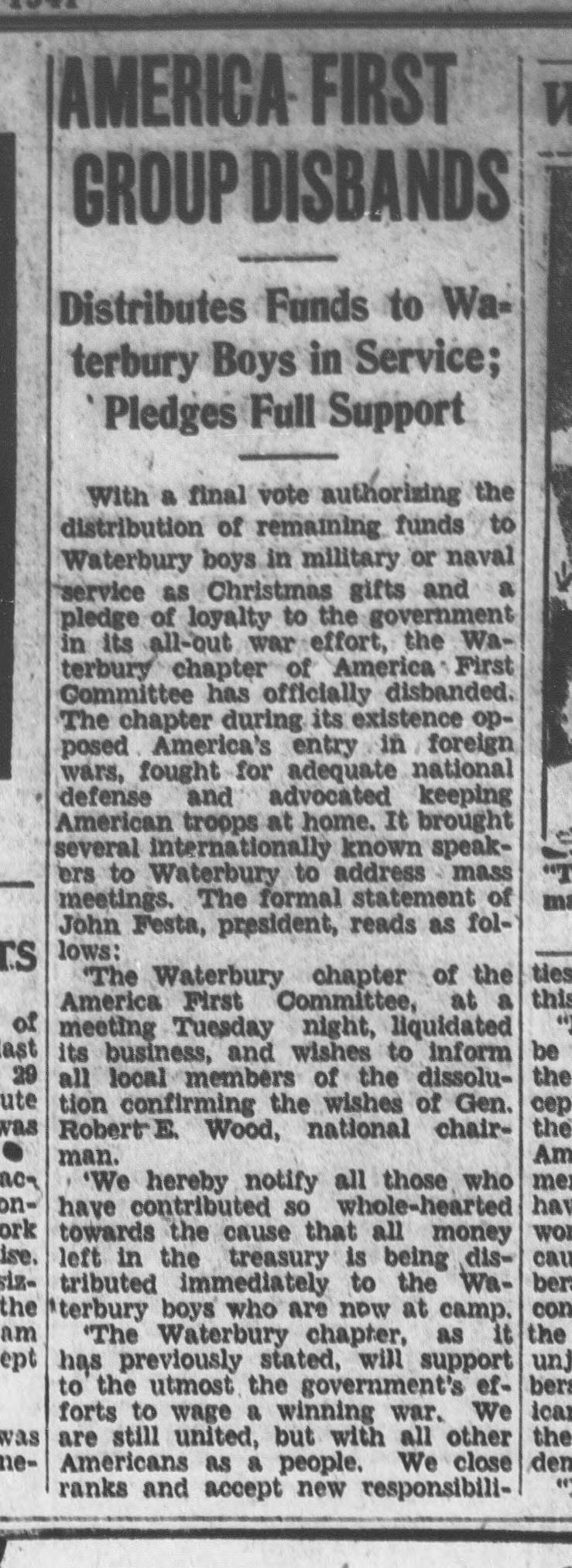
On Friday the 19th the Democrat ran the end under a two-line headline on page 16: AMERICA FIRST / GROUP DISBANDS. “With a final vote authorizing the distribution of remaining funds to Waterbury boys in military or naval service as Christmas gifts and a pledge of loyalty to the government in its all-out war effort, the Waterbury chapter of America First Committee has officially disbanded.” Festa’s last statement said the chapter had “liquidated its business” at a meeting Tuesday night, and that “all money left in the treasury is being distributed immediately to the Waterbury boys who are now at camp.” “We are still united, but with all other Americans as a people. We close ranks and accept new responsibilities and obligations to help win this war.” Then, in his own voice: “Personally, I hope there will be an end to all bickering. I hope the government on its side will accept cheerfully and unquestioningly the loyal support of all patriotic Americans regardless of our former opinions. The committee need have no regrets; it has waged a wonderful fight in a patriotic cause.” The last sentence, as the page printed it: “If anyone hereafter uses the name of the American [sic] First Committee, you will know it is without the authority of its officers and without the approval of its members.”
The bickering did not end. Three days later Dorothy Thompson’s column in the Evening Star found “a monstrous fifth column in the United States” and turned to the committee: “Miss Ingalls was a speaker for the America First Committee.” The column was careful. “This does not say that the leaders of the America First Committee were foreign agents, but it does say that the America First Committee was used by German agents.”
In Waterbury the money had already gone to the boys at camp.
“First, Last and Always,” Waterbury Democrat, December 19, 1941, p. 16. Library of Congress, Chronicling America. loc.gov/resource/sn82014085/1941-12-19/ed-1/?sp=16